Top Toys for Screen-Free Learning: Building Minds Without Screens
In an era dominated by glowing rectangles and endless notifications, the value of screen-free learning has never been more urgent. Parents and educators alike are searching for ways to engage children’s minds without relying on tablets, smartphones, or televisions. The right toys can be powerful tools—they spark curiosity, foster critical thinking, and nurture creativity in ways that passive screen time cannot. Below, we explore the best toys for screen-free learning, organized by the cognitive and developmental skills they target. Each category offers hands-on, immersive experiences that turn play into profound learning.
1. Building Blocks and Construction Sets: The Foundation of Spatial Reasoning
Construction toys are perhaps the most timeless screen-free learning tools. Classic wooden blocks, LEGO bricks, and magnetic tiles like Magna-Tiles or Picasso Tiles invite children to plan, experiment, and problem-solve in three dimensions. When a child stacks blocks to build a tower, they are grappling with gravity, balance, and symmetry. When they connect magnetic squares to form a cube, they are exploring geometry and spatial relationships.
These toys also teach resilience. A tower that collapses becomes a lesson in engineering: “Why did it fall? How can I make the base wider?” Unlike a digital game that offers instant success or failure, physical building allows for gradual iteration and tangible feedback. For older children, more advanced construction sets—such as K’NEX, Meccano, or architectural model kits—introduce mechanical principles like gears, levers, and pulleys. The result is a deep, intuitive understanding of physics that no app can replicate.
2. Puzzles and Brain Teasers: Sharpening Logic and Patience
Puzzles come in countless forms, from traditional jigsaw puzzles to wooden tangrams, Rubik’s Cubes, and logic-based games like Rush Hour or Kanoodle. Each type trains a different cognitive muscle. Jigsaw puzzles enhance visual-spatial skills and memory as children search for matching shapes and colors. Tangrams develop geometric reasoning and the ability to rotate shapes mentally—a skill closely linked to later success in mathematics.
Logic puzzles, especially those that require trial and error, teach perseverance. A child trying to move cars out of a gridlock in Rush Hour must hold multiple steps in working memory and plan ahead. Such exercises strengthen executive function, which includes impulse control, flexible thinking, and problem-solving. Unlike many screen-based puzzles that reward quick reactions, physical puzzles demand sustained attention and careful manipulation—skills that are increasingly rare in the age of endless scrolling.
3. Arts and Crafts Kits: Unleashing Creativity and Fine Motor Skills
Screen-free learning is not just about logic; it is also about expression. Art kits—ranging from watercolor sets and clay modeling to knitting looms and bead weaving—provide children with the raw materials to create something uniquely their own. The process of mixing colors, cutting paper, or threading a needle develops fine motor control and hand-eye coordination, which are crucial for writing and everyday tasks.
Beyond motor skills, arts and crafts encourage divergent thinking. There is no single “right” way to paint a picture or sculpt a vase. Children must make aesthetic choices, solve design problems (such as “how do I make this clay figure stand up?”), and learn to tolerate imperfection. Kits that focus on specific techniques—like origami, embroidery, or stamp-making—also introduce cultural traditions and mathematical patterns. For example, folding a piece of paper into a crane requires following sequential instructions and understanding fractions, symmetry, and angles. All of this happens without a single notification interrupting the flow.
4. Science and Exploration Kits: Inspiring Inquiry Through Hands-On Experiments
Nothing fuels a child’s natural curiosity like a real-world experiment. Science kits—such as crystal-growing sets, volcano kits, circuit-building toys (like Snap Circuits), or bug-catching tools—transform abstract concepts into tangible phenomena. When a child watches a vinegar-and-baking-soda volcano erupt, they are witnessing an acid-base reaction firsthand. When they snap together a simple circuit to light a bulb, they grasp the concept of electrical flow in a way that no video can convey.
Exploration kits also foster the scientific method. A kid mixing different ratios of baking soda and vinegar learns to hypothesize, observe, and draw conclusions. “If I add more vinegar, will it fizz longer?” This iterative questioning builds critical thinking and a love for discovery. Nature exploration sets—magnifying glasses, collection jars, field guides—encourage outdoor play and observation, teaching children to notice patterns in leaves, insects, and clouds. These experiences connect learning to the real world, making abstract school lessons meaningful.
5. Pretend Play and Role‑Playing Sets: Developing Social and Emotional Intelligence
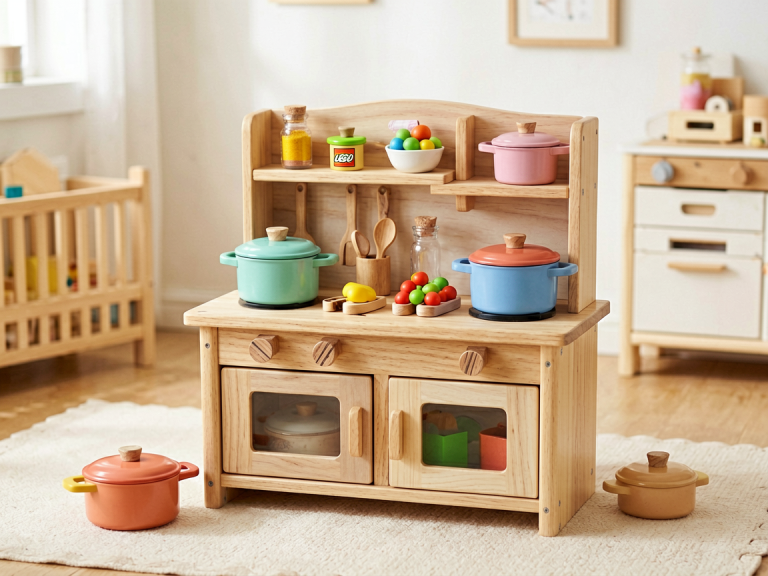
Dress-up costumes, play kitchens, tool benches, doctor kits, and dollhouses are far more than mere entertainment. Imaginative play is a cornerstone of cognitive and emotional development. When children role-play as a chef, a firefighter, or a parent, they practice language skills, negotiate roles with peers, and explore complex social dynamics. They learn to empathize by imagining another’s perspective: “How would the patient feel? What does the doctor need to say?”
Toys that support open-ended pretend play—such as sets of wooden animals, miniature vehicles, or fabric “fort building” kits—are especially valuable because they have no predefined rules. A cardboard box can become a spaceship, a castle, or a submarine. This flexibility encourages divergent thinking and narrative construction. Children invent stories, create problems, and solve them through dialogue and cooperation. Such screen-free play also reduces stress and helps regulate emotions, as kids work through fears or anxieties in a safe, symbolic way.
6. Board Games and Card Games: Building Strategic Thinking and Social Skills
Board games have enjoyed a renaissance in recent years, and for good reason. Games like “Catan Junior,” “Ticket to Ride,” “Blokus,” and classic card games like “Go Fish” or “Uno” teach turn-taking, patience, and strategy. Many modern board games also incorporate math, vocabulary, and logic. For instance, “Qwirkle” requires pattern recognition and scoring, while “CodeNames” builds word association and deductive reasoning.
Unlike single-player screen games, board games are inherently social. Players must communicate, negotiate, and handle both victory and defeat gracefully. They learn that winning is not the only goal—understanding the rules, adapting to opponents’ moves, and enjoying the process are equally important. Cooperative games, such as “Forbidden Island” or “Outfoxed,” where players work together against the game, teach teamwork and shared problem-solving. These experiences are vital for developing emotional regulation and collaboration, skills that no algorithm can teach.
Conclusion: The Lasting Power of Tangible Play
The best toys for screen-free learning are not necessarily the most expensive or the most technologically sophisticated. They are the ones that invite children to touch, manipulate, experiment, and imagine. Construction sets build spatial intelligence; puzzles sharpen logic; art supplies unleash creativity; science kits ignite inquiry; pretend play nurtures empathy; and board games develop strategy and social grace. Each category offers a unique pathway to learning that is active, hands-on, and deeply engaging.
In a world where screens constantly compete for attention, these toys provide a sanctuary for focused, meaningful play. They allow children to make mistakes without algorithms, to create without filters, and to connect with others in real time. By choosing screen-free toys, we invest not just in skills, but in habits of mind—curiosity, persistence, creativity—that will serve children for a lifetime. The next time you search for a gift or an activity, remember: the most powerful learning tool is not a glowing screen, but a child’s own hands and imagination.