The Logical Ladder: A Toy Progression for Building Critical Thinking from Tots to Teens
Introduction
Logical thinking is not an innate gift that appears overnight; it is a skill cultivated through consistent practice, challenge, and engagement. Among the most effective and enjoyable tools for this cultivation are toys. From the first soft block a baby grasps to the complex robotics kit a teenager programs, toys offer a scaffolded journey that mirrors the development of the human mind. A well-designed toy progression does more than entertain—it systematically builds the neural pathways responsible for analysis, deduction, pattern recognition, and problem-solving. This article explores how a thoughtful sequence of toys, aligned with developmental stages, can transform play into a powerful engine for logical reasoning. We will examine four key phases—sensorimotor exploration, concrete manipulation, rule-based abstraction, and formal operational challenge—each supported by specific toy categories that push a child’s thinking one step further.
—
## Early Foundations: Sensory-Motor Play and Cause-Effect Reasoning (0–2 Years)
In the first two years of life, logical thinking is rooted in the body. Infants and toddlers learn through sensory input and physical action: grabbing, shaking, dropping, and mouthing. Toys at this stage should encourage basic cause-and-effect understanding—the earliest form of logic.
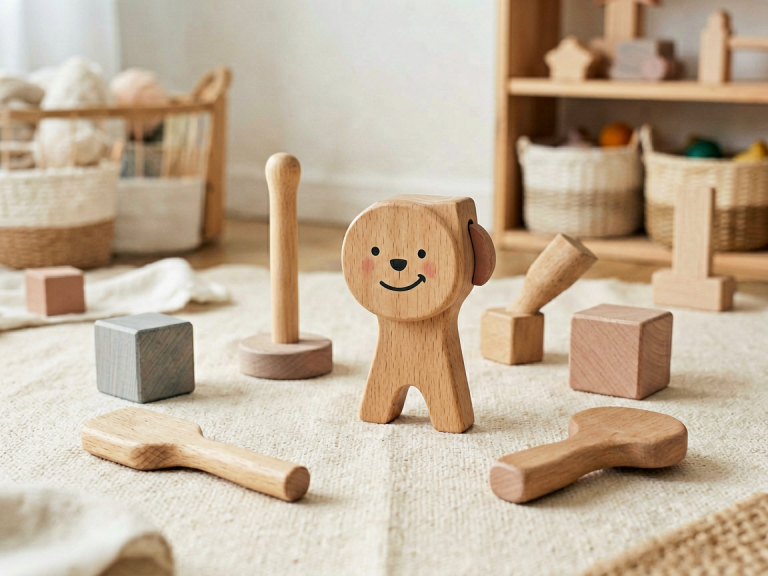
Stacking rings and nesting cups are classic examples. A baby discovers that a larger ring cannot fit onto the peg before a smaller one. This tactile experience encodes the concept of seriation: ordering objects by size. When the child repeatedly fails and adjusts, they are engaging in trial-and-error reasoning, a precursor to hypothesis testing. Shape sorters take this further: a square block only fits the square hole. The child learns classification and matching—attributes that form the bedrock of logical categories.
Activity boxes with buttons, levers, and doors that open when pressed teach “if-then” relationships. Press a button to hear a sound; pull a lever to see a puppet pop up. These simple loops create mental models of action and consequence. Importantly, this stage is about *embodied* logic—the kind that feels real because it is physically experienced. Parents and caregivers should provide a variety of safe objects that invite repetition and variation, allowing the child to internalize the pattern “this action leads to that result.” The progression here is from random exploration to intentional manipulation, laying the foundation for later symbolic reasoning.
—
## Concrete Operations: Building, Sorting, and Sequencing (2–6 Years)
As toddlers become preschoolers, their cognitive world expands dramatically. They begin to think symbolically—words and images stand for real things—but their logic remains tied to concrete, visible objects. Toys at this stage should encourage systematic comparison, classification, and early planning.
Unit blocks (simple wooden blocks of standard sizes) are an unparalleled tool. A child building a tower learns balance and symmetry; they discover that a wide base supports a taller structure. By arranging blocks in patterns (e.g., red, blue, red, blue), they practice sequencing and prediction. Magnetic tiles add transparency and geometric exploration: a square and two triangles combine to make a larger square. The child begins to understand part-whole relationships, a critical logical concept.
Puzzle progression is vital here. Start with knob puzzles (one piece per shape), move to jigsaw puzzles of 4–12 pieces, then to interlocking puzzles of 24–100 pieces. Puzzles require visual discrimination, trial and error, and the ability to hold a mental image of the completed picture. They teach systematic searching—trying the piece that *looks* like it belongs in the corner. Dominoes and simple card games such as “Go Fish” introduce matching, pairing, and turn-taking, reinforcing the logic of sets and subsets.
Pattern blocks (colored shapes like hexagons, rhombi, and trapezoids) are especially potent. Given a design card, the child must figure out which combination of shapes fills the outline. This spatial reasoning task demands analytical decomposition—seeing the whole as a sum of parts. It also encourages flexibility: there may be multiple correct solutions, fostering divergent logical thinking. At this stage, guided questions from adults (“How do you know that piece goes there?”) help children verbalize their reasoning, making the logic conscious.
—
## Rule-Based Systems: Games, Sequences, and Early Coding (6–9 Years)
Between ages six and nine, children enter Piaget’s “concrete operational” stage in full force. They can perform mental operations (reversibility, conservation, classification) but still need tangible objects. Toys now shift toward rule-based systems that require planning, deduction, and systematic testing.
Board games become powerful logic trainers. Games like Candy Land (color matching and following a linear path) evolve into Sorry! (strategic movement with chance) and Ticket to Ride (route planning under constraints). However, games that emphasize pure logic are most valuable. Mastermind (guess a color code by reasoning about clues) teaches hypothesis testing and information analysis. Blokus (placing geometric tiles on a grid) requires spatial strategy and blocking opponents—a form of game theory at a child’s level. Chess for beginners (simplified rules, mini-games) introduces conditional thinking: “If I move my knight here, then my rook is threatened.”
Logic puzzles in toy form are excellent. Rush Hour (slide cars out of a traffic jam) is a classic: the player must sequence moves to free the target car. Each move has consequences, and backtracking is necessary when a dead end is reached. This teaches algorithmic thinking—breaking a problem into steps. Gravity Maze (build a marble run using colored towers) combines spatial reasoning with sequential planning; the marble’s path must be predicted and adjusted.
Early coding toys like Code-a-Pillar (segmented caterpillar that follows command sequences) or Botley the Coding Robot introduce abstract cause-effect through simple “programming.” Children arrange physical cards or buttons to direct the toy’s movement. They learn that a sequence of instructions produces an outcome, and that changing one instruction changes the result. Debugging—finding why the robot didn’t follow the intended path—is a logical skill that mirrors software development. These toys bridge concrete play and symbolic logic, preparing the mind for more abstract systems.
—
## Abstract Reasoning: Strategy, Deduction, and Systems Thinking (9–12 Years)
As children approach adolescence, they begin to handle abstract concepts—variables, hypotheticals, and multi-step deductions. Toys at this level should challenge them to think beyond the immediate, to formulate rules, and to manipulate symbols mentally.
Complex board games like Settlers of Catan (resource management, negotiation, and probability estimation) force players to weigh trade-offs and predict opponents’ moves. Azul (tile-laying with patterns and scoring constraints) demands forward planning and spatial optimization. Clue (deducing a murder scenario by eliminating possibilities) explicitly teaches logical deduction: “If Professor Plum was in the library, then he couldn’t have been in the conservatory.” These games require note-taking, evidence tracking, and systematic elimination—the essence of formal logic.
Construction sets with advanced mechanics, such as LEGO Technic or Meccano, introduce gears, pulleys, and levers. Building a functional crane or car requires understanding mechanical advantage and motion transfer. The child must follow complex diagrams (reading symbolic representations) and troubleshoot when gears don’t mesh. This is applied physics logic. Makey Makey (a circuit board that turns everyday objects into touchpads) bridges hardware and software; children design switches and triggers, learning input-output logic in a tangible way.
Deductive puzzle books and brain teasers (e.g., Einstein’s riddle, logic grid puzzles) train working memory and systematic reasoning. A child given a grid puzzle with clues like “The person who owns the cat drinks tea” must hold multiple constraints simultaneously and eliminate possibilities. These puzzles often require constructing a truth table mentally or on paper—a direct precursor to formal logical proof. Rubik’s Cube and similar twisty puzzles teach algorithm memorization and pattern recognition; solving one by layer requires understanding sequences and their effects on the whole cube.
Strategy video games (carefully curated) can also be logical tools. Minecraft in creative mode involves resource management and structural planning; in survival mode, it requires optimizing resource allocation. Logic grid games on apps like “Logic Puzzle Museum” or “Kami” offer immediate feedback and escalating difficulty. The key is to ensure the child is actively reasoning, not passively reacting.
—
## Formal Operations: Systems, Programming, and Design Thinking (12+ Years)
By early adolescence, many youths reach Piaget’s formal operational stage, capable of hypothetical-deductive reasoning. Toys that involve designing systems, writing code, or engaging in complex strategy become appropriate. The focus shifts from using toys to *creating* with them, which demands higher-order logic.
Microcontroller kits such as Arduino or micro:bit allow teens to build interactive electronics. A temperature sensor triggers a fan, or a button press changes an LED pattern. This requires understanding conditional logic (if-else), loops, and variables. Programming these devices in text-based languages (Python or C++) moves beyond the drag-and-drop coding of earlier years, requiring precise syntax and debugging of logic errors. Robotics kits like LEGO Mindstorms or VEX combine mechanical design with programming; students must optimize claw grip or sensor placement, applying iterative design logic.
Advanced strategy games like Go (an ancient board game of immense complexity) or Settlers of Catan expansions demand long-term planning and probabilistic reasoning. Tabletop role-playing games (Dungeons & Dragons) require character-building, rule interpretation, and narrative logic; players must deduce the best course of action given limited information and chance outcomes. Escape room board games (e.g., Exit: The Game) present multi-layered puzzles that require collaboration and logical decomposition.
Computer science toys such as Circuit Scribe (conductive ink pens that draw circuits) or littleBits (magnetic electronic modules) demystify how computers process information. Building a binary counter or a logic gate (AND, OR, NOT) concretely illustrates Boolean logic, the foundation of all digital computation. Teens can also engage with programming games like Human Resource Machine (solving puzzles with assembly-like commands) or Zachtronics titles (designing factories with precise sequential logic). These demand attention to efficiency and error-proofing.
Design thinking toys—kits that encourage prototyping solutions to real-world problems, such as Sphero (programmable ball) or Makeblock—foster iterative logic: hypothesize, test, analyze results, refine. This mirrors the scientific method and engineering design process. The progression culminates in open-ended creation, where the toy is no longer a prescribed plaything but a platform for original logical exploration.
—
## Conclusion
A thoughtful toy progression for logical thinking is not a rigid checklist but a flexible framework that respects a child’s developmental readiness. From the sensorimotor cause-effect of a shape sorter to the formal logic of a microcontroller, each stage builds upon previous competencies while gently pushing the boundary of what the child can understand. The best toys are those that invite self-correction, reward persistence, and allow multiple strategies—because real logic is not about finding the single right answer but about learning how to think about thinking itself.
Parents, educators, and caregivers who design this toy sequence do more than foster academic success; they equip children with a mindset that values evidence, questions assumptions, and embraces complexity. In a world overflowing with information and misinformation, the ability to reason logically is perhaps the most essential skill of all. And it can begin with a simple block—and a curious child.
Start with the complete guide: Building Minds: The Best Beginner Toys for Problem Solving.