Beyond Play: How Advanced Toys Unlock Logical Thinking in the Digital Age
1. Introduction
In an era where screens dominate children’s attention and passive entertainment is just a tap away, the concept of a “toy” has undergone a profound transformation. No longer are playthings merely about amusement or physical activity; they have evolved into sophisticated tools designed to challenge the mind. Among the most impactful of these innovations are advanced toys specifically engineered to foster logical thinking. These are not your traditional building blocks or simple board games. They integrate principles of computer science, mathematics, engineering, and cognitive psychology to create immersive experiences that demand analysis, deduction, planning, and systematic reasoning. As parents, educators, and technologists search for ways to prepare young minds for an increasingly complex world, these advanced toys have emerged not just as educational aids, but as essential catalysts for cognitive development. This article explores the multifaceted world of advanced logical thinking toys—their types, benefits, underlying principles, and the critical role they play in shaping the problem-solvers of tomorrow. By understanding what makes these toys unique, we can harness their power to cultivate sharp, adaptable minds capable of tackling real-world challenges with confidence and creativity.
2. The Evolution from Passive to Active Learning
To appreciate the significance of advanced logical thinking toys, it is useful to look back at the history of playthings. Traditional toys, such as dolls, cars, or simple puzzles, primarily engaged children through imitation, sensory stimulation, or basic motor skills. While valuable, they rarely required sustained abstract reasoning or multi-step decision-making. The shift began with the rise of educational philosophy that emphasized “learning by doing,” and accelerated dramatically with the digital revolution. Today, advanced toys blend physical and digital experiences, encouraging children to become active participants rather than passive consumers. For example, a modern programmable robot is not a self-contained entertainment unit; it is a blank slate that responds to the logic the child inputs. This paradigm shift—from toys that entertain to toys that demand intellectual engagement—marks a crucial turning point. It recognizes that play is the most natural form of learning, and that the right environment can turn a child’s curiosity into a systematic pursuit of understanding. The best advanced toys do not simplify concepts; they present them in engaging contexts that require the player to think like a scientist, engineer, or mathematician.
3. Categories of Advanced Toys for Logical Thinking
The landscape of logical thinking toys is rich and diverse. They can be broadly classified into several categories, each targeting different facets of reasoning.
3.1 Coding and Robotics Kits
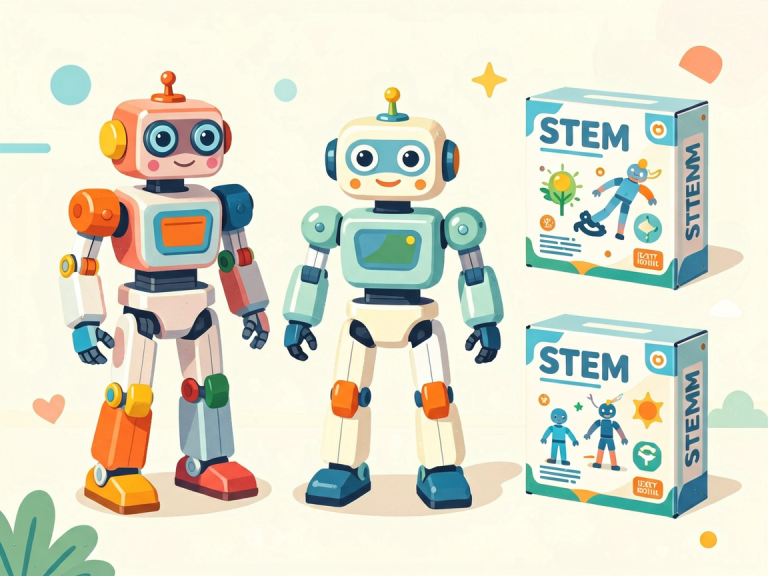
Perhaps the most prominent category, coding toys such as LEGO Mindstorms, Sphero, and Cubetto teach children the fundamentals of programming—sequencing, loops, conditionals, and debugging—through hands-on construction and play. Users must break down tasks into logical steps, anticipate outcomes, and correct errors. These toys transform abstract code into tangible actions, making cause-and-effect relationships instantly visible.
3.2 Modular Construction Systems with Logic
Beyond simple stacking, advanced construction sets like Makeblock or Fishertechnik incorporate gears, sensors, and actuators that require understanding of mechanical advantage, feedback loops, and spatial reasoning. Children must plan assemblies based on constraints of weight, balance, and motion, effectively engaging in early engineering design thinking.
3.3 Strategy and Logic Board Games
Games like “Rush Hour,” “Gravity Maze,” or “RoboRally” are deceptively complex. They present spatial puzzles, route planning, and resource management challenges that demand forward-thinking and recursive problem-solving. Some incorporate elements of game theory, requiring players to anticipate opponents’ moves—a high-level logical skill.
3.4 Electronic Logic Circuits and Kits
Products like LittleBits or Snap Circuits allow children to build working electronic devices. By connecting modules that represent AND, OR, NOT gates, flip-flops, and timers, they learn boolean algebra and binary logic in a concrete, visual way. This directly parallels the internal workings of computers and digital systems.
3.5 Puzzle-Based Adventure and Escape Room Kits
Many modern escape-room-in-a-box sets require deciphering codes, solving mathematical riddles, and linking clues across multiple mediums. Success depends on systematic pattern recognition, hypothesis testing, and collaborative logical deduction—skills that are both fun and deeply cognitive.
4. Cognitive and Psychological Benefits
The value of these toys extends far beyond mere entertainment. Engaging regularly with advanced logic toys yields measurable improvements in several key cognitive domains.
4.1 Enhanced Problem-Solving and Critical Thinking
When a child faces a challenge such as programming a robot to navigate a maze, they must identify the problem, decompose it into smaller subproblems, generate possible solutions, test them, and refine based on feedback. This iterative process mirrors the scientific method. Over time, children develop a structured approach to challenges, moving from trial-and-error to hypothesis-driven analysis.
4.2 Development of Sequential and Abstract Reasoning
Logical thinking toys inherently require understanding sequences—what must happen first, second, and third. This scaffolds the ability to comprehend cause and effect, time-oriented planning, and conditional logic (if-then-else). Abstract reasoning improves as children learn to manipulate symbols, variables, and mental models that represent real-world phenomena.
4.3 Strengthened Executive Functions
Executive functions—working memory, inhibitory control, and cognitive flexibility—are heavily engaged. For instance, a complex construction project demands holding multiple steps in memory, resisting distractions, and shifting strategies when a design fails. These abilities are strong predictors of academic and life success.
4.4 Fostering Persistence and a Growth Mindset
Many advanced toys are inherently difficult. They require multiple attempts and the willingness to fail and try again. This teaches children that mistakes are not failures but data points for improvement. They learn to embrace challenges and persist in the face of frustration, which builds resilience and a growth mindset—the belief that intelligence can be developed through effort.
4.5 Multidisciplinary Integration
Logical thinking is not confined to mathematics or computer science. When children engage with a robotics kit, they simultaneously apply principles of physics (force, friction, leverage), geometry (angles, symmetry), and even storytelling (designing a robot character). This cross-pollination helps them see the interconnectedness of knowledge.
5. The Role of Technology: AI, VR, and Adaptive Learning
The latest frontier in advanced logical thinking toys involves artificial intelligence and adaptive algorithms. Some toys now incorporate AI that can adjust difficulty levels in real time based on the player’s performance. For example, a coding puzzle app may introduce new concepts only when the child has mastered the current level, preventing boredom or frustration. Virtual reality (VR) and augmented reality (AR) are also emerging, adding immersive layers that require 3D spatial logic and rapid decision-making. Furthermore, some toys collect data on a child’s problem-solving patterns and provide personalized hints or challenges. This adaptivity mimics a one-on-one tutor, making the learning experience highly efficient. However, it also raises questions about over-reliance on digital guidance versus organic discovery. The best toys strike a balance, offering enough scaffolded support to keep the child within their “zone of proximal development” while preserving the joy of independent insight.
6. Selecting the Right Toy: Age, Complexity, and Engagement
Not all advanced logic toys are appropriate for every child. To maximize benefits, parents and educators should consider several criteria.
6.1 Age and Developmental Readiness
Young children (ages 3–5) benefit from concrete, hands-on toys that introduce basic sequencing and cause-and-effect, such as simple coding robots that move with color-coded blocks. Older children (ages 6–10) can handle more abstract puzzles and introductory programming languages like Scratch or Blockly. Teenagers may tackle text-based coding (Python, JavaScript), complex engineering kits, or competitive strategy games. Pushing too advanced a toy too early can cause frustration and disengagement, while too simplistic a toy fails to challenge.
6.2 Open-Ended vs. Goal-Directed Play
Some toys have clear end goals (e.g., solve a specific puzzle), while others are open-ended (e.g., build any machine with a set of parts). Both are valuable. Goal-directed toys teach systematic problem-solving, while open-ended toys encourage creativity and divergent thinking. A balanced collection should include both.
6.3 Collaborative vs. Solo Play
Many logic toys are designed for individual use, but group activities—such as cooperative board games or robot-building competitions—develop teamwork, communication, and the social dimension of reasoning. These skills are critical in real-world problem-solving where multiple perspectives are needed.
6.4 Digital vs. Physical Balance
While digital toys (apps, software) offer powerful simulations and instant feedback, they can also increase screen time. Physical toys provide tactile feedback and reduce the risk of eye strain. The ideal is a hybrid approach—a physical construction set paired with a digital component that logs progress or adds interactive levels.
7. Challenges and Considerations
Despite their many advantages, advanced logical thinking toys are not without drawbacks. The first is cost: high-quality robotics kits, coding robots, and modular electronics can be expensive, potentially creating an equity gap. Schools and communities must work to ensure access for all children. Second, there is the risk of “gaming the system”—children may find shortcuts or follow solutions from online videos rather than engaging in genuine reasoning. Parental and educator involvement is critical to encourage authentic problem-solving. Third, an overemphasis on logical-mathematical reasoning might neglect other equally important domains such as emotional intelligence, creativity in the arts, or physical development. A child’s play diet should be varied. Finally, some toys are marketed as “STEM” but lack genuine depth, offering only superficial interactions. Adults should research and test toys to ensure they truly promote logical thinking and are not just electronic gimmicks.
8. Conclusion
Advanced toys for logical thinking represent a powerful convergence of play and education. They are not merely novelties but essential instruments for developing the cognitive tools that our complex, data-driven world demands. By engaging with coding robots, logic puzzles, modular construction systems, and strategy games, children learn to approach problems systematically, think flexibly, and persist through difficulty. They gain fluency in the languages of science, technology, engineering, and mathematics—all while having fun. Yet, the true magic of these toys lies not in their circuits or algorithms, but in the human mind they help shape. They teach that logic is not a cold, mechanical process but a creative, iterative, and deeply satisfying way of understanding the world. As we continue to invent new ways to play, we must remember that the most important outcome is not the toy itself, but the curious, resilient, and logical thinker it helps create. Investing in these tools is an investment in a future where children are not just consumers of technology, but its architects and critics. The next generation of innovators will be those who, from an early age, learned to think—one playful step at a time.