The Power of Creative Play: Nurturing Children’s Imagination and Development
Introduction
In a world increasingly dominated by screens, structured schedules, and academic pressure, the simple act of creative play has become more vital—and more endangered—than ever before. Creative play is not just a way for children to pass the time; it is the very engine of childhood development. It is through imaginative, self-directed, unstructured play that children learn to solve problems, regulate emotions, build social skills, and explore the boundless possibilities of their own minds. This article delves deep into the multifaceted world of creative play for kids, exploring why it matters, what forms it can take, and how parents, educators, and communities can foster an environment where creativity flourishes.
What Is Creative Play?
Creative play, often referred to as imaginative or unstructured play, is any activity in which children use their creativity to transform ordinary objects, roles, and scenarios into something new. Unlike rule-based games or adult-directed activities, creative play is child-initiated and open-ended. A cardboard box becomes a spaceship, a blanket draped over chairs becomes a castle, and a stick becomes a magic wand. This type of play allows children to experiment with ideas, test boundaries, and express their inner world without fear of failure. It is the antithesis of passive entertainment—it actively engages the brain, the body, and the spirit.
The Cognitive Benefits of Creative Play
One of the most profound impacts of creative play is on cognitive development. When children engage in make-believe, they are constantly exercising their executive functions—the set of mental skills that include working memory, flexible thinking, and self-control. For example, a child pretending to run a restaurant must remember the roles of chef, waiter, and customer, shift between those roles as the game evolves, and inhibit the impulse to grab a toy that another child is using. Research by psychologists such as Lev Vygotsky has shown that imaginative play is a leading factor in the development of abstract thought, language, and problem-solving abilities.
Moreover, creative play enhances divergent thinking—the ability to generate multiple solutions to a single problem. When a child builds a tower with blocks that keeps falling, they try different strategies: widening the base, stacking in a spiral, or using smaller blocks on top. Each attempt is a hypothesis tested in real time. This scientific process, embedded in play, builds a foundation for innovation that lasts a lifetime. In a 2019 study published in *Frontiers in Psychology*, researchers found that children who engaged in more frequent pretend play demonstrated higher levels of creativity and cognitive flexibility compared to their peers who spent more time in structured activities.
Emotional and Social Growth Through Play
Creative play is also a powerful tool for emotional regulation and social development. Children often use play to process complex feelings they cannot yet articulate verbally. A child who is anxious about starting school may act out a scene of saying goodbye to a parent, rehearsing the emotional script in a safe environment. Through role-playing, they can explore different outcomes and gain a sense of control. Similarly, play provides a space for children to practice empathy. When a child takes on the role of a doctor caring for a sick doll, they are learning to imagine another being’s perspective—a cornerstone of social intelligence.
Socially, creative play teaches negotiation, cooperation, and conflict resolution. When two children want to be the captain of the pirate ship, they must communicate, compromise, or invent a new role (like co-captain) to keep the game going. These micro-negotiations are rehearsals for real-world interactions. In an age of increasing social isolation, the face-to-face, tactile nature of creative play is irreplaceable. It builds the kind of deep, reciprocal relationships that online interactions cannot replicate.
Types of Creative Play
Creative play is wonderfully diverse. Here are some of the most common and valuable forms:
- Dramatic or Pretend Play: Children adopt roles (doctor, superhero, parent) and act out scenarios. This is the classic form of imaginative play, often involving costumes or props.
- Constructive Play: Building with blocks, LEGOs, clay, sand, or recycled materials. This type emphasizes design, engineering, and spatial reasoning.
- Artistic Play: Drawing, painting, collage, sculpting—any open-ended art activity where the process matters more than the product.
- Exploratory Play: Nature play, such as collecting leaves, digging in dirt, or observing insects. It fosters curiosity and scientific thinking.
- Movement Play: Dance, improvisational movement, or simply running and climbing with an imaginative overlay (e.g., “Let’s pretend we are running through a lava flow”). This combines physical activity with creativity.
- Storytelling and Language Play: Children invent stories, create secret languages, or rewrite favorite fairy tales. This strengthens narrative skills and vocabulary.
Each type of creative play engages different domains of development, and the best environments offer children the freedom to move fluidly between them.
How Parents and Educators Can Encourage Creative Play
Supporting creative play does not require expensive toys or elaborate planning. In fact, the most powerful tools are often the simplest. Here are practical strategies for fostering creative play in children:
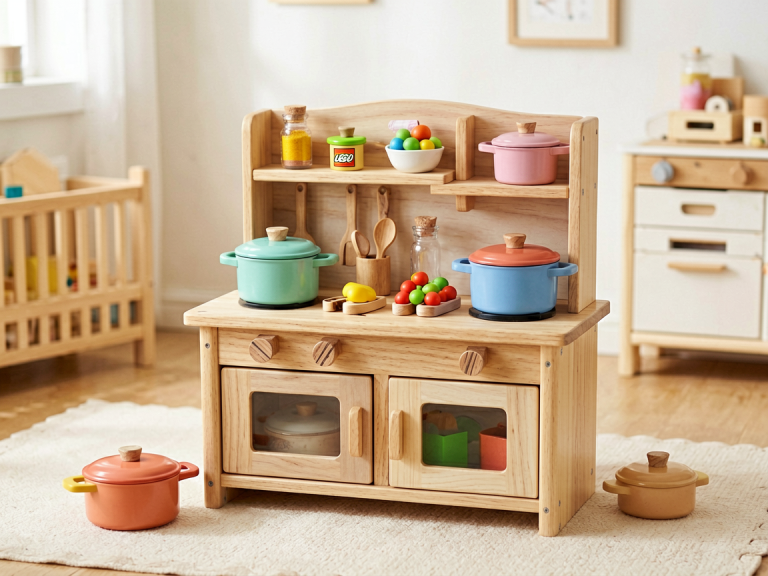
- Provide Open-Ended Materials: Instead of toys that have a single, predetermined function (like a video game or a talking doll that repeats phrases), offer materials that can be used in countless ways: blocks, fabric scraps, cardboard tubes, pots and pans, art supplies, and natural objects like pinecones and stones.
- Create a Safe Physical and Emotional Space: Children need to feel free from judgment and interruption. Designate a play area where mess is okay, and where adults do not constantly correct or direct. Resist the urge to ask “What are you making?”—instead, simply observe and comment on the process (“I see you’re stacking those blocks very carefully”).
- Model Creative Thinking: Children learn by watching adults. If you occasionally engage in your own creative activities—building a model, sketching, gardening, or even daydreaming—and share your enthusiasm, you validate the importance of creativity.
- Limit Screen Time and Structured Activities: Every hour spent in front of a screen is an hour not spent in self-directed, tactile play. While not all screen time is harmful, it often crowds out the time and mental space needed for deep, immersive play. Strive for a balanced schedule that includes large blocks of unscheduled time.
- Embrace Boredom: Boredom is the mother of invention. When children say “I’m bored,” resist the urge to immediately provide an activity. Let them sit with the feeling; it often sparks the creativity needed to invent their own games.
- Join Without Taking Over: Adults can be co-players, but they should follow the child’s lead. Ask open-ended questions like “What happens next?” or “Who is this character?” rather than giving instructions. Your role is to add texture, not to write the script.
Overcoming Common Barriers to Creative Play
Despite its benefits, creative play faces numerous obstacles in modern society. Over-scheduled lives, academic pressure, and a cultural emphasis on measurable outcomes all work against unstructured play time. Additionally, some adults worry that play without learning is “wasted time.” This is a misconception. In fact, the most profound learning happens precisely when children are playing freely. Another barrier is the rise of digital toys that offer pre-programmed responses—these may entertain but they rarely require children to imagine or invent.
To overcome these barriers, communities can create public play spaces that encourage creativity: “junk playgrounds” where children build with scrap materials, or nature playgrounds with loose parts like logs and ropes. Schools can incorporate more recess and project time. Parents can connect with like-minded families to form playgroups that prioritize free play. Most importantly, we must shift our mindset to recognize creative play not as a luxury, but as a biological necessity for healthy child development.
Conclusion
Creative play is not a frill to be squeezed into a busy schedule; it is the very soil in which the seeds of intelligence, empathy, and innovation grow. As children build imaginary worlds, solve invented problems, and negotiate shared fantasies, they are building the skills that will help them navigate an uncertain future. The next time you see a child lost in a cardboard box or chatting with invisible friends, remember: you are witnessing one of the most sophisticated learning processes known to humanity. Protect it. Nurture it. And perhaps, every now and then, join them in the kingdom of make-believe. For in that kingdom, the only limit is the borders of their imagination—and those borders are infinite.