Building Blocks of Thought: Top Beginner Toys for Spatial Reasoning
Spatial reasoning—the ability to visualize, manipulate, and mentally rotate objects in two and three dimensions—is a foundational cognitive skill that supports achievement in STEM fields, art, navigation, and everyday problem-solving. Research consistently shows that children who develop strong spatial skills early on tend to perform better in mathematics, engineering, and even creative disciplines. Yet many parents and educators overlook the simple, playful tools that can nurture this ability from a young age. The key lies in choosing the right beginner toys: those that engage curiosity, offer gradual challenges, and transform abstract spatial concepts into hands-on, tangible experiences. This article explores why spatial reasoning matters, what makes a toy effective for beginners, and provides a curated selection of toys that can turn playtime into a powerful learning journey.
Why Spatial Reasoning Deserves Our Attention
Spatial reasoning is far more than just “thinking in pictures.” It involves four core components: mental rotation (turning an object in your mind), spatial visualization (understanding how parts fit into a whole), spatial perception (determining spatial relationships despite distracting information), and spatial orientation (knowing where you are in relation to objects). These skills predict success in fields as diverse as surgery, architecture, chemistry, and video game design. A landmark 2013 study by researchers at the University of Chicago found that children who engaged in more spatial play—such as puzzles and building blocks—scored higher on spatial reasoning tests years later, even after controlling for socioeconomic factors. The brain’s plasticity during early childhood means that even 15 minutes of structured spatial play per day can yield measurable gains. This is why beginner toys are not just amusements; they are investments in cognitive architecture.
What Makes a Good Beginner Toy for Spatial Reasoning
Not all toys labeled “educational” actually build spatial skills. Effective beginner toys share several characteristics. First, they are open-ended, allowing multiple solutions rather than a single correct arrangement. A set of wooden blocks, for example, can become a tower, a bridge, or a castle, each requiring different mental maps. Second, they offer graduated complexity—a natural progression from simple stacking to more intricate assemblies, so that children experience success before facing frustration. Third, they are hands-on and tactile, because spatial reasoning is deeply connected to proprioception and kinesthetic learning. Touching and manipulating physical objects activates brain regions that mental imagery alone cannot. Fourth, they provide immediate visual feedback: when a block falls or a puzzle piece doesn’t fit, the child can see and correct the error, building an internal model of cause and effect. Finally, they are age-appropriate, with pieces large enough for small hands and safe for mouthing in the case of toddlers. With these criteria in mind, let’s explore specific categories of toys that excel at building spatial reasoning from the ground up.
The Foundational Category: Stacking and Nesting Toys
For the youngest beginners—ages 6 months to 2 years—spatial reasoning begins with the simplest cause-and-effect relationships. Nesting cups or stacking rings are archetypal examples. A set of brightly colored cups that fit one inside another teaches size discrimination, ordering, and the concept of containment. When a toddler tries to stack a large cup on top of a small one and watches it topple, they are performing an unintended experiment in physics and spatial relationships. Similarly, stacking rings on a central post requires matching hole size to post diameter, which is an early form of mental rotation. The best versions have slightly varying rim widths, so the child must actively judge which ring goes where. Brands like *Fisher-Price Rock-a-Stack* or *Green Toys Stacking Cups* are durable, dishwasher-safe, and deliberately simple. A 2019 study in *Developmental Science* noted that just three minutes of stacking play per day for two weeks significantly improved 12-month-olds’ ability to recognize spatial patterns. These toys may seem trivial, but they lay the neural groundwork for later, more complex spatial tasks.
Puzzling It Out: Junior Jigsaw and Shape Sorters
Once a child can stack, they are ready for puzzles that require fitting pieces into defined spaces. The classic shape sorter—a box with holes in the shapes of a circle, square, triangle, and star—is a spatial reasoning powerhouse. To succeed, a child must mentally rotate the shape in their hand to align it with the hole, then adjust their wrist angle to insert it. This is pure mental rotation training. For older beginners (age 2–4), floor puzzles with large, chunky pieces are ideal. The *Melissa & Doug Farm Animals Floor Puzzle* has only 12 oversized pieces, each with a unique contour, so the child must analyze the shape of each piece and its relationship to the image. As they grow, jigsaw puzzles with 24 to 48 pieces introduce the concept of “part-whole” relationships: the edge piece has a flat side that must align with the frame, while interior pieces have complex tabs and blanks. A 2021 study from the University of Arizona found that children who regularly completed jigsaw puzzles scored significantly higher on the Mental Rotation Test, a standard measure of spatial ability. For beginners, avoid puzzles with tiny, identical-looking pieces; instead choose those with varying colors and distinctive shapes to provide visual cues.
The Building Revolution: Magnetic Tiles and Wooden Blocks
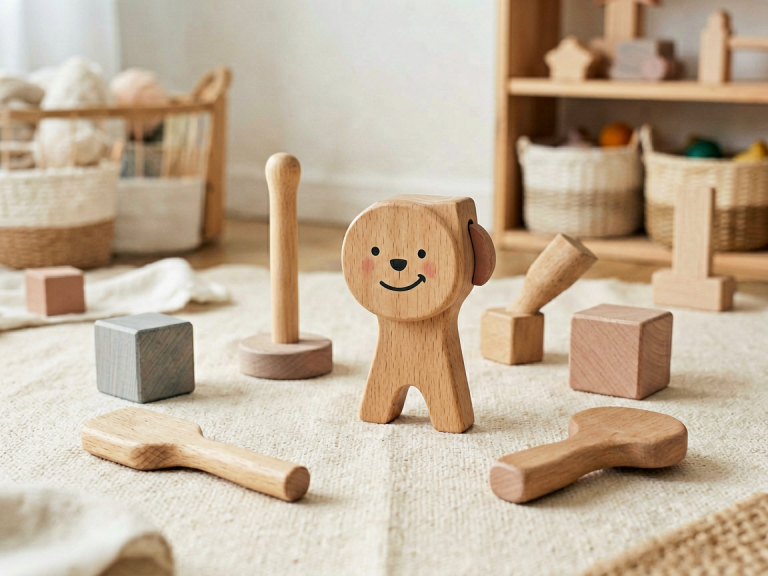
No list of spatial reasoning toys would be complete without construction sets. Magnetic tiles—such as *Magna-Tiles* or *PicassoTiles*—have become a modern classic for good reason. These translucent, geometric shapes (squares, triangles, rectangles) click together with embedded magnets, allowing even toddlers to build stable 3D structures. The magnetic connection gives immediate tactile feedback, and the clear plastic lets children see how internal spaces connect. Beginners can start by laying tiles flat to make 2D patterns, then gradually tilt them into 3D forms like cubes and pyramids. The impossibility of making a square from two triangles forces children to experiment with angles. More advanced sets include windows, doors, and curved pieces, encouraging complex designs. Meanwhile, traditional wooden unit blocks—like those from *Guidecraft* or *Hape*—offer a different kind of challenge. Without magnets, the child must rely on gravity and balance, learning concepts like center of mass, symmetry, and support. Stacking a series of rectangular blocks to form a stable tower requires spatial estimation: is the base wide enough? Will the next block tip the tower? Both magnetic tiles and wooden blocks excel because they are open-ended; there is no single “right” answer, so children engage in iterative trial and error, which is the essence of spatial problem-solving.
2D to 3D Bridges: Pattern Blocks and Tangrams
Pattern blocks and tangrams occupy a unique niche: they are 2D shapes that can be arranged to form recognizable pictures or abstract designs, yet they implicitly teach 3D thinking. Pattern blocks are typically hexagonal, trapezoidal, rhombus, and triangular shapes in bright colors. A beginner might be asked to “fill in” a silhouette of a bird or a boat, requiring them to mentally rotate and combine shapes to cover the area. This is called “spatial visualization under constraints.” Tangrams, an ancient Chinese puzzle consisting of seven pieces (five triangles, one square, one rhomboid), are even more demanding because the pieces can be arranged to form hundreds of different silhouettes. For a beginner (age 4–7), start with a printed outline that shows the exact placement of each piece, then move to a silhouette without internal lines. The act of rotating a triangle to fit a specific corner engages the same neural circuits as mentally turning a molecular model in chemistry. Many pattern block sets come with activity cards that increase in difficulty, making them a structured yet playful tool. A 2017 study in *Cognitive Research* found that just 10 sessions of tangram play improved children’s spatial ability scores by 12%, compared to a control group that did other fine motor activities.
Structured Building: LEGO Duplo and Gears
LEGO is so ubiquitous that we may forget its profound spatial benefits. For beginners, LEGO Duplo (the larger brick line for ages 1.5–5) provides an ideal entry point. Duplo bricks lock together with a satisfying click, but unlike traditional LEGO, they are large enough for small hands and pose no choking hazard. Stacking two bricks of different sizes requires the child to align the studs and evenly distribute pressure—a fine spatial-motor challenge. As they follow simple instructions (e.g., build a house with a roof), they learn to read 2D diagrams and translate them into 3D structures. This is a direct precursor to reading architectural blueprints or assembling furniture. For slightly older beginners (age 4–7), gear-based sets like *Learning Resources Gears! Gears! Gears!* add the dimension of motion. Gears must be placed so that their teeth interlock; turning one gear causes others to spin, teaching cause and effect, mechanical advantage, and directional relationships. A child who builds a gear train learns that the orientation of each axle determines the rotation path. These sets often include pegboards that serve as a coordinate grid, reinforcing spatial mapping.
Choosing and Using These Toys Effectively
Having a great spatial reasoning toy is only half the equation; how you present it matters enormously. For beginners, avoid overwhelming them with all the pieces at once. Start with just a few items and demonstrate a simple action—for example, stacking two blocks or fitting a shape into its sorter. Narrate your thinking aloud: “I’m turning this triangle to see if the point faces the hole. Oh, that fits better!” This models metacognitive strategies. Allow plenty of free play without adult correction; even “failed” structures teach valuable spatial lessons. After a child has explored freely, introduce gentle challenges: “Can you make a tower as tall as your teddy bear?” or “How many different shapes can you make with these four triangles?” Praise the process of trying different configurations rather than the final product. For group settings, cooperative building—where two children must communicate about how to fit pieces together—enhances spatial language and perspective-taking. Finally, rotate toys to maintain novelty; a toy that has been untouched for weeks can regain appeal if stored away and reintroduced.
Conclusion: Play as the Foundation for Lifelong Spatial Thinking
Spatial reasoning is not a fixed trait; it is a skill that can be cultivated through deliberate, joyful play. Beginner toys—from humble nesting cups to sophisticated magnetic tiles—provide the sensory, motor, and cognitive experiences that wire the brain for 3D thinking. By choosing toys that are open-ended, progressively challenging, and hands-on, parents and educators can give children a head start in understanding geometry, physics, engineering, and art. Moreover, these toys foster resilience and creative problem-solving, qualities that extend far beyond the playroom. The next time you see a child stacking blocks or puzzling over a tangram, remember: they are not just playing. They are building the neural architecture that will help them navigate a world that is, in every sense, three-dimensional. So go ahead—spill out the blocks, scatter the tiles, and let the spatial reasoning adventure begin.