Beyond the Screen: Unlocking Learning Through Play with Toys
In an era where digital devices dominate children's attention, the concept of screen-free learning has become both a challenge and a necessity. Parents and educators increasingly worry about the effects of excessive screen time on cognitive development, attention spans, and social skills. Yet the solution does not lie in banning technology entirely, but in rediscovering the profound educational potential of toys. Toys are not mere distractions; they are powerful tools for learning that engage multiple senses, foster creativity, and build foundational skills in ways no app ever can. This article explores how to intentionally use toys for screen-free learning, turning playtime into a rich educational experience that prepares children for a lifetime of curiosity and problem-solving.
The Power of Open-Ended Play: Building Cognitive Skills
At the heart of screen-free learning lies the concept of open-ended play. Toys that have no single correct outcome—such as building blocks, LEGO bricks, wooden planks, or magnetic tiles—encourage children to think divergently. Unlike digital games that often present pre-programmed solutions, open-ended toys invite experimentation, failure, and iteration. When a child stacks blocks and the tower falls, they learn cause and effect, spatial reasoning, and resilience. They must adjust their strategy, try different alignments, and discover principles of balance and gravity. This process mirrors the scientific method in its most natural form. Furthermore, open-ended play supports executive function skills: planning, organizing, and self-regulation. A child building a castle must decide on a goal, sequence steps, and manage frustration when things go wrong. These are skills that transfer directly to academic learning and life. Parents can enhance this by asking questions like, "What happens if you add another block here?" or "How could you make your bridge stronger?" Such prompts extend thinking without dictating the outcome, keeping the child in control of their learning journey.
Sensory Toys and Tactile Learning: Engaging the Whole Brain
Young children, especially those in the preschool years, learn best through their senses. Screen-based learning often reduces experience to visual and auditory inputs, but sensory toys activate the tactile, proprioceptive, and vestibular systems, which are critical for brain development. Toys like kinetic sand, playdough, water beads, sensory bins filled with rice or beans, and textured puzzles offer hands-on exploration that strengthens neural connections. For example, squeezing playdough not only develops fine motor skills—essential for writing—but also provides a calming effect that can improve focus. Sensory play also supports language development: as children describe the texture ("squishy," "rough," "cold"), they build vocabulary. More importantly, sensory toys allow children to learn abstract concepts through concrete experiences. A child pouring water from one container to another learns about volume and conservation, a fundamental mathematical concept. To make the most of sensory toys, rotate them regularly to maintain novelty, and allow children to combine materials—for instance, adding scoops and small toys to a bin of dyed rice to create a pretend farm. Such activities promote creativity while grounding learning in physical reality.
Construction and Engineering Toys: STEM in Action
Toys that focus on building, assembling, and mechanism design are invaluable for introducing STEM (Science, Technology, Engineering, and Math) concepts in a hands-on, screen-free manner. Beyond basic blocks, consider gear sets, marble runs, simple machines kits, or magnetic construction sets. When a child builds a marble run, they unconsciously learn about gravity, momentum, angles, and friction. They must design a path that ensures the marble reaches the end, requiring trial and error that cultivates engineering thinking. Similarly, gear toys teach about rotational motion, ratios, and interconnected systems. Unlike a digital simulation, a physical gear train forces the child to feel the resistance and see the real-world consequence of a gear that is too small or too large. These experiences build intuition that later supports formal science education. Parents can guide learning by asking open-ended challenges: "Can you build a bridge that holds this toy car?" or "How can you make the marble go faster?" Such challenges encourage children to hypothesize, test, and revise—the core of the scientific process. Additionally, construction toys often require following visual instructions (in the case of LEGO sets), which develops literacy skills like reading diagrams and sequencing. The key is to balance free creation with guided challenges, allowing both exploration and skill-building.
Role-Playing and Pretend Play: Social-Emotional Development
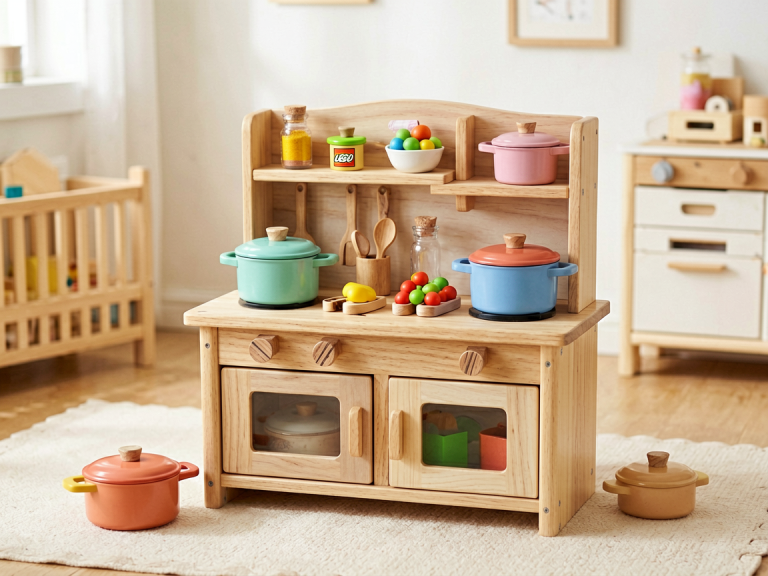
Toys that spark pretend play—dolls, action figures, kitchen sets, doctor kits, costumes, and miniature worlds—offer profound learning opportunities in social-emotional development and literacy. When children engage in role-playing, they practice empathy by imagining another person's perspective. A child playing "teacher" must consider how to explain a concept; a child playing "patient" learns to express feelings of discomfort. These scenarios build emotional vocabulary and self-regulation. Moreover, pretend play naturally fosters narrative skills: children create stories with characters, settings, and plots, which lays the groundwork for reading comprehension and writing. A simple toy farm can become a complex story about a lost lamb, a rescue mission, and a happy ending. To maximize learning, adults can participate without dominating. For instance, if a child is playing "restaurant," a parent can ask, "What's the special today?" and "How much does it cost?" This integrates math (counting money) and literacy (writing menus) into the play. Offering props like notepads, blank cards, or fabric pieces extends possibilities. Importantly, role-playing also helps children process real-life experiences, reducing anxiety and building confidence. By giving children control over their imaginary worlds, toys become tools for emotional growth.
Puzzles, Games, and Problem-Solving: Sharpening the Mind
Board games, jigsaw puzzles, logic games, and memory matching cards are classic screen-free tools that teach critical thinking, strategy, patience, and social skills. Unlike screens, which often provide instant feedback and reduce frustration, puzzles require sustained attention and the ability to tolerate ambiguity. A child working on a 100-piece puzzle learns to sort pieces by color and edge shape, developing categorization skills that underpin mathematics and science. Board games like chess, checkers, or simpler games like "Candy Land" teach turn-taking, following rules, and dealing with winning and losing—all essential life skills. Strategy games like "Connect Four" or "Quoridor" encourage forward-thinking and planning multiple moves ahead, which boosts working memory and cognitive flexibility. Cooperative games, where players work together against a common goal, teach teamwork and communication. To integrate learning, choose games that match the child's developmental level but also stretch their abilities. For younger children, simple matching games build visual discrimination; for older ones, logic puzzles like Sudoku or tangrams challenge reasoning. The social aspect of playing with others—negotiating rules, celebrating successes, managing disappointment—is something no screen can replicate. Regular family game nights can become a cherished routine that strengthens bonds while sharpening young minds.
Nature-Based Toys and Outdoor Exploration: Connecting with the World
Toys that connect children with the natural world—such as magnifying glasses, bug catchers, seed kits, rock collections, and simple gardening tools—offer unique screen-free learning that grounds children in real-world science. Nature-based play encourages observation, classification, and wonder. A child using a magnifying glass to examine a leaf's veins or an ant's legs practices scientific observation skills that are the foundation of biology. Collecting rocks and sorting them by color, texture, or weight introduces basic geology and properties of matter. Gardening toys teach patience, responsibility, and the life cycle of plants. Even a simple sandbox, when equipped with shovels, sieves, and molds, provides endless opportunities for physics (digging, pouring) and creativity (building castles). Unlike a digital nature app, real outdoor play exposes children to unpredictable variables—wind, temperature, living creatures—that demand adaptive thinking. Parents can enhance learning by providing field guides, clipboards for drawing, or simple science notebooks. For example, a "nature scavenger hunt" with a list of items to find (a smooth rock, a feather, a yellow flower) develops attention to detail and classification. Importantly, outdoor play also supports physical development and reduces stress. Encouraging children to build forts, dig holes, or create mud pies fosters creativity and resilience. The combination of physical activity and unstructured exploration makes nature-based toys among the most powerful for holistic development.
Practical Tips for Parents: Creating a Screen-Free Play Environment
To successfully integrate screen-free learning through toys, parents need to be intentional about the environment and their own involvement. First, curate toys thoughtfully. Quality over quantity matters: a few open-ended, high-quality toys are far better than a closet full of single-purpose plastic gadgets that dictate play. Rotate toys every few weeks to keep interest alive without overwhelming the child. Second, designate a play space that is free from screens. This does not mean eliminating all technology, but creating a cozy corner with shelves, a rug, and storage bins where toys are accessible and respected. Third, model screen-free behavior. If children see parents engaged in reading, crafting, or playing a board game, they are more likely to value these activities. Fourth, allow for unstructured time. The most powerful learning often happens when children have long, uninterrupted periods to immerse themselves in play. Resist the urge to schedule every minute or to correct every "mistake" in their play. Fifth, ask open-ended questions that prompt reflection: "Tell me about your creation," "What would happen if…?" "How did you solve that problem?" These conversations deepen learning and show that you value their ideas. Finally, be patient. Children who are used to screens may initially resist slower, more demanding play. Start with short, engaging sessions, and gradually increase time. The rewards—a child who thinks critically, collaborates, and finds joy in the real world—are worth the effort.
In conclusion, toys hold remarkable potential for screen-free learning when used with intention and creativity. From building blocks that teach physics to pretend sets that nurture empathy, from puzzles that hone logic to nature tools that inspire wonder, each category offers distinct cognitive, social, and emotional benefits. As parents and educators, we can harness this power by choosing toys wisely, creating supportive environments, and engaging with children in their play. The result is not just an alternative to screens, but a richer, more holistic foundation for lifelong learning. So put down the tablet, pick up a wooden block, and discover the world of learning that lies in the simple act of play.