Learning Through Play: A Comprehensive Guide for Parents
Introduction: Why Play Matters More Than You Think
In an era of structured schedules, screen time, and academic pressure, many parents find themselves asking: “Is my child learning enough?” The instinct to push early literacy, math skills, and structured activities is understandable. But research in developmental psychology and neuroscience continually points to a surprising truth: play is the most powerful engine of learning for young children. Far from being a frivolous distraction, play is the natural language of childhood, a dynamic process through which children make sense of their world, build essential cognitive skills, and develop emotional resilience.
This guide will help you understand what “learning through play” really means, why it works, and—most importantly—how you, as a parent, can create an environment that supports playful learning without turning it into a chore. By the end, you will see that the best educational “curriculum” is often already in your living room, waiting to be unlocked.
What Is Learning Through Play?
Learning through play is not about replacing fun with flashcards. It is about recognizing that when children build with blocks, pretend to be superheroes, or splash in puddles, they are actively constructing knowledge. Play-based learning is child-led, hands-on, and intrinsically motivated. It encompasses five key characteristics:
- Meaningful – Children connect play to their own experiences.
- Joyful – The activity itself is rewarding, not forced.
- Iterative – Children try, fail, adjust, and try again.
- Socially Interactive – Play often involves communication, negotiation, and cooperation.
- Actively Engaging – The mind and body work together.
When these elements are present, learning becomes deep and lasting. A child building a tower learns physics (balance, gravity), math (symmetry, counting), and executive function (planning, patience) all at once—without a single worksheet.
The Science Behind Play: Why It Works
Neuroscientific studies show that play activates the prefrontal cortex, the area responsible for problem-solving, self-regulation, and creativity. During play, the brain releases dopamine, a neurotransmitter linked to motivation and memory. This means that what children learn while playing is more likely to be stored long-term than information drilled in a stressful setting.
Furthermore, play reduces cortisol levels (the stress hormone). A relaxed brain learns better. Children who engage in regular, unstructured play develop stronger language skills, better impulse control, and greater adaptability. The American Academy of Pediatrics has even declared play essential for healthy brain development.
How to Foster Learning Through Play at Home (Ages 2–6)
The following sections provide age-specific strategies, but remember: children develop at different rates. Observe your child’s interests and let them guide the play.
For Toddlers (Ages 2–3): Sensory Exploration and Cause-Effect
At this stage, the world is a giant laboratory. Toddlers learn through their senses—touching, tasting, hearing, and seeing. Provide open-ended materials that invite exploration.
- Sensory bins: Fill a shallow tub with rice, beans, or sand. Add scoops, cups, and small toys. This builds fine motor skills, vocabulary (scoop, pour, full, empty), and scientific thinking (what sinks? what floats?).
- Simple puzzles and stacking rings: These teach spatial reasoning and problem-solving. Avoid overwhelming choices; two or three options are enough.
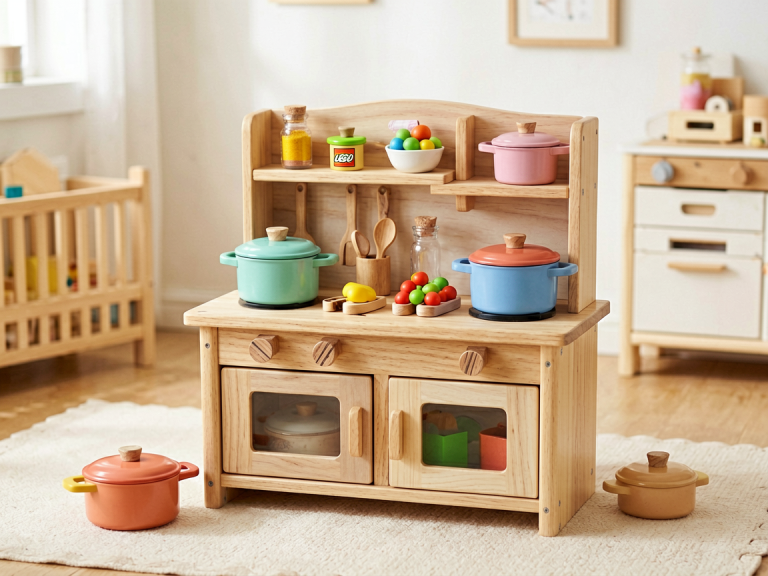
- Imitative play: Let your toddler “cook” with plastic pots or “talk” on a toy phone. This develops narrative skills and empathy.
Your role: Narrate what your child is doing without directing. “You are pouring the beans into the red cup. It’s getting full!” This builds language without interrupting the child’s flow.
For Preschoolers (Ages 3–5): Pretend Play and Early Literacy
This is the golden age of imaginative play. Preschoolers begin to create stories, assign roles, and follow complex rules. This is where foundational academic skills emerge naturally.
- Dramatic play corner: Set up a pretend grocery store, doctor’s office, or post office. Include paper, pens, empty boxes, and play money. Children will practice counting, writing, reading, and social negotiation all on their own.
- Board games with simple rules: Games like Candy Land or Snakes and Ladders teach turn-taking, counting, and resilience (losing gracefully).
- Block building: Unit blocks or LEGO Duplo encourage geometry, balance, and creativity. Ask open-ended questions: “What would happen if you added one more block here?”
Your role: Let the child lead the story. If they pretend the stuffed bear is sick, ask, “What does the bear need to feel better?” Follow their script rather than imposing your own.
For Kindergarteners (Ages 5–6): Complex Problem-Solving and Collaboration
Children at this age are ready for more structured play that mimics real-world challenges. They can plan, negotiate, and reflect.
- Construction challenges: “Can you build a bridge that holds three toy cars?” This integrates engineering, math, and trial-and-error.
- Card games and dice games: Simple card games like “Go Fish” teach matching, strategy, and early arithmetic.
- Nature scavenger hunts: Create a list (“find something smooth, something rough, something that smells like rain”). This builds observation skills, classification, and vocabulary.
Your role: Step back and resist the urge to correct. If a child’s bridge collapses, wait and see if they try a different design. Offer encouragement: “That didn’t work. I wonder what you could try next.”
Overcoming Common Parental Concerns
Many parents worry that play-based learning will leave their child “behind” academically. Here are the facts:
Concern 1: “My child only plays. When do they learn letters and numbers?”
Reality: Play is where letters and numbers become *meaningful*. A child who pretends to write a restaurant menu is motivated to learn letters. A child who counts toy animals learns number sense far better than one who fills out worksheets.
Concern 2: “Play feels unstructured. How do I measure progress?”
Reality: Progress is visible if you know what to look for. Instead of a test, observe: Is your child asking more questions? Creating longer stories? Solving problems without frustration? These are the real markers of cognitive growth.
Concern 3: “I don’t have time to set up elaborate activities.”
Reality: The best play requires minimal setup. A cardboard box can become a spaceship. Cooking together involves measuring, sequencing, and chemistry. Even waiting in line can become a game (e.g., “I spy something green”).
Practical Tips for Busy Parents
You don’t need to be a Pinterest-perfect parent. Focus on these small, sustainable habits:
- Follow the child’s curiosity: If your child is obsessed with dinosaurs, don’t fight it. Read dino books, count dino toys, draw dino footprints. This deep engagement is more valuable than a broad, shallow curriculum.
- Limit screen time, but use quality content judiciously. Episodes of *Sesame Street* or *Bluey* can spark imaginative play afterward. The key is to discuss and extend the ideas, not just zone out.
- Create a “yes” space. Designate a corner of your home where your child can make a mess—paint, build, dig. A cheap plastic tablecloth and washable materials are all you need.
- Let boredom happen. When a child says, “I’m bored,” resist the urge to instantly provide entertainment. Boredom is the mother of creativity. After a few minutes, children often invent elaborate games on their own.
- Play alongside your child, but don’t take over. Engage when invited, but allow silence and independent exploration. Your presence provides security; your restraint provides autonomy.
Conclusion: Trust the Process
Learning through play is not a trend—it is a return to how human beings have always learned. Before schools and curricula, children learned by doing, by imitating, and by playing alongside elders. As modern parents, we have the privilege of understanding the science behind this ancient wisdom.
Your most important job is not to teach, but to create the conditions for play to flourish. Offer raw materials, ask thoughtful questions, and show genuine interest in your child’s discoveries. Let go of the pressure to have a perfectly “educational” home. Instead, trust that a child deeply engaged in play is already building the brain of a lifelong learner—one block, one story, one joyful moment at a time.
Remember: The guide is not in this article. The guide is already inside your child, waiting to be unleashed. Your role is simply to step back, watch, and wonder alongside them.