Navigating the Developmental Toy Path for 6-Year-Olds: A Guide to Growth Through Play
Introduction
The age of six represents a remarkable turning point in a child’s life. Kindergarten friendships deepen, academic skills begin to take shape, and the world of imagination expands at an astonishing rate. Yet this period also presents a unique challenge for parents and educators: how do we choose toys that genuinely support a child’s development rather than merely entertain? The answer lies in understanding what I call the developmental toy path—a curated, stage-appropriate sequence of playthings that nurture cognitive, physical, social‑emotional, and language skills. For 6‑year‑olds, this path must balance structured learning with open‑ended creativity, while respecting the child’s growing independence. This article explores the key developmental domains of a typical 6‑year‑old, explains how specific toys address those domains, and offers a practical roadmap for building a toy collection that grows alongside the child.
—
Understanding the 6‑Year‑Old Developmental Stage
To choose wisely, we must first appreciate the rapid changes occurring in a 6‑year‑old’s brain and body. At this age, children typically exhibit:
- Improved fine motor control – They can tie shoelaces, write letters, and manipulate small objects with increasing precision.
- Emerging executive functions – Planning, working memory, and impulse control are still developing, but children can follow multi‑step instructions and stick with a task for 15–20 minutes.
- Social awareness – Friendships become more intentional; children begin to understand turn‑taking, cooperation, and simple rules.
- Imaginative play peaks – They create elaborate scenarios, invent characters, and enjoy pretend play that often mirrors real‑world roles (doctor, teacher, superhero).
- Language explosion – Vocabulary grows to about 2,000–6,000 words, and children start telling longer stories, using past tense correctly, and asking “why” questions repeatedly.
A well‑designed developmental toy path acknowledges that no single toy can address all these domains at once. Instead, it provides a variety of tools that challenge the child just enough to promote growth without causing frustration.
—
The Core Developmental Domains and Corresponding Toy Types
A useful framework for choosing toys is to map them onto four core developmental areas: cognitive, physical, social‑emotional, and language/literacy. Each area requires different types of play.
*Cognitive Development*
Cognitive play for a 6‑year‑old moves beyond simple sorting and matching into logic, strategy, and problem‑solving. Board games such as *Candy Land* or *Hoot Owl Hoot* teach turn‑taking and counting, but more advanced games like *Outfoxed!* or *Robot Turtles* introduce deduction and basic programming concepts. Puzzles with 50–100 pieces strengthen visual‑spatial reasoning and persistence. Building sets (LEGO Classic, Magna‑Tiles) allow children to follow step‑by‑step instructions or invent their own structures, exercising both convergent and divergent thinking.
*Physical Development*
Gross motor skills benefit from balance bikes, jump ropes, and balls for kicking or throwing. Fine motor development is best supported by threading beads, lacing cards, and construction toys with small connectors (e.g., K’NEX or Plus‑Plus). Arts and crafts also play a role: scissors, clay, and drawing tools refine hand muscles essential for writing. For 6‑year‑olds who love movement, an obstacle course kit or a simple pedometer can turn energy into structured play.
*Social‑Emotional Development*
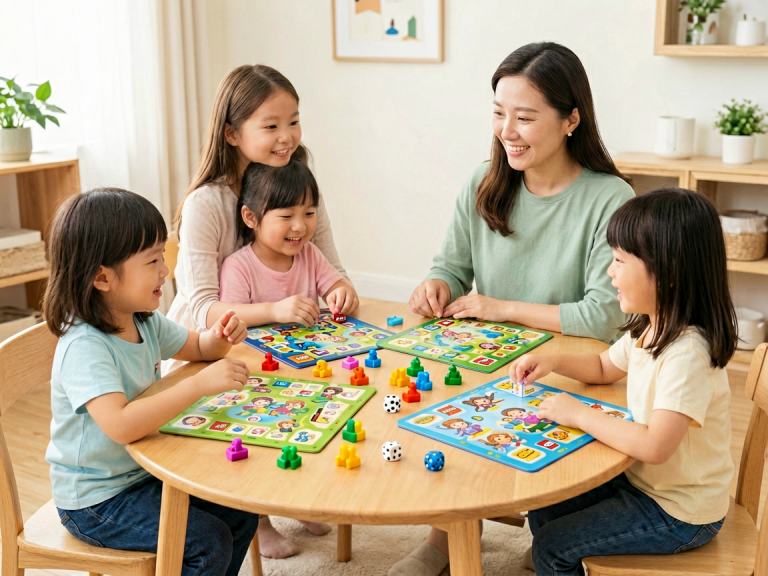
At age six, children are learning to navigate peer relationships, manage frustration, and express empathy. Cooperative board games (where everyone wins or loses together) are excellent for this purpose. Role‑playing toys—doctor kits, cash registers, dress‑up costumes—allow children to practice social scripts and emotional regulation. Dolls and action figures can be used to act out conflicts and resolutions. Additionally, toys that require two or more players, such as simple card games (Go Fish, Uno Junior) or building challenges (e.g., “who can build the tallest tower?”), teach patience and sportsmanship.
*Language and Literacy Development*
Books remain crucial, but the 6‑year‑old benefits from interactive reading tools: phonics‑based games (like *Zingo! Word Builder*), magnetic letters, and story‑telling cubes (e.g., *Rory’s Story Cubes*). Word‑matching games and simple crossword‑style puzzles reinforce spelling. Children also enjoy writing “thank you” notes or creating their own little books with blank paper and markers. For auditory learners, audiobooks paired with physical books (read‑along sets) strengthen listening comprehension and vocabulary.
—
Constructing the Toy Path: A Sample Progression
A developmental toy path is not a single purchase but a thoughtful sequence over time. Below is a suggested roadmap, organized by skill focus, for a 6‑year‑old’s journey through the year.
Phase 1: Foundation Building (Ages 6–6½)
Focus on toys that reinforce emerging academic and social skills.
- Logic & Math: *Sum Swamp* (a math‑based board game) or *ThinkFun’s Math Dice Jr.*.
- Fine Motor & Creativity: A set of wooden blocks or LEGO Classic bricks (no theme, just creative building).
- Social Play: A cooperative game like *The Snail’s Pace Race* or *Hoot Owl Hoot*.
- Language: *Alphabet Go Fish* cards and a set of magnetic lowercase letters with a metal cookie sheet.
Phase 2: Expanding Complexity (Ages 6½–7)
As the child’s attention span grows, introduce more open‑ended and multi‑step challenges.
- Strategy: *Robot Turtles* (teaches coding logic) or *Castle Logix* (spatial reasoning puzzles).
- Role‑Play: A detailed doctor’s kit with stethoscope, blood pressure cuff, and patient chart.
- Gross Motor: A balance board or a beginner’s jump rope with a counter.
- Creative Writing: Blank books with lined paper inside, plus a set of colorful gel pens, to encourage story creation.
Phase 3: Mastery and Independent Play (Ages 7+)
Towards the end of age six, many children are ready for toys that require sustained effort and collaboration.
- Engineering: *K’NEX Simple Machines* set, which teaches levers, pulleys, and gears.
- Language: *Scrabble Junior* or *Boggle Junior* for word building.
- Emotional Intelligence: A “feelings” card deck (e.g., *The Talking, Feeling & Doing Game*) to discuss emotions in a safe context.
- Physical Challenge: A simple marble run or a beginner’s robotics kit (e.g., *Ozobot Bit*).
—
Avoiding Common Pitfalls
Even with the best intentions, parents can derail the developmental toy path. Here are three common mistakes to avoid:
- Over‑scheduling play. The toy path should not be a rigid curriculum. Children need unstructured, “just because” play with open‑ended materials.
- Choosing age labels over observation. A 6‑year‑old may be ready for a toy marked “7+” if they show strong interest, or may need simpler options if they struggle with frustration. Watch the child, not the package.
- Ignoring the power of boredom. Resist the urge to buy a new toy every week. When children have fewer toys, they engage more deeply with each one, inventing new uses and scenarios.
—
Conclusion
The developmental toy path for a 6‑year‑old is neither a checklist nor a shopping list—it is a philosophy of intentional play. By understanding the child’s cognitive, physical, social‑emotional, and language needs at this pivotal age, we can select toys that not only entertain but also build competence, confidence, and curiosity. A marble run teaches perseverance; a cooperative game teaches teamwork; a blank notebook teaches the joy of authorship. When these experiences are combined in a thoughtful sequence, the result is a child who plays with purpose and grows with delight.
Ultimately, the best toy path is one that adapts: it grows as the child grows, celebrates their unique interests, and leaves room for the unexpected magic of childhood. Trust the process, watch the play, and let the toys become tools for a lifetime of learning.
*(Word count: approximately 1,080)*