Building Blocks of Numeracy: How Toys Foster Early Math Development
Introduction
Mathematics is often perceived as a subject of abstract symbols, memorized formulas, and rigid classroom drills. Yet long before children encounter a textbook, they are already deeply engaged in mathematical thinking through the most natural medium of childhood: play. Toys are not merely instruments of entertainment; they are the unsung heroes of early cognitive development, quietly laying the groundwork for number sense, spatial reasoning, pattern recognition, and logical problem-solving. From the simple act of stacking blocks to the more complex strategy of a board game, toys provide hands-on, concrete experiences that transform abstract mathematical concepts into tangible discoveries. This article explores the multifaceted ways in which toys support early math development, examining the psychological and pedagogical principles behind each type of play, and offers practical insights for parents and educators who wish to harness the power of play to cultivate a strong mathematical foundation.
The Role of Manipulatives in Understanding Number Concepts
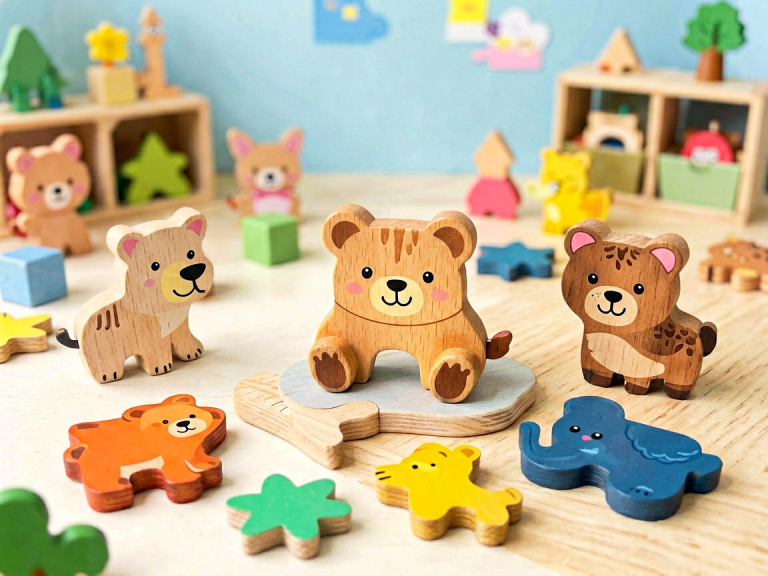
At the heart of early numeracy lies the ability to count, compare quantities, and understand one-to-one correspondence. Toys that function as manipulatives—such as counting bears, colored pegs, beads, and small animal figurines—allow children to physically interact with numbers rather than merely reciting them. When a three-year-old picks up three red bears and places them in a row, she is not just playing; she is internalizing the concept of cardinality: the idea that the last number she says when counting represents the total number of objects. Research in developmental psychology consistently shows that children who engage in frequent, structured manipulation of small objects demonstrate stronger counting skills and a more robust understanding of number magnitude than those who rely solely on rote memorization.
Moreover, manipulatives support the development of subitizing—the ability to instantly recognize small quantities without counting. Toys like dice or dot cards encourage this skill. A child rolling a die and immediately saying “five” without counting each dot is practicing subitizing, which is a precursor to mental arithmetic. Similarly, toys that require grouping, such as sorting trays or egg cartons with numbered compartments, help children grasp the relationship between numbers and quantities. For instance, placing exactly five buttons into a compartment labeled “5” reinforces the link between the symbol and the set. These experiences are not merely academic; they build the neural pathways that eventually allow children to manipulate numbers in their heads, forming the basis for addition and subtraction.
Sorting, Classifying, and Patterning: The Foundations of Algebraic Thinking
Before children can understand variables and equations, they must first recognize that objects can be grouped according to shared attributes—color, size, shape, or texture. Toys that invite sorting and classifying, such as shape sorters, colorful building bricks, or sets of buttons, are essentially introducing the core concepts of set theory and classification. When a toddler tries to fit a triangular block into a triangular hole, she is not only practicing fine motor skills but also engaging in logical deduction: this shape belongs here, not there. Over time, these activities evolve into more complex classifications. A preschooler might sort a pile of toy animals into “farm animals” and “zoo animals,” demonstrating an early understanding of categories and subsets—a skill directly linked to the mathematical idea of grouping numbers by properties (e.g., even vs. odd, prime vs. composite).
Patterns are another critical component of early algebra. Toys like pattern blocks, stringing beads with repeating color sequences, or even simple floor puzzles encourage children to recognize, extend, and create patterns. A child who places a red bead, then a blue bead, then a red bead, and then a blue bead is engaging in the fundamental mathematical practice of identifying regularities. This ability to detect patterns underpins much of later mathematics, from multiplication tables to algebra. Teachers often report that children who played extensively with pattern toys in early childhood have an easier time understanding number sequences and the commutative property of addition. Furthermore, pattern play hones executive function skills, such as working memory and attention to detail, which are essential for solving multi-step math problems.
Spatial Reasoning and Geometry Through Construction Toys
Geometry is often introduced in school through diagrams and formulas, but children first learn about shapes and spatial relationships by manipulating three-dimensional objects. Construction toys—LEGO bricks, magnetic tiles, wooden blocks, and interlocking gears—are among the most powerful tools for developing spatial reasoning, a skill that predicts later success in STEM fields. When a child builds a tower and observes that it topples if the base is too narrow, she is experimenting with balance, stability, and measurement. When she tries to fit a square block into a triangular hole, she learns about shape properties. When she rotates a piece to see if it matches, she practices mental rotation—a sophisticated spatial skill that correlates strongly with geometry performance in middle school.
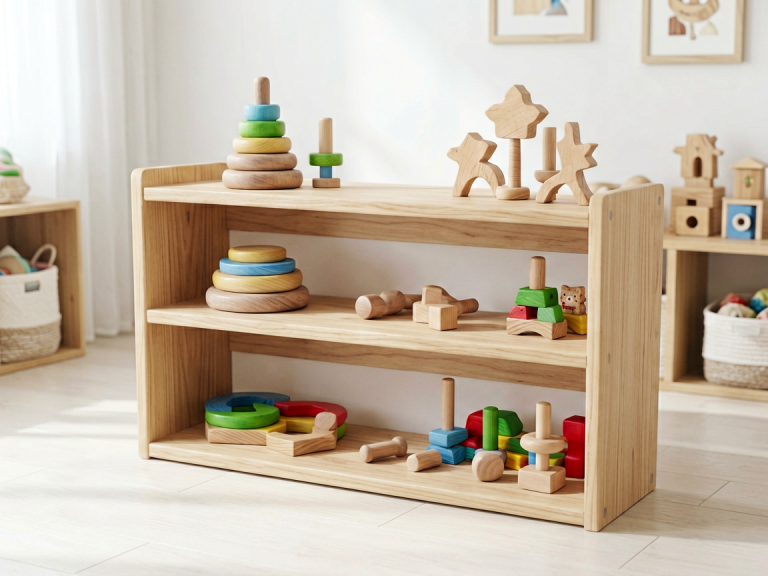
Stacking toys, such as graduated rings on a rocking base, teach size seriation: ordering objects from largest to smallest. This is a direct precursor to understanding numerical order and the number line. Puzzles, especially those with irregular shapes, require children to visualize how pieces fit together, fostering an intuitive grasp of area, symmetry, and angles. Some construction toys even incorporate gear systems or ramps, introducing basic physics concepts like cause and effect, slope, and rotational motion—all of which have mathematical underpinnings. The beauty of these toys is that they provide immediate feedback: if a structure falls, the child must revise her hypothesis and try again, embodying the iterative problem-solving cycle central to mathematical thinking.
Measurement and Comparison Through Play
Measurement is a fundamental mathematical skill, yet it can feel abstract to young children. Toys naturally introduce measurement in playful, meaningful contexts. For example, a set of measuring cups and spoons in a sand or water table allows children to compare volumes: “Which cup holds more? How many smaller cups does it take to fill the big one?” Similarly, balance scales with toy counters let children compare weights and explore the concept of equality (“We need the same number of bears on both sides for it to balance”). Even simple activities like using a toy tape measure to see who built a taller tower transform measurement into a competitive and engaging game.
Board games are another excellent vehicle for measurement and comparison. Games like “Chutes and Ladders” require counting spaces, estimating distances, and comparing positions. “The Game of Life” involves moving along a numbered path, managing currency, and comparing numerical values. Card games like “War” directly compare numbers, reinforcing the concept of greater than and less than. These games also incorporate turn-taking and rules, which teach children to follow mathematical procedures in a social context. Moreover, many modern board games introduce probability and statistics in a rudimentary way: “If I roll a six, I win; what are my chances?” This early probabilistic thinking, while informal, seeds the understanding that mathematical models can describe uncertainty.
The Social and Emotional Benefits of Math Play
While the cognitive benefits of toys for math development are well-documented, the social and emotional dimensions are equally important. Mathematical anxiety is a real and pervasive problem that often begins in early childhood when children are pressured to perform calculations without a supportive, playful foundation. Toys create a low-stakes environment where mistakes are part of the process, not failures. A child who knocks over a block tower can rebuild it without shame; a child who misplaces a puzzle piece can try another. This resilience is critical for developing a growth mindset—the belief that mathematical ability can be improved through effort and strategy.
Furthermore, when children play with peers or adults, they engage in mathematical discourse that builds vocabulary and reasoning. A child might say, “I have more dinosaurs than you,” prompting a conversation about comparison. A parent might ask, “How many more blocks do we need to finish the wall?” This type of talk, known as “math talk,” has been shown to predict later mathematical achievement. Playing with toys also encourages children to explain their strategies, justify their choices, and negotiate rules—all of which require logical argumentation, a cornerstone of mathematical proof. The emotional safety of play allows children to take intellectual risks, such as trying a novel way to sort or a new building strategy, without fear of evaluation.
Practical Recommendations for Parents and Educators
To maximize the mathematical potential of toys, adults should be intentional without being overbearing. First, choose open-ended toys that can be used in multiple ways: wooden blocks, LEGO bricks, magnetic tiles, and shape sets are far more valuable than single-purpose electronic toys that simply flash numbers. Second, model the language of mathematics during play. Instead of saying “good job,” try “I see you put all the red ones together—that’s a pattern!” or “You used three blocks to make a triangle. Can you make a square with four?” Third, allow free play followed by guided challenges. For instance, after a child has freely explored a set of pattern blocks, ask, “Can you make a pattern that repeats in two colors?” or “Can you fill this hexagon shape with smaller pieces?”
Incorporate measurement naturally: ask children to help measure ingredients while baking (using measuring cups), or compare the lengths of their toys. Use board game nights to practice counting, addition, and strategy. Finally, avoid rushing to formal worksheets or apps. The concrete, sensory experiences that toys provide are far more effective for building a deep, intuitive understanding of mathematics than passive screen time. The goal is not to turn play into a lesson but to see the lesson already embedded in play.
Conclusion
Toys are far more than diversions; they are the first textbooks of mathematics, written in the language of shape, color, size, and quantity. Through sorting, stacking, building, measuring, and patterning, children construct their own understanding of mathematical concepts—concepts that will later support everything from simple arithmetic to advanced calculus. The power of toys lies in their ability to make the abstract concrete, to turn mistakes into discoveries, and to nurture a joyful relationship with numbers that lasts a lifetime. As parents and educators, we need not force-feed mathematics; we need only provide the right toys, step back, and let the children play their way to numeracy. In doing so, we honor the fundamental truth that the best learning is the one that feels like play.
Sources and further reading
- CDC: Developmental Milestones milestone context for how children play, learn, speak, act, and move.
- American Academy of Pediatrics: Toy Buying Tips for Babies and Young Children guidance on matching toys and play to developing abilities.