Building Numerical Minds: A Guide to Early Math Development Toys by Age
Introduction
Mathematics is often perceived as a subject reserved for older children and adults, but the foundations of mathematical thinking are laid much earlier—during the first five years of life. Long before a child can recite numbers or solve equations, they are absorbing concepts of quantity, pattern, shape, and space through everyday interactions. The right toys can transform play into a powerful learning experience, nurturing a child’s innate curiosity and building the neural pathways that support future academic success. This article explores the most effective early math development toys by age, providing parents and educators with a roadmap to choose playthings that align with each developmental stage. From tactile exploration in infancy to symbolic reasoning in kindergarten, each age group requires specific types of stimulation. By understanding these milestones, caregivers can turn simple play into a springboard for lifelong mathematical confidence.
Infants (0–12 Months): Sensory Exploration and Cause-and-Effect
During the first year, babies are not consciously counting or sorting, but they are developing the foundational concepts of object permanence, size, and cause-and-effect. Toys that engage multiple senses and encourage repetition are ideal for this stage.
High-Contrast Mobiles and Black-and-White Cards
Newborns are drawn to high-contrast patterns, such as black-and-white stripes or checkered shapes. These simple visual stimuli help infants begin to recognize boundaries and shapes, which are precursors to spatial reasoning. As they track the moving mobile, they practice visual scanning—a skill later used for comparing sets of objects.
Soft Blocks and Textured Balls
Around four to six months, babies start reaching and grasping. Soft blocks with varied textures, colors, and sizes allow them to explore the concept of “big” versus “small” through touch and sight. When they knock over a stack of blocks, they observe cause and effect: an action (pushing) leads to a result (blocks falling). This is an early form of mathematical prediction. Similarly, textured balls that roll differently teach about speed and trajectory, introducing intuitive physics.
Squeaky Toys and Rattles
Toys that produce sound when shaken or squeezed help infants understand that their actions have measurable outcomes. The number of squeaks correlates with the force applied—a primitive form of “more” and “less.” Repeating an action to produce the same sound reinforces the concept of patterns, a key mathematical process.
Important Note: At this age, the toy itself is less about explicit math and more about building the sensory-motor foundation. Parents should talk to infants while playing (“That block is big! This one is small.”) to associate language with size concepts.
Toddlers (12–24 Months): Sorting, Stacking, and Early Number Sense
Toddlers are natural explorers. They begin to understand that objects have attributes—color, shape, size—and that these can be categorized. This is the golden age for hands-on manipulation toys.
Nesting Cups and Stacking Rings
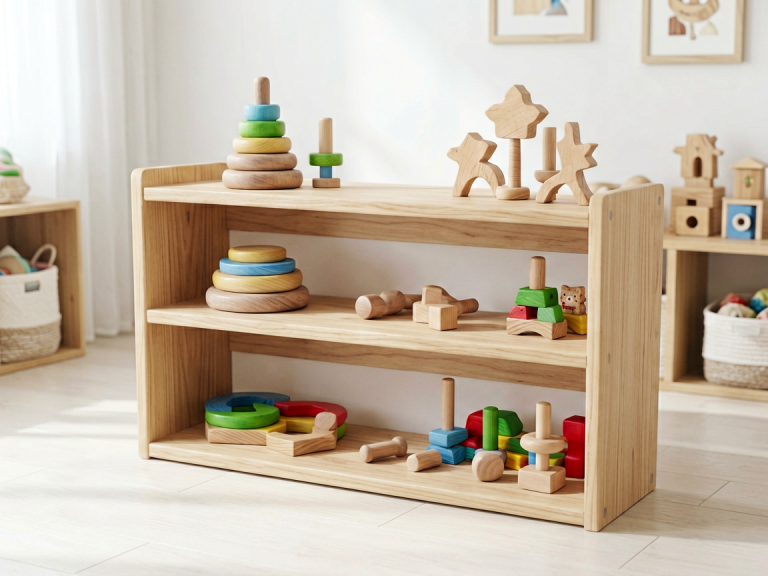
Nesting cups are a classic early math toy. A toddler learns to order cups by size, from largest to smallest, and to nest them inside one another. This activity teaches seriation (arranging objects in a sequence) and spatial relationships. Stacking rings on a peg require the child to select a ring that fits—an early lesson in size matching. Parents can count the rings as they are stacked: “One ring, two rings, three rings!” This builds one-to-one correspondence, the understanding that each number word corresponds to a single object.
Shape Sorters
A shape sorter box with square, circle, and triangle holes demands that the child match a shape to its corresponding opening. Through trial and error, toddlers develop an intuitive grasp of geometry. They also learn about rotation and orientation—for instance, a square must be aligned correctly to fit. This is a rudimentary exercise in problem-solving and attribute recognition.
Simple Puzzles with Knobs
Puzzles with two or three pieces (e.g., a wooden apple that splits into two halves) introduce part-whole relationships. When a toddler successfully places the piece, they experience a sense of completion, reinforcing the concept that parts combine to form a whole—a core idea in early fractions.
Counting Songs and Finger Plays
While not a toy per se, incorporating toys like plush animal sets or finger puppets during counting songs (e.g., “Five Little Ducks”) helps toddlers connect abstract numbers to tangible objects. The physical act of tapping each puppet or duck as you sing “1, 2, 3, 4, 5” reinforces touch-counting.
Preschoolers (2–3 Years): Patterning, Classification, and Simple Arithmetic
By age two, children have a growing vocabulary and can follow simple instructions. They are ready for toys that explicitly introduce patterns, classification, and the concepts of “more” and “less.”
Connecting Cubes (e.g., Unifix Cubes or LEGO Duplo)
Plastic interlocking cubes are versatile math tools. A two-year-old can snap them together to make a tower or a train, learning about length and height. More importantly, these cubes can be sorted by color and used to create simple patterns (red-blue-red-blue). Pattern recognition is a fundamental math skill that underlies algebra and logic. Parents can ask, “What comes next?” and help the child continue the sequence.
Counting Bears and Sorting Trays
Small plastic bears in three sizes and colors come with sorting bowls and tweezers. A toddler can sort bears by color (classification) or size. They can also practice one-to-one correspondence by placing one bear in each cup. Introducing the concept of “more” is easy: “You have three bears, and I have two. Who has more?” Such hands-on comparisons build number sense without worksheets.
Wooden Number Puzzles with Pegs
Puzzles that have a number shape (e.g., a wooden “3”) with a corresponding number of pegs underneath allow the child to count the pegs and match them to the numeral. This bridges the gap between the symbol (the written number) and the quantity (the pegs). The tactile feedback helps solidify the association.
Balance Scales
A simple two-pan balance scale lets children experiment with weight and equilibrium. Placing a large bear on one side and three small bears on the other, they observe that equal weight can come from different quantities. This introduces the concept of equivalence—a key idea in early algebra. The language of “heavier” and “lighter” also builds comparative vocabulary.
Pre-K Children (3–4 Years): Counting, Measuring, and Logical Thinking
As children approach four, their attention spans lengthen and their ability to remember sequences improves. They start to understand cardinality (the last number counted tells how many) and can solve simple addition and subtraction problems with concrete objects.
Number Bingo and Dice Games
Board games that incorporate dice, such as a simple number bingo, teach subitizing—the ability to instantly recognize the number of dots on a die without counting. Pre-K children can also play games where they roll two dice and add the dots, using counters to find the total. This is a natural, playful introduction to addition.
Measuring Cups and Sand/Water Tables
A water table with measuring cups, funnels, and graduated cylinders is a treasure trove for early math. Children can pour water from a large container into a small one and discover that the same amount of water looks different depending on the container’s shape. They experiment with volume, capacity, and (with a little help) begin to estimate. Measuring cups with number markings (1 cup, ½ cup) connect the abstract symbol to a visual volume.
Geometric Pattern Blocks and Design Cards
Wooden or plastic pattern blocks (triangles, squares, rhombuses, etc.) allow children to build shapes and patterns. Given a design card, they must select the correct tiles to replicate an image. This hones spatial visualization and symmetry. They also learn that two smaller triangles can form a rhombus—a hands-on experience with fractions and area.
Simple Board Games with a Number Line Path
Games like “Chutes and Ladders” or “Candy Land” (adapted with numbers) require children to move a token along a path of numbered squares. As they count spaces forward or backward, they practice sequential counting and ordinal numbers. The addition of “move forward 2 spaces” or “go back 1 space” is their first exposure to integer arithmetic.
Kindergarteners (4–6 Years): Formal Arithmetic, Place Value, and Problem Solving
By kindergarten, children are ready for more structured mathematical thinking. Toys should now support symbolic representation, reasoning about quantities beyond 10, and basic operations.
Ten-Frames and Counters
A ten-frame is a 2×5 grid that helps children visualize numbers up to ten. Using two-sided counters (red on one side, yellow on the other), a child can represent numbers like 7 as “5 and 2 more.” This develops a strong sense of ten as a benchmark and introduces part-part-whole relationships. Ten-frames are the perfect precursor to addition and subtraction facts.
Base-Ten Blocks (Place Value Sets)
Base-ten blocks (units, rods, flats, and cubes) are the gold standard for teaching place value. A child can physically trade ten unit cubes for one rod (ten), and ten rods for one flat (hundred). This concrete manipulation makes abstract concepts like regrouping tangible. Building numbers with these blocks reinforces the idea that 23 is two tens and three ones.
MathLink Cubes with Activity Cards
These colored cubes can be snapped together in longer strips. Activity cards might ask: “Make a train that is 8 cubes long. Now add 3 more. How long is it now?” Such tasks require counting, adding, and measuring. The cubes can also be used to introduce multiplication arrays: arranging 12 cubes into 3 rows of 4. This lays the groundwork for multiplication and division.
Tangrams and Wooden Geometry Puzzles
A set of seven tangram pieces can be arranged to form hundreds of shapes, from animals to buildings. Solving a tangram puzzle challenges a child to use mental rotation, decomposition (breaking a larger shape into parts), and symmetry. It also strengthens persistence and problem-solving—traits essential for higher mathematics.
Pretend Play with Cash Registers and Play Money
A play cash register with pretend coins and bills (in denominations of 1, 5, 10) allows children to role-play buying and selling. While they count out change, they practice coin recognition, skip counting (by 5s and 10s), and simple subtraction. The social context makes math meaningful and fun.
Coding Toys with Sequential Logic
Toys like “Robot Turtles” (a board game) or simple programmable robots (e.g., Code-a-Pillar) teach sequencing, direction, and debugging. Each move corresponds to a command (forward, left, right), and children must plan a sequence to reach a target. Computational thinking is closely related to mathematical problem-solving, and these toys introduce algorithms in a playful way.
Conclusion
Choosing the right early math development toys by age is not about forcing academic pressure on young children. Rather, it is about meeting them where they are developmentally and providing the tools that naturally spark their curiosity about patterns, quantities, shapes, and relationships. From the soft blocks of infancy to the base-ten blocks of kindergarten, each stage builds upon the previous one, reinforcing concepts through repetition and joy. The common thread across all ages is hands-on, concrete play—the very opposite of rote memorization. When a toddler stacks rings, a preschooler sorts bears, or a kindergartener trades units for rods, they are not just playing; they are constructing a mental framework for mathematics that will serve them for life. By being intentional about toy choices, parents can ensure that their child’s first encounters with numbers and shapes are positive, meaningful, and filled with wonder. After all, the best math education begins not with a worksheet, but with a smile and a toy.
Sources and further reading
- CDC: Developmental Milestones milestone context for how children play, learn, speak, act, and move.
- American Academy of Pediatrics: Toy Buying Tips for Babies and Young Children guidance on matching toys and play to developing abilities.