The Ultimate Toy Guide for Early Math Development: Building a Strong Foundation Through Play
Introduction
Mathematics is often perceived as a subject reserved for older children or adults—something abstract, formulaic, and intimidating. But in reality, the foundations of mathematical thinking begin in infancy, long before a child ever encounters a textbook or a blackboard. Early math development is not about drilling numbers or memorizing multiplication tables; it is about exploring patterns, recognizing shapes, comparing sizes, understanding sequences, and developing spatial awareness—all through the natural, joyful medium of play.
Toys are among the most powerful tools parents and educators can use to nurture early mathematical thinking. The right toys provide hands-on, multisensory experiences that make abstract concepts concrete. When a toddler stacks rings on a peg, they are learning about size ordering. When a preschooler sorts colorful buttons into groups, they are practicing classification—a key logic skill. When a kindergartner builds a tower with blocks, they are intuitively exploring geometry, balance, and measurement.
This guide offers a comprehensive, age-based roadmap for selecting toys that support early math development. Each section explains the key mathematical concepts the toys address, why they are effective, and how to engage with children during play to maximize learning. Whether you are a parent, a caregiver, or an early childhood educator, you will find practical recommendations to turn playtime into a rich mathematical adventure.
—
1. Infants and Toddlers (0–2 Years): Laying the Groundwork for Number Sense and Spatial Awareness
At this stage, children are sensory explorers. Their mathematical journey begins with noticing differences: big versus small, full versus empty, near versus far, one versus many. The most effective toys for this age group are simple, safe, and rich in sensory feedback.
1.1 Stacking Rings and Nesting Cups
Concepts: Size ordering (seriation), spatial relationships, cause and effect.
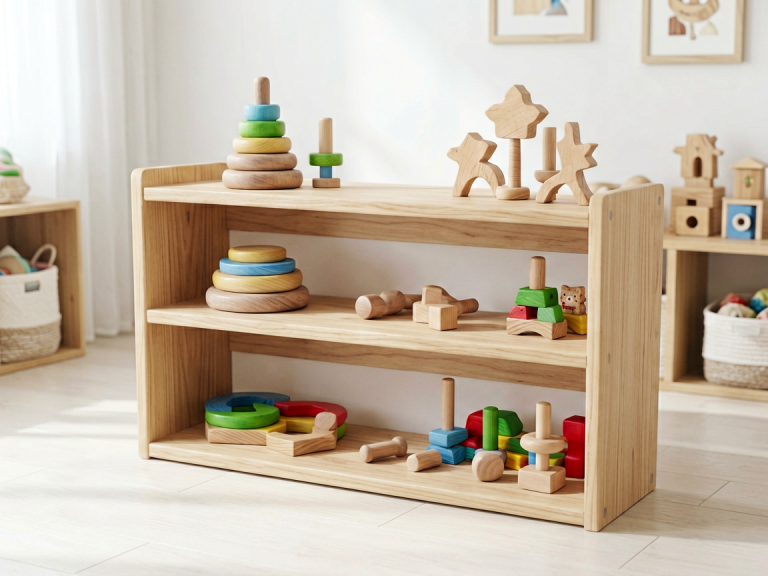
Why they work: A classic stacking ring toy—a central peg with rings of varying diameters—teaches toddlers that objects can be arranged in a sequence. When a child tries to place the large ring before the small one and it doesn’t fit, they learn a lesson in trial and error, comparison, and logical reasoning. Nesting cups add the dimension of “inside” and “outside,” introducing early volume and containment ideas.
Play tips: Instead of simply letting the child stack, narrate your actions: “This ring is big. Now let’s find the bigger one? No, this one is bigger—it goes first.” Ask questions like, “Can you put the little cup inside the big cup?” These simple verbal cues label mathematical vocabulary.
1.2 Shape Sorters
Concepts: Shape recognition, classification, problem-solving, fine motor integration.
Why they work: A shape sorter box with cutout holes for triangles, squares, circles, and stars demands that a child match the shape of the block to the shape of the opening. This is an early form of geometry—understanding that the physical form of an object determines its fit. It also requires persistence and spatial reasoning as the child rotates the block to align it.
Play tips: Encourage the child to trace the shapes with their fingers. Talk about the number of sides: “A triangle has three points. Can you count them with me?” When the child succeeds, celebrate the process, not just the result. This builds a positive association with solving mathematical problems.
1.3 Simple Puzzle Boards (with Pegs or Knobs)
Concepts: Matching, spatial orientation, part-whole relationships.
Why they work: A basic wooden puzzle with a picture (e.g., a farm animal) cut into two or three large pieces teaches that a whole can be broken into parts and reassembled. This is a precursor to understanding fractions and geometry. Knob puzzles also strengthen the pincer grip, which is essential for later writing—and writing numbers.
Play tips: Start with puzzles that have only two pieces. Describe the position: “The cow’s head is next to its body. Where does the tail go?” Use words like “above,” “below,” “beside” to build spatial vocabulary.
—
2. Preschoolers (2–4 Years): Counting, Pattern Recognition, and Comparison
Preschool-age children begin to grasp the concept of quantity and can often recite numbers by rote, but true counting—one-to-one correspondence—develops between ages 2 and 4. This is also the stage where pattern awareness blossoms. Toys should encourage active manipulation, grouping, and repetitive sequences.
2.1 Counting Bears and Sorting Bowls
Concepts: One-to-one correspondence, counting, sorting by attributes (color, size), simple addition and subtraction.
Why they work: A set of small plastic bears in three sizes and six colors, paired with sorting trays or cups, is a mathematical powerhouse. Children can line up bears to count, place one bear in each cup (matching quantity to container), create patterns (red, blue, red, blue), and even play “take away” games. The tactile nature of the bears makes abstract numbers tangible.
Play tips: Lay out numeral cards (0–10) and ask the child to place the correct number of bears beneath each card. Play “feed the bear” where you say, “Give the big bear three blueberries” and the child counts out three small pom-poms. This integrates counting with language and motor skills.
2.2 Linking Cubes (or Snap Cubes)
Concepts: Enumeration, patterns, length measurement, addition/subtraction, and early multiplication (e.g., groups of equal size).
Why they work: These small plastic cubes that snap together on all sides allow children to build towers, trains, or arrays. A tower of 10 cubes is visibly taller than a tower of 5. Children can snap cubes into repeating color patterns (ABAB, AABB) or make a “cube train” and count the cars. Linking cubes also support the concept of unit—the idea that a whole is made of equal parts.
Play tips: Challenge the child: “Build a tower that is 5 cubes high. Now build one that is 3 cubes higher. How tall is it now?” Use two different colors to represent groups: “Let’s put 3 red cubes and 2 blue cubes together. How many are there in all?” This is a concrete model for addition.
2.3 Magnetic Tiles (e.g., Magna-Tiles or Picasso Tiles)
Concepts: Geometric shapes, symmetry, area, perimeter, spatial visualization, fractions.
Why they work: Magnetic tiles are translucent, colorful shapes (squares, triangles, rectangles, hexagons) that snap together via magnets. They allow preschoolers to build 2D and 3D structures, exploring how shapes combine to form new shapes—a foundational geometry concept. A child might discover that two right triangles can make a square, or that four squares form a larger square, introducing area and fraction ideas informally.
Play tips: Start by asking the child to make a “big square” using smaller squares. Then ask, “How many small squares did you use?” This introduces the concept of area as covering. For symmetry, build half a butterfly and ask the child to mirror the design. Use the tiles to create patterns: “Red square, blue triangle, red square, blue triangle—what comes next?”
2.4 Simple Board Games with Dice and Spinners
Concepts: Counting, number recognition, subitizing (recognizing small numbers instantly), taking turns, and simple strategy.
Why they work: Games like *Hi Ho! Cherry-O* or *The Sneaky, Snacky Squirrel Game* require children to count spaces, match colors, and identify numbers on a die or spinner. The social element makes counting purposeful and fun. Repeating the game dozens of times builds number fluency.
Play tips: Emphasize the counting step. When a child rolls a 3, ask them to count the dots on the die together, pointing to each dot. Then count aloud as they move the game piece. Avoid rushing to “win”—instead, focus on the process. Incorporate language like “one more” or “one less” when moving backward.
—
3. Kindergarten and Early School Age (4–6 Years): Operations, Measurement, and Logical Thinking
By ages 4 to 6, children are ready to move from simple counting to basic operations (addition and subtraction), measurement using non-standard units, and more complex pattern work. They can also begin to understand the concept of time and money through play. Toys should now offer more challenge and encourage symbolic thinking.
3.1 Balance Scale with Weights (or a Bucket Scale)
Concepts: Weight, comparison, equality, addition, and subtraction (e.g., balancing equations).
Why they work: A simple two-pan balance scale allows children to physically see the relationship between weight and number. They can place a toy on one side and add counting bears to the other until it balances. This is a powerful concrete model for the concept of “equals”—not as a static number, but as a state of equilibrium.
Play tips: Start with non-standard units: “How many bears does it take to balance this toy car?” Then introduce numerals: “Can you make both sides equal to 5?” Write simple equations like 3 + 2 = 5 and demonstrate with objects on the scale. For subtraction, remove objects and observe the tipping.
3.2 Pattern Blocks (Wooden or Plastic)
Concepts: Geometry, symmetry, tessellation, fractions, angles, pattern duplication.
Why they work: Pattern blocks come in six standard shapes (triangle, square, rhombus, trapezoid, parallelogram, hexagon). Children can create designs that repeat, tile, or form larger shapes. They begin to see that one hexagon can be covered by six triangles or three rhombuses—a natural introduction to fractions.
Play tips: Provide pattern cards with half-finished designs and ask the child to complete the pattern. Challenge them: “How many different ways can you fill this hexagon?” Use the blocks to create a “growing pattern” (e.g., one triangle, two triangles, three triangles) and ask what comes next. This builds algebraic thinking.
3.3 Play Money and Cash Register
Concepts: Coin recognition, value, counting, addition and subtraction with amounts, practical problem-solving.
Why they work: Children love playing “store.” Using play coins and bills, they naturally engage in exchanging money, making change, and comparing prices—all of which involve real-world mathematics. A simple cash register with a number pad also reinforces numeral writing and reading.
Play tips: Set up a small shop with labeled prices (e.g., an apple costs 2 cents). Give the child a handful of coins and ask them to pay exactly. For older children, incorporate making change: “If you give me a dime for a 3-cent apple, how much change do you get?” Use role-play to add vocabulary like “total,” “cost,” “more than,” “less than.”
3.4 Math Manipulative Kits: Ten Frames and Rekenreks
Concepts: Place value, subitizing, addition and subtraction strategies, number bonds, making 10.
Why they work: A ten frame is a 2×5 grid of squares. Children place counters (like bingo chips or small toys) into the squares to represent numbers 0–10. A Rekenrek is a counting frame with two rows of ten beads each. These tools help children “see” numbers as groups, rather than counting one by one. For example, to solve 8 + 5, a child using a ten frame can fill up 10 and then see the remainder, understanding that 8 + 2 = 10, then 10 + 3 = 13.
Play tips: Start with the “make 10” game: Show a ten frame with some counters (say, 7). Ask the child, “How many more do we need to make 10?” This builds number sense deeply. For Rekenrek, push beads to represent numbers and ask the child to say the number without counting one by one—an exercise in subitizing.
—
4. Advanced Play for Children 6+ (Optional Enrichment)
While early math development primarily focuses on ages 0–6, some children crave more challenge. The following toys can extend mathematical thinking into formal operations:
- Base Ten Blocks (or Dienes Blocks): Represent units, tens, hundreds, and thousands. Essential for understanding the decimal system and regrouping in addition/subtraction.
- Fraction Tiles or Circles: Teach fractional equivalence, addition of fractions, and decimals in a visual, hands-on way.
- Tangram Puzzles: Seven geometric pieces that can form countless silhouettes. Develops spatial reasoning, problem-solving, and geometry.
- Math-Themed Card Games (e.g., Sum Swamp, Math Dice Jr.): Build mental math fluency and strategic thinking through repeated play.
—
Conclusion: The Golden Rule of Math Toys
No single toy, no matter how cleverly designed, can replace the role of a caring adult who interacts, questions, and encourages. The most powerful mathematical learning happens when a parent or educator sits alongside the child, not directing every move, but supporting their curiosity. Talk about what you see: “Your tower has 12 blocks—that’s taller than the table! How many more blocks do you need to reach the shelf?” Celebrate mistakes as learning opportunities. A block that doesn’t fit in a sorter is not a failure; it’s a clue that the shape or orientation needs adjusting—a core mathematical lesson.
When choosing toys for early math development, prioritize open-ended materials that can be used in many ways. Avoid toys that are overly didactic, flashy, or that “do the math for the child.” The best toys are simple, durable, and invite the child to act upon them: to sort, stack, count, measure, compare, and pattern. By filling your home or classroom with such toys—and by playing together with intention and joy—you are giving your child the most precious gift: a confident, positive, and intuitive relationship with mathematics that will last a lifetime.
Sources and further reading
For additional evidence-based guidance, consult these authoritative resources: