Building Bridges Through Play: How Toys Foster Social Skills Development
Introduction
From the earliest moments of childhood, toys are far more than simple objects of amusement. They serve as the first tools through which children explore the world, express emotions, and—most critically—learn to interact with others. While parents often focus on academic or motor skills when selecting playthings, the social benefits of toys are equally profound. Social skills—such as cooperation, empathy, negotiation, turn-taking, and conflict resolution—do not emerge in a vacuum; they are cultivated through repeated, meaningful interactions. Toys, whether a set of building blocks, a board game, or a dollhouse, provide the structured yet flexible environment where these interactions can flourish. This article examines the multifaceted ways in which toys support social skills development, drawing on developmental psychology, educational theory, and practical examples. By understanding these mechanisms, parents, educators, and caregivers can make informed choices that turn playtime into a powerful training ground for lifelong social competence.
The Foundational Role of Play in Social Learning
Before delving into specific toys, it is essential to understand why play itself is such a potent vehicle for social growth. According to the pioneering work of psychologist Lev Vygotsky, social interaction is the primary engine of cognitive development. During play, children operate in what Vygotsky called the "zone of proximal development"—the space between what they can do alone and what they can achieve with guidance from a more skilled peer or adult. Toys act as mediators in this space. For instance, when two children build a tower together, they must communicate their intentions, negotiate whose block goes where, and adjust their plans when the tower topples. These micro-interactions teach patience, perspective-taking, and the ability to read non-verbal cues. Moreover, play allows children to experiment with social roles without real-world consequences. A child pretending to be a doctor can try out authoritative language and caring gestures, while the "patient" learns to follow instructions and express feelings. This safe rehearsal is critical for building social confidence.
Types of Toys and Their Specific Social Benefits
Not all toys contribute equally to social skill development. The key lies in how a toy is designed and used. Below, several categories are examined for their unique social affordances.
*Cooperative Board Games and Card Games*
Unlike competitive games that crown a single winner, cooperative games require players to work together toward a common goal. Examples include "The Sneaky, Snacky Squirrel Game" (where players help each other collect acorns) or "Hoot Owl Hoot" (where players move owls to safety before sunrise). These games teach turn-taking, joint problem-solving, and the ability to celebrate collective success rather than individual victory. A child who loses a turn in a cooperative game learns to manage frustration not by blaming others but by recalibrating the group strategy. Research by developmental psychologists has shown that cooperative games reduce aggressive behavior and increase prosocial acts like sharing and encouraging teammates. Even simple card games like "Go Fish" require memory, patience, and the social skill of asking questions politely—a fundamental building block of conversation.
*Role-Playing and Pretend Play Toys*
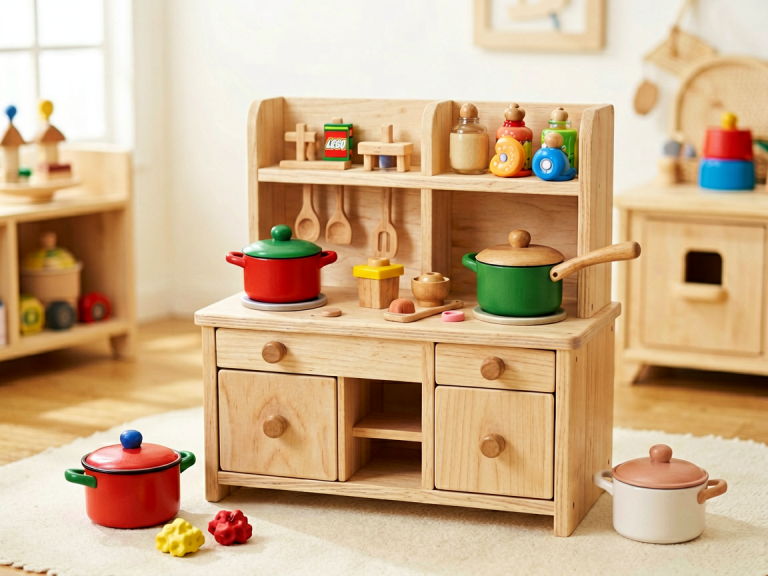
Dress-up costumes, toy kitchens, doctor kits, and dollhouses are staples of imaginative play. Their social value lies in the way they require children to adopt and synchronize roles. When a group of children plays "restaurant," they must decide who is the chef, the server, the customer, and the cashier. This negotiation demands compromise: "I was the chef last time; now it's my turn to be the customer." It also fosters empathy, as the "server" must anticipate what the "customer" might want. Pretend play provides a natural laboratory for practicing emotional vocabulary. A child holding a crying doll might say, "Don't worry, baby, I'll give you a bandage," thereby internalizing comforting language. Moreover, role-playing allows children to explore complex social dynamics such as authority, fairness, and inclusion. Studies have linked rich pretend play in early childhood with higher levels of social competence and reduced loneliness later in school.
*Building and Construction Toys*
Blocks, LEGO sets, magnetic tiles, and construction kits are often praised for spatial reasoning, but their social benefits are equally significant. When two or more children build together, they must coordinate their actions. One child may hold a piece steady while another attaches it; they may argue over whether to build a castle or a spaceship, requiring them to articulate their vision and listen to others. These interactions teach negotiation and the value of shared ownership. Importantly, construction toys also provide a tangible outcome that can be admired by the group, reinforcing a sense of collective achievement. If a structure collapses, children must decide whether to rebuild together or abandon the project—a lesson in resilience and group decision-making. The open-ended nature of building toys also allows for flexible social roles: a child who struggles with verbal expression might excel at designing and thus earn respect from peers, boosting self-esteem and encouraging further social engagement.
*Outdoor and Active Play Toys*
Balls, jump ropes, playground equipment, and ride-on toys promote social skills through physical cooperation. Games like catch, kickball, or tag require children to follow rules, take turns, and manage their emotions when they are tagged out. A child who learns to pass the ball to a teammate rather than hoarding it is practicing generosity and strategic thinking simultaneously. Group jumping rope, for example, demands timing, rhythm, and the ability to coordinate with others—skills directly transferable to classroom group work. Furthermore, outdoor play often involves spontaneous rule-making: "Let's say the red slide is the safe zone, and the blue slide is lava." This informal rule creation teaches children how to negotiate boundaries and respect collective agreements, a foundation for democratic citizenship.
*Digital and Interactive Tech Toys*
In today's world, digital toys—such as tablet apps, interactive robots, and multiplayer video games—cannot be ignored. While concerns about screen time are valid, certain digital toys are designed to foster collaboration. Apps that require two players to solve puzzles, or games like "Minecraft" in creative mode, encourage communication, delegation, and planning. A child building a virtual village with a friend must discuss allocation of resources and decide on a shared aesthetic. Moreover, some interactive robots (like programmable toys) prompt children to teach each other coding sequences, turning the learning into a social experience. The key is moderation and co-play: when adults or siblings join in, digital toys can become vehicles for joint attention and conversation, rather than solitary consumption.
Mechanisms: How Toys Explicitly Teach Social Skills
To fully appreciate the impact of toys, it is helpful to identify the specific psychological and behavioral mechanisms at work.
*Modeling and Imitation*
Many toys come with instructions or scenarios that implicitly model social behavior. For example, a tea set encourages children to imitate adult tea parties, complete with polite greetings, pouring gestures, and thank-you exchanges. Through repetition, these polite scripts become automatic. Similarly, dolls with emotional expressions (happy, sad, angry) help children label and discuss feelings—a key aspect of emotional intelligence. When a child sees a doll that looks sad, they may ask, "What's wrong?" and then create a narrative around comforting the doll, thereby practicing empathy in a low-stakes context.
*Turn-Taking and Rule Adherence*
Toys that involve alternating actions—such as board games, card games, or even a simple seesaw—teach the fundamental social expectation of taking turns. A child who learns to wait for their turn on a swing is also learning impulse control and respect for others' desires. Over time, these experiences build a neural framework for patience and fairness. The explicit rules of a game also teach children that fairness is a shared agreement; breaking the rule spoils the fun for everyone. This is a direct lesson in social contract theory, albeit at a toddler level.
*Negotiation and Conflict Resolution*
When children share toys, disagreements are inevitable. A toy truck that both children want becomes a catalyst for negotiation. "You can have it first, but then I get it for five minutes." "Let's take turns pulling it." This real-time bargaining teaches children to articulate their needs, listen to the other's perspective, and find a mutually acceptable solution. Toys that have multiple pieces (like a set of colored blocks) actually reduce conflict because there are enough to share—but they also require children to decide how to allocate them. These small conflicts are practice for larger ones later in life.
*Cooperation and Joint Attention*
Some toys are designed to be impossible to use alone. A large puzzle that requires two sets of hands, a seesaw that needs a partner, or a tandem bicycle (for older children) forces cooperation. When children realize that their own success depends on the success of others, they develop a collaborative mindset. Joint attention—focusing on the same object or goal—is a foundational social skill that underpins language development and relationship building. Toys that require shared gaze, such as a marble run where both children must watch the marble's path, strengthen this ability.
*Emotion Regulation and Resilience*
Toys can also teach children to manage their emotions in social contexts. Losing a game of checkers, having a tower knocked over, or being excluded from a pretend scenario can trigger frustration or sadness. But toys provide a safe arena to practice recovering from these setbacks. A child who learns to take a deep breath and try again after a loss is building emotional resilience. Moreover, toys that invite repetition (like building the same castle again) give children multiple chances to succeed socially, reducing the fear of failure.
Practical Implications for Parents and Educators
Understanding the social power of toys allows adults to intentionally design play environments that maximize growth. First, selection matters. Parents should seek toys that require more than one participant—cooperative games, role-play sets, and construction kits with multiple components. Second, adult involvement can amplify the benefits. When a parent sits down to play a board game, they can model turn-taking talk ("Now it's your turn, sweetie") and emotional labeling ("I see you're disappointed that you didn't get a six; that's okay, you'll have another chance"). Third, variety is important. Offering both structured games (with rules) and unstructured toys (like blocks or clay) gives children practice with different social scenarios. Finally, limiting solitary digital play and encouraging face-to-face interaction around toys ensures that the social lessons are not lost.
Educators can use toys to scaffold social skills in the classroom. For example, a kindergarten teacher might place a new toy in a "cooperative center" with a sign that says, "This toy works best when two friends use it together." Observing how children approach the toy provides rich data for social-emotional learning lessons. Role-play corners with cultural props (such as a Chinese restaurant set or a post office) also help children practice social scripts in a multicultural context, fostering inclusivity.
Conclusion
In summary, toys are far from trivial. They are the training grounds where children first learn to share, negotiate, empathize, and cooperate. From the simplest building block to the most complex digital game, every toy carries the potential to shape a child's social brain. The mechanisms of modeling, turn-taking, negotiation, and joint attention operate through play, laying the foundation for healthy relationships in school, work, and life. As we choose toys for the children in our lives, we should look beyond entertainment and consider the social bridges they help build. By doing so, we turn every play session into an investment in a child's future ability to connect, collaborate, and thrive in a social world.