The Architecture of Thought: How Toys That Build Spatial Reasoning Shape Young Minds
Introduction
In a world increasingly driven by technology, engineering, and design, the ability to think in three dimensions has never been more critical. Spatial reasoning—the capacity to visualize, manipulate, and navigate objects in space—underpins success in fields as diverse as surgery, architecture, robotics, and even music. Yet this cognitive skill is not innate; it must be nurtured. Among the most powerful and enjoyable tools for this task are toys. From wooden blocks to digital sandboxes, toys that build spatial reasoning offer children a natural, hands-on way to develop mental rotation, perspective-taking, and geometric intuition. This article explores the science behind spatial reasoning, examines classic and modern toys that sharpen these skills, and provides guidance for parents and educators on selecting developmentally appropriate playthings. By understanding how these toys work, we can better appreciate why play is not just fun—it is the architecture of thought itself.
—
The Science Behind Spatial Reasoning
Spatial reasoning is a multifaceted cognitive ability that involves several distinct sub-skills: mental rotation (imagining how an object looks from different angles), spatial visualization (understanding how parts fit into a whole), and spatial perception (determining spatial relationships despite distracting information). These abilities are not fixed; they can be improved through practice, especially during critical periods of brain development in early and middle childhood.
Neuroscientific research shows that engaging in spatial activities strengthens the parietal lobe, particularly the intraparietal sulcus, which is central to processing spatial information. A landmark study by Uttal and colleagues (2013) in *Psychological Science* found that spatial training—including activities like puzzle play and block building—significantly improved children's performance on standardized spatial tests. Moreover, these gains transferred to academic domains: students who practiced spatial tasks showed better performance in math and science courses years later.
Why do toys matter so much? Unlike abstract worksheets, spatial toys provide tangible, immediate feedback. When a child tries to fit a triangular block into a square hole, they experience a physical mismatch that forces them to adjust their mental model. This iterative process of trial, error, and correction builds neural pathways that support flexible thinking. Additionally, toys that require construction—such as building sets—engage working memory and executive function, as children must hold a mental plan while physically assembling parts. The hands-on nature of these toys also activates multiple sensory modalities (touch, sight, proprioception), creating richer learning experiences than two-dimensional screens alone can offer.
—
Classic Toys That Cultivate Spatial Skills
Some of the most effective toys for building spatial reasoning have been around for generations, yet their power remains undiminished.
Building Blocks and Construction Sets
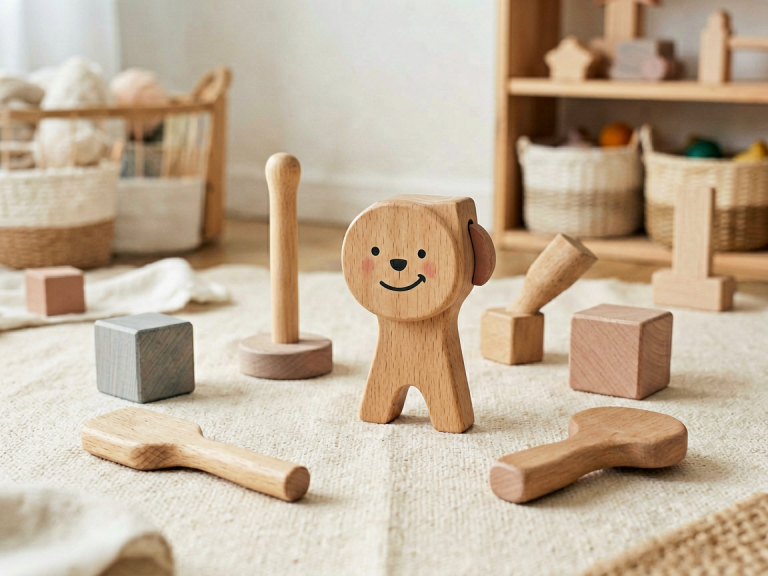
Wooden blocks, LEGO bricks, and magnetic tiles are quintessential spatial toys. When children stack, arrange, and balance blocks, they learn about gravity, symmetry, stability, and geometric relationships. A simple task like building a tower requires estimating height, aligning edges, and adjusting for weight distribution. More complex projects—such as constructing a bridge or a castle—demand planning and mental rotation: the child must visualize the finished structure before placing each piece. Research by Caldera et al. (1999) observed that preschoolers who played frequently with blocks scored higher on spatial visualization tests than those who did not. LEGO, in particular, offers graduated complexity through themed sets and architectural models, allowing children to gradually master increasingly intricate spatial challenges.
Jigsaw Puzzles
Puzzles are deceptively simple spatial training tools. Solving a jigsaw requires the solver to match shapes, colors, and edge contours while mentally rotating each piece to fit. This involves both mental rotation and spatial visualization. A study by Levine et al. (2012) at the University of Chicago found that children who completed puzzles more frequently showed superior spatial skills, especially in mental rotation. Moreover, puzzles encourage persistence and attention to detail—qualities that support deeper cognitive processing. For maximum benefit, experts recommend using puzzles with a variety of piece shapes and orientations, rather than those with large, easily identifiable sections.
Tangrams and Geometric Puzzles
Tangrams, consisting of seven geometric pieces that can be rearranged into countless shapes, are a classic tool for developing spatial flexibility. The challenge lies in understanding how the same set of pieces can produce different figures by rotating and flipping them. This exercises mental rotation and spatial visualization simultaneously. Similarly, pentominoes and pattern blocks allow children to explore tessellation, symmetry, and area. These puzzles require the child to hold a target shape in mind while manipulating real pieces—a dual load that strengthens working memory and spatial planning.
Models and Kits
Architecture and vehicle model kits, from wooden dinosaur skeletons to snap-together spacecraft, offer another avenue. Following step-by-step instructions forces children to decode two-dimensional diagrams into three-dimensional objects—a skill directly analogous to reading blueprints or technical drawings. However, open-ended model kits (e.g., K’NEX or Meccano) go further by allowing children to design their own structures, fostering creative spatial problem-solving.
—
Modern Innovations and Digital Tools
While classic toys remain invaluable, the digital age has introduced new ways to build spatial reasoning through interactive play.
Minecraft and Virtual Building Worlds
Minecraft, the iconic sandbox game, is essentially a 3D block-building environment. Players must navigate a three-dimensional grid, estimate distances, and plan structures while managing resources. The game’s creative mode removes survival constraints, letting children build anything from simple houses to complex redstone circuitry. Research suggests that even brief play sessions in Minecraft can improve mental rotation performance. The key is the game’s inherent spatial demands: digging tunnels requires understanding of volume; constructing a roof involves slant and angle calculations; and navigating the world relies on a mental map. Unlike passive video games, Minecraft is an active spatial playground.
Augmented Reality (AR) and Physical-Digital Hybrids
Toys like Merge Cube or Osmo’s Numbers/Tangram combine physical pieces with digital feedback. For example, Osmo uses a camera to track the movement of real tangram pieces on a table, and the game responds on the screen. This hybrid approach maintains the tactile benefits of physical manipulation while adding adaptive challenges and instant feedback. Similarly, AR building blocks allow children to see virtual structures overlaid on their real-world creations, helping them visualize how parts relate to wholes. These tools are especially effective for children who may struggle with purely spatial reasoning exercises, because the digital component offers scaffolding and motivation.
3D Printing Pens and Modeling Software
For older children and teenagers, 3D printing pens (e.g., 3Doodler) enable freeform three-dimensional drawing. By extruding heated plastic, users can literally “draw” in the air, creating objects that require continuous spatial awareness: they must understand how lines become volumes and how to support structures against gravity. More advanced tools like Tinkercad or SketchUp introduce computational spatial thinking, where children design models on a screen that will later be printed. This process demands mental rotation on both macro and micro scales—rotating the entire object to check proportions while adjusting individual vertices.
—
Choosing the Right Toys for Different Ages
The most effective spatial toys are those that match a child’s developmental stage.
Infants and Toddlers (0–2 years)
At this age, spatial awareness begins with bodily movement and simple object exploration. Stacking cups, nesting bowls, and soft building blocks are ideal. These toys teach concepts like inside/outside, on top/underneath, and size relationships. Look for large, safe pieces that babies can grasp and mouth. Shape sorters are particularly valuable because they require matching a three-dimensional shape to a corresponding hole—a foundational spatial skill. Even a simple ball rolling toward a toddler encourages visual tracking and depth perception.
Preschoolers (3–5 years)
This is a golden period for spatial development. Provide a variety of blocks (wooden, magnetic, interlocking), chunky puzzles (8–20 pieces), and simple construction kits. Encourage free building as well as copying simple patterns from cards. At this stage, children begin to engage in mental rotation—they can imagine what a shape looks like when turned upside down. Toys like LEGO Duplo, Magna-Tiles, and large floor puzzles work well. Avoid overwhelming them with too many pieces; instead, rotate toys to maintain novelty.
School-Age Children (6–11 years)
As children gain fine motor control and attention span, introduce more complex sets. Standard LEGO, K’NEX, Erector sets, and 100+ piece jigsaw puzzles are excellent. Tangrams, pentominoes, and 3D puzzles (like a wooden crystal ball or a small globe) challenge their growing spatial vocabulary. Digital tools like Osmo or Minecraft (in creative mode) can be introduced with appropriate screen-time limits. Encourage children to build from instructions but also to invent their own designs. Consider tasks like “build a bridge that can support a toy car” to combine spatial reasoning with engineering.
Adolescents and Teens (12+ years)
At this level, spatial reasoning can be refined through more sophisticated modeling and design toys. 3D printing pens, architectural model kits (e.g., Thames & Kosmos), and advanced robotic kits (Lego Mindstorms, VEX) require understanding of spatial relationships in dynamic systems. Digital tools like Blender, SketchUp, or even CAD software turn toys into real-world skills. Woodworking or model rocketry kits also provide authentic spatial challenges. Encourage participation in competitions like FIRST LEGO League or math Olympiad puzzles that involve geometry and spatial visualization.
—
Conclusion
Spatial reasoning is not merely a nice-to-have skill; it is a cornerstone of human cognition, vital for academic achievement, professional success, and everyday problem-solving. Toys that build spatial reasoning—whether humble wooden blocks or sophisticated digital sandboxes—offer children a joyful, self-directed path to developing this crucial ability. By engaging in construction, puzzle-solving, and three-dimensional exploration, children learn to think in ways that transcend the flat confines of a page or a screen.
The best part is that this learning happens naturally, through play. Parents and educators need not force drills or worksheets; simply providing a rich variety of spatial toys and encouraging open-ended exploration is enough. As the architect of a child’s mind, you have the privilege of selecting the building materials. Choose wisely—and watch their world expand from flat lines to infinite dimensions.