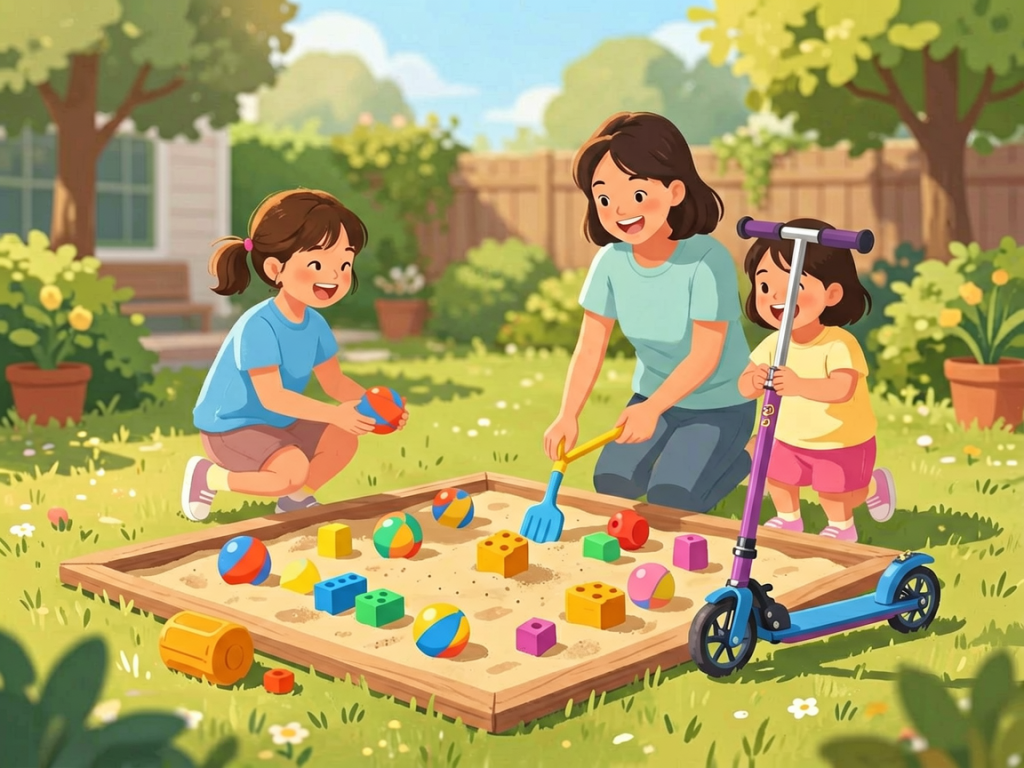
Three is the year the toy shelf has to become a stage. Until now, most toys were tools for a single action: stack, post, push, pour. At three, the child starts to build something and then tell you about it, which means the toys have to support a plan, a story, and a set of rules that exist in the child’s head before the play starts.
This is step three of the upgrade order. It covers two to three: what has genuinely finished, what should stay because it now serves a bigger purpose, and the order in which the new things should arrive so that each one lands on a skill that is already there.
The change that drives this step
Two-year-olds play with what is in front of them. Three-year-olds play with what is in their head, and use the objects to serve it. That single shift explains almost every toy decision on this rung.
It is why a three-year-old will ignore a beautiful wooden garage and spend forty minutes putting a family of figures to bed under a chair. The garage has one script. The chair and the figures have whatever script the child brings. Toys that leave room for a plan outlast toys that come with one.
What to retire at three
Knob puzzles. The knob exists to make a piece graspable before the fingers can pinch a flat edge. Once the child can pick up a flat piece and rotate it, the knob is a step down, not a help.
Single-shape sorters and posting boxes. Both are solved. If the child still enjoys them, they are being used as a container, which means the container can be a box.
Baby board books with one image per page. Keep the two the child is attached to, but the shelf needs books with a plot, a problem, and a repeated line the child can chant.
Toys that only do one thing when a button is pressed. The lesson was learned two years ago. The version of that lesson a three-year-old needs is a toy with parts that can be rearranged.
Anything with a character printed on it and no other function. A three-year-old does not need the branded version of a toy they already own. The character adds recognition, not play.
What to keep, and what it becomes
Chunky interlocking bricks. This is the backbone of the rung. At two they were a connecting exercise; at three they become a construction material for houses, zoos, and ramps. Add a base plate and a handful of windows rather than a new set.
The pretend-play starter. Play food, a pot, a doll, a cloth. At three it expands rather than retires: a doctor’s bag, a set of keys, a small suitcase, three figures that can be a family. Props that suggest a scene beat props that dictate one.
Crayons and paper. The marks now get names before they are made. Keep the paper large and the colour range small; six colours invites choosing, twenty-four invites tipping.
Blocks, ball, sand and water tools. All still working, all still open-ended. The ball becomes a target game, the sand tools become a measuring experiment.
The ride-on. If it pedals, it graduates to real steering. If it only scoots, it will be outgrown this year.
What to add, in this order
Seven additions, sequenced. The first three can arrive in the first month or two of the year; the last four belong later, when the earlier ones are being used without prompting.
| Order | Add at this step | What it unlocks | Move to the next when |
|---|---|---|---|
| 1 | Framed puzzles, nine to twelve pieces | Picture logic: the frame removes guessing, so the child starts matching the image | Completes a twelve-piece frame puzzle without help |
| 2 | More chunky bricks, a base plate, simple build cards | Building to a plan rather than by impulse | Copies a three-step build card, then modifies it |
| 3 | Pretend expansion: costumes, doctor kit, small figures and vehicles | Multi-scene stories with roles, which is where language and negotiation grow | Plays a scene for ten minutes and narrates it |
| 4 | Blunt-tip scissors, glue stick, scrap paper | Two hands doing different jobs, which is the physical gate for all later tool use | Cuts across a strip of paper, not just snips the edge |
| 5 | Counting and matching sets: peg boards, counting bears, number puzzles | One-to-one correspondence, the real foundation of number sense | Counts five objects by touching each once |
| 6 | Pedal trike or balance bike | Coordinating steering with propulsion, and judging speed | Pedals and turns a corner without stopping to think |
| 7 | Matching and memory games, three to six pairs, no winner | Holding information in mind and taking turns without a scoreboard | Waits for a turn and remembers two card positions |
What to leave off the shelf for another year
Puzzles with twenty-four pieces or more and no frame. The frame is doing real work at three: it limits the search space. Without it, most three-year-olds stall at the edge pieces and lose interest.
Small interlocking bricks. The size is the issue, not the concept. Small bricks need a grip that can press and release precisely, which is closer to four.
Board games with a winner. Cooperative games with a shared goal work near three. Anything that produces a loser waits, because the emotional skill for losing arrives later than the counting skill for the game.
Letter and number worksheets. A three-year-old learns sounds before symbols, and learns both faster through play than through tracing. The reading line in this site’s skill paths starts with sounds for a reason.
Two mistakes that stall the third year
Building a shelf of single-script sets. A themed set with one correct way to play gets used twice and then becomes furniture. The three-year-old shelf should be mostly materials, not sets: bricks, figures, props, paper, and one or two things with rules.
Adding the fourth-year toys in the third year. The most common version of this is the small-brick set bought because an older sibling has one. It gets built by an adult, admired for a day, and then dismantled into a drawer. Waiting a year costs nothing and saves the toy.
Details worth keeping from the parallel guides
When two ages share one shelf. A two-year-old and a four-year-old in the same room need one shelf they can both reach and one they cannot. Put the props with a wide floor and a high ceiling on the shared shelf — blocks, play dough, pretend sets — because the same object reads as stacking to the two-year-old and as a script to the four-year-old. Keep the age-specific items, the jigsaw puzzles and the first games with rules, on the higher shelf, and rotate only those. Shared props make shared play; shared rules make arguments.
That is also the test for what to add at this step: if a new toy needs a rule the two-year-old cannot follow, it belongs on the edge shelf rather than the shared one. The rung below is the toy path for two-year-olds, and the age page for this step is the toy path for three-year-olds.
Frequently Asked Questions
What toys should a three-year-old have?
Mostly open-ended materials plus a few things with rules: chunky bricks and a base plate, pretend props and small figures, framed puzzles of nine to twelve pieces, crayons and scissors, counting sets, and a ride-on. Seven categories cover the year.
Is three too early for board games?
Not for cooperative games with one shared goal, where everyone wins or loses together. Competitive games with a winner usually work better after the fourth birthday, when losing becomes survivable.
How do I know when to move from chunky bricks to small ones?
When the child can press two chunky bricks together and pull them apart without bracing one against the floor, and can pick up a coin-sized piece with thumb and finger. That is usually a four-year-old hand.
Where this step sits in the toy path
Step three of six. The full map is in the toy path by age, and the rung you are leaving is the toy path for two-year-olds.
Next in the series: From Three to Four: Which Toys to Retire, Keep, and Add.
The age page for this rung is the toy path for three-year-olds, and the counting line continues in from blocks to number lines.