Four is the year toys start having instructions. Until three, almost everything was open-ended or single-purpose. At four, the child can follow a diagram, keep a rule in mind for the length of a game, and work toward a result that is not visible yet. That is a different kind of play, and it needs a different shelf.
This is step four of the upgrade order: three to four, what leaves, what stays, and the order the new things should arrive. The theme of this step is plans. Every addition below asks the child to hold an idea and work toward it.
What changes between three and four
Three-year-olds play the scene. Four-year-olds plan the scene, assign the roles, and object when someone breaks the rules they invented. The same shift shows up in construction: at three the tower is the goal, at four the tower is meant to be a castle with a gate.
Two abilities make that possible. The first is following a sequence of steps that someone else set, which is why instruction cards start working this year. The second is tolerating a rule that costs something, which is why the first real games arrive now and not earlier.
What to retire at four
Framed puzzles of nine to twelve pieces. The frame was a search-space limit. At four it is a ceiling. Move to jigsaws without a frame, starting at twenty-four pieces.
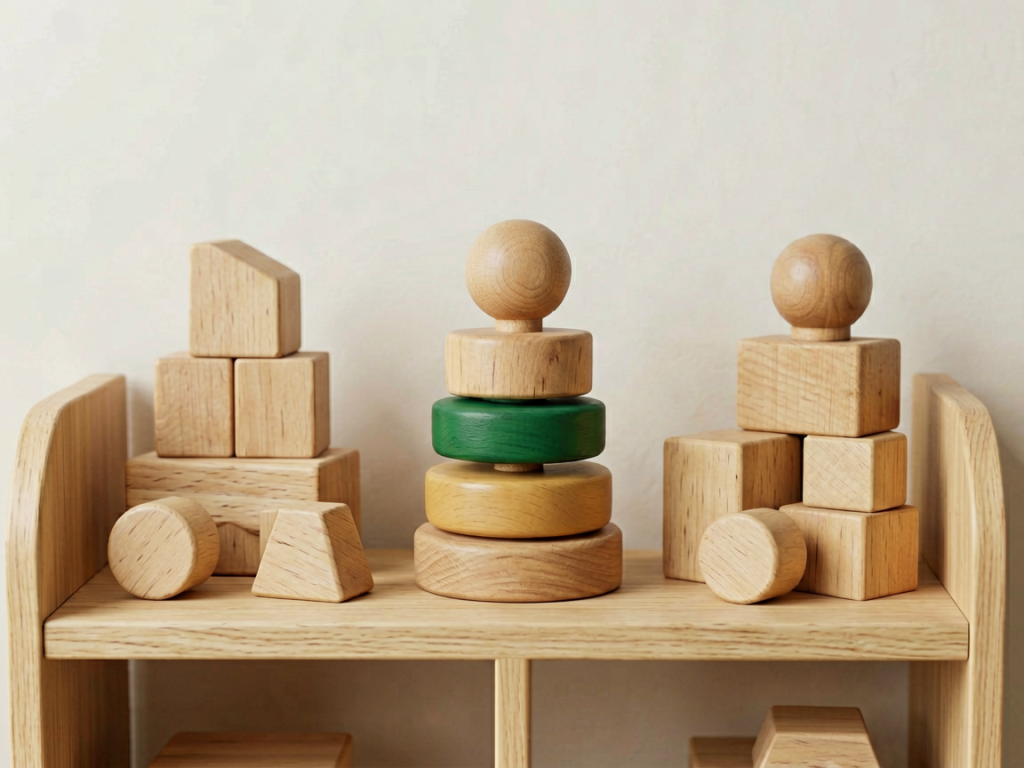
Toddler stacking and nesting sets. Rings on a post and cups that nest are solved. If they are still in use, it is as a pretend prop, and one set is enough for that.
First ride-on and basic scoot-along toys. Replaced by something with pedals or balance, which the child can now actually control.
Baby pretend kits. The first doctor kit with three chunky pieces is done. What replaces it is a kit with more instruments and a bag, because the play is now about the procedure, not the object.
Matching games with three pairs. Memory with three pairs is solved by luck. Move to six to ten pairs, or to a game with a rule that can be broken.
What to keep, and what it becomes
Chunky bricks. Still the most-used toy of the year, but the job changes from building to planning: a base plate, a few wheels, and a set of windows turn a pile into a project. Do not replace them, extend them.
Pretend props and figures. The most valuable thing on the shelf at four, because the stories now have plots, problems, and other children in them. Add props that imply a role: a clipboard, a torch, a set of keys, a bag.
Scissors, glue, and paper. Fine motor work continues all year. What changes is the ambition: cutting along a line rather than across a strip, and gluing pieces into a picture rather than a collage.
Counting sets. One-to-one correspondence becomes counting to twenty and comparing quantities. Keep them, and add a dice so counting becomes a game mechanic.
The trike or balance bike. Still in use, and still the best whole-body toy on the shelf.
What to add, in this order
Eight additions for the year, in sequence. The pattern is deliberate: first the child follows someone else’s plan (puzzles, instruction cards), then a rule (games), then starts making their own plans (drawing, patterns, builds that need a diagram).
| Order | Add at this step | What it unlocks | Move to the next when |
|---|---|---|---|
| 1 | Jigsaw puzzles, twenty-four to forty-eight pieces, no frame | Working from a picture while searching, and tolerating a long unfinished task | Finishes a forty-eight-piece puzzle in one sitting |
| 2 | Small interlocking bricks with simple instruction cards | Reading a diagram and building to it, which is a plan made by someone else | Follows a ten-step card and corrects a mistake in it |
| 3 | First competitive game with one rule and a dice | Taking turns under a rule, and finishing something that has a loser | Plays a full game and survives losing without leaving the table |
| 4 | Drawing with intent: stencils, step-by-step drawing cards, shape cutting | Representation: making a mark that stands for a specific thing on purpose | Draws a person with a head, body, and limbs, and names it |
| 5 | Pattern and sequencing: threading beads, pattern cards, tangram-style shapes | Recognising and continuing a rule, the same thinking that later powers number patterns | Continues an AB and an ABC pattern without help |
| 6 | Connecting track: train track or a simple marble run | Designing a path and debugging it when the ball stops halfway | Rebuilds a track after a failure instead of abandoning it |
| 7 | Simple science tools: magnifier, balance scale, measuring cups | Asking a question and testing it, rather than being told the answer | Predicts which of two objects is heavier, then checks |
| 8 | Balance bike or pedal bike with a real frame | Balance and steering as separate skills, then together | Coasts with feet off the ground for several seconds |
What to leave off the shelf for another year
Puzzles with a hundred pieces. The persistence is not there yet, and a puzzle that takes three days to finish usually does not get finished.
Games with more than two rules. A four-year-old can hold one rule and one turn order. Add a second rule and the game becomes an adult explaining while the child waits.
Strategy games with a winner and a plan. Checkers, chess, and anything with a capture mechanic belong after five, when the child can think about what the other player will do.
Screen-based coding toys. The sequencing skill is real, but it is being built well by pattern cards, tracks, and instruction builds. The screen version lands better at six.
Two mistakes that stall the fourth year
Turning the shelf into a curriculum. Four is the age when workbooks and flashcards start looking appealing, because the child can finally sit still for them. They are the least efficient way to build the same skills, and they crowd out the toys that do it through play.
Retiring pretend play too early. Because four-year-olds can now do “real” tasks like puzzles and games, pretend props often get cleared away as babyish. In fact pretend play is at its richest this year, and it is where language, negotiation, and emotional regulation are practised.
Frequently Asked Questions
What puzzles should a four-year-old be doing?
Twenty-four to forty-eight pieces, without a frame. The exact number matters less than the child finishing in one sitting: a puzzle that takes three days usually gets abandoned.
When can a child start real board games?
Around four, with one rule and a dice, and with an adult modelling how to lose. Multi-rule games and strategy games belong after five, once thinking about the other player’s move becomes possible.
Are small bricks appropriate at four?
Yes, with instruction cards, and with the pieces stored out of reach of younger siblings. The size is fine for a four-year-old hand; the risk is a two-year-old in the same room.
Where this step sits in the toy path
Step four of six. The full map is in the toy path by age, and the rung you are leaving is the toy path for three-year-olds.
Next in the series: From Four to Five: Which Toys to Retire, Keep, and Add.
The age page for this rung is the toy path for four-year-olds, and the shape-and-space line continues in blocks to blueprints.
The board game branch of this rung, where first real rules arrive, is first board games from ages three to six.