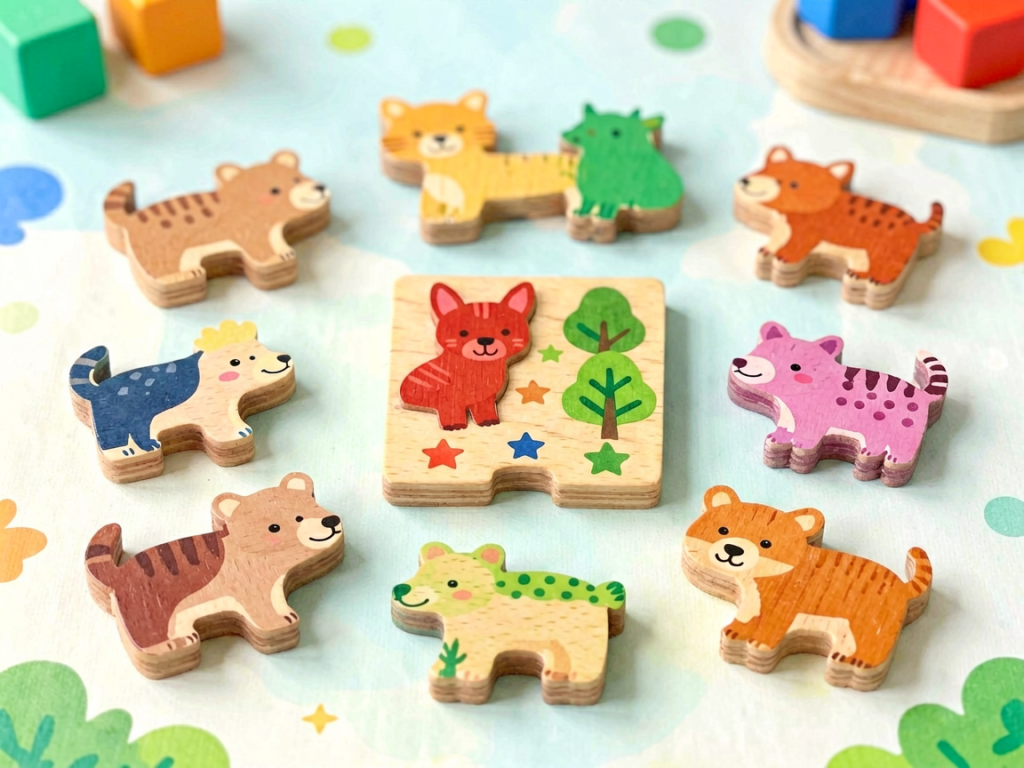
The second birthday does not change what a child likes. It changes what a child can do with the same object, and that is what makes the toy shelf obsolete overnight. Toys that were solved by mouthing are now solved by naming. Toys that were solved by grabbing are now solved by stacking, sorting, and pretending.
This is step two of the upgrade order. It covers the twelve months from two to three: what to take off the shelf, what earns another year, and the exact order to add the new things, because adding them out of order is why so many two-year-olds end up with a shelf they tip out and walk away from.
How to tell a toy has finished its stage
Before anything moves, run the same four questions on every toy in the room. They work at every birthday from one to six, which is why this series uses them at each step.
Is it solved without effort? If the child gets it right every time and stops after twenty seconds, the toy has done its job. Mastery is the retirement signal, not boredom.
Is it being used in a new way? A stacking cup used as a drum, a scoop, and a hat is not finished. Open-ended toys graduate rather than retire.
Is the failure still interesting? The right toy produces attempts, not tantrums. If the child tries, misses, and tries again, it stays.
Can the body do the next step? Two hands doing different jobs, holding one piece while attaching another, is the physical gate for most of what comes next. If it is not there yet, the new toy will be handed back to you.
What to retire at two
Five things usually leave the shelf around the second birthday. None of them need to be thrown away, but keeping them visible makes the new shelf harder to use.
Rattles and teethers. Their job was mouthing and grabbing. Both are finished.
Single-action cause-and-effect toys. The pop-up box that opens when one button is pressed has taught its lesson: my action produces an effect. A two-year-old needs the next version of that lesson, which is that actions can be sequenced.
The push-along walker. Walking is now automatic. If it converts into a wagon for hauling blocks, keep that part; the upright frame is done.
One-piece knob puzzles. A puzzle with one recess teaches nothing once the child can place it without looking. Move to three to six pieces with knobs, then to framed puzzles without them.
Baby board books with a single image per page. Keep two or three that the child loves, but the shelf now needs books with a simple story and repeated phrases, because the language job has moved from naming to combining.
What to keep, and what it turns into
The most valuable toys of the first year are also the most valuable of the second, because their job changes rather than ends. This is worth saying plainly: a two-year-old does not need a new shelf, they need a re-read of the old one.
Nesting cups become a counting set, a pouring set in the bath, and a size-ordering challenge. Line them up and let the child find the mistake.
Blocks become a tower with a purpose, then a wall for a pretend animal, then a road. They also become a sorting task: all the red ones here, all the big ones there.
A ball moves from rolling to kicking to throwing at a target. It is the only toy on the shelf that trains the whole body at once.
Board books stay, at a higher level: books with a repeated refrain invite the child to finish the sentence, which is the bridge from single words to phrases.
Posting and shape sorting survive as a speed challenge, then as a two-attribute task: this shape goes here, but only the blue one.
What to add, in this order
The order below is not a preference. Each item borrows a skill the item before it built, so adding number five before number two produces a toy that gets ignored.
| Order | Add at this step | What it unlocks | Move to the next when |
|---|---|---|---|
| 1 | Knob puzzles, three to six pieces | Shape recognition and deliberate placement, one piece at a time | Solves all six without turning the piece over repeatedly |
| 2 | Chunky interlocking bricks | Holding one piece steady while attaching another, then pulling apart | Builds a stack of four connected bricks and names it |
| 3 | Pretend-play starter: play food, a pot, a doll with a cloth | Using one object to stand for another, which is the root of all symbolic play | Feeds the doll, then narrates what the doll is doing |
| 4 | Fat crayons, paint sticks, large paper | Intentional marks, then a name for the mark: “that is the dog” | Draws a circle and tells you what it is |
| 5 | Sorting with two attributes: colour and size together | Holding two rules in mind at once, the beginning of classification | Sorts a mixed pile by colour, then by size, without a prompt |
| 6 | Ride-on or balance trike | Steering, pedalling, and judging distance while moving | Steers around a cone without stopping |
| 7 | Sand and water tools: scoop, funnel, sieve | Volume, flow, and the first real cause-and-effect experiments | Pours to fill a container without spilling most of it |
Spread those seven across the year rather than the birthday week. Two or three new things in the first month, the rest as the earlier ones are mastered. A child who receives the whole table at once gets seven toys and no sequence, which is the opposite of what the sequence is for.
What to leave off the shelf for another year
Three things look age-appropriate at two and are not.
Puzzles with twenty or more pieces. A two-year-old solves by shape, not by picture, so extra pieces are just extra variables. Twelve pieces is the realistic ceiling before the third birthday.
Small interlocking bricks. The chunky version is the right size for two. The small version needs a pincer grip that can also apply pressure, which is a three-year-old hand.
Games with a winner. Cooperative games with one shared goal can work near three. Anything with a scoreboard waits, because losing gracefully is a skill that arrives with the fourth year, not the second.
Two mistakes that stall the second year
Buying the next stage early. A toy that is eighteen months ahead is not a challenge, it is a rejection. The child tries, fails, and learns that this shelf is not for them. The reliable rule is: if the child cannot succeed at the simplest version of the toy within a few minutes, it is early.
Retiring the open-ended toys instead of the closed ones. The temptation at two is to clear out the baby things and buy a shelf of themed sets. But the themed set has one script, and the blocks have a hundred. Keep the blocks, the cups, the ball, the paper. The single-script toys are the ones that get abandoned first.
Frequently Asked Questions
Should a two-year-old still have baby toys?
Only the open-ended ones. Nesting cups, blocks, balls, and board books keep working because their job changes with the child. Rattles, teethers, and single-button toys have finished and can be stored.
How many puzzles does a two-year-old need?
Three is enough: one easy knob puzzle, one framed puzzle of six to twelve pieces, and one that is currently slightly too hard. Rotating which of the three is visible does more than owning ten.
When should pretend play toys be introduced?
Once the child uses one object as if it were another, usually between eighteen months and two and a half years. A block that becomes a phone is the signal; a play kitchen before that signal tends to sit unused.
Where this step sits in the toy path
Step two of six. The full map is in the toy path by age, and the rung you are leaving is the toy path for one-year-olds.
Next in the series: From Two to Three: Which Toys to Retire, Keep, and Add.
The age page for this rung, with the full category breakdown, is the toy path for two-year-olds.
For the puzzle line specifically, what comes after beginner puzzle toys continues the same sequence past this step.