The Best Toys for Learning Through Play: Unlocking Child Development Through Fun
Play is the language of childhood. It is through play that children first explore the world, test boundaries, and build the cognitive, social, and emotional skills that will serve them for a lifetime. Yet in a market flooded with flashy, noisy, and often passive toys, parents and educators face a critical question: Which toys truly support learning through play? The answer lies not in the most expensive or most popular products, but in toys that encourage active engagement, imagination, problem-solving, and collaboration. This article explores the best toys for learning through play, organized by developmental domains, and explains why these carefully chosen items are worth every penny.
The Importance of Play in Child Development
Before diving into specific toys, it is essential to understand why play itself is so powerful. Research in developmental psychology and neuroscience consistently shows that play is not merely a break from learning—it *is* learning. When children play, they practice executive functions such as planning, self-regulation, and flexible thinking. They develop language skills through social interactions, strengthen fine and gross motor abilities, and learn to manage emotions like frustration and excitement. The best learning-through-play toys are those that scaffold these natural processes, offering just enough challenge to keep a child engaged without causing overwhelming frustration. They are open-ended, meaning there is no single “right” way to use them, and they grow with the child, providing new layers of complexity over months or even years.
Building Blocks and Construction Sets: Foundations of STEM Learning
Perhaps no category of toys is more universally praised by educators than building blocks and construction sets. From simple wooden unit blocks to sophisticated magnetic tiles and interlocking plastic bricks, these toys are the gold standard for learning through play.
What they teach: Spatial reasoning, early engineering concepts, cause and effect, mathematical thinking, and persistence. When a child stacks blocks and watches them tumble, they are not just making a mess—they are conducting an experiment in gravity, balance, and stability. As they build taller structures, they naturally explore symmetry, weight distribution, and geometric relationships.
Recommended examples: Classic wooden unit blocks (like those from Melissa & Doug) allow for infinite creativity without predetermined outcomes. Magnetic tiles (such as Magna-Tiles or PicassoTiles) add the magical element of magnetism, enabling children to build 3D shapes that defy gravity. For older preschoolers and elementary-aged children, interlocking systems like LEGO Classic or DUPLO encourage following step-by-step instructions (a key literacy skill) while also leaving room for free-form creation.
Why they work: These toys are inherently open-ended. A set of 100 blocks can become a castle one day, a bridge the next, and a spaceship the day after. This flexibility ensures that play remains fresh and challenging. Moreover, construction play often involves social negotiation—children must agree on a plan, share resources, and solve conflicts—which builds crucial social-emotional skills.
Puzzles and Problem-Solving Toys: Enhancing Cognitive Skills
Puzzles are another staple of learning-through-play toy collections, and they come in forms far beyond the traditional jigsaw. From shape sorters for toddlers to logic puzzles for older children, these tools sharpen analytical thinking and pattern recognition.
What they teach: Visual-spatial reasoning, logical deduction, memory, and fine motor control. When a toddler tries to fit a triangle block into a square hole (and fails), they learn to compare shapes, adjust their strategy, and eventually succeed. For older children, puzzles like tangrams, Rubik’s Cubes, or 3D brainteasers require sustained attention and systematic trial-and-error.
Recommended examples: For infants and toddlers, simple shape sorters and stacking rings lay the groundwork for categorization and sequencing. Preschoolers benefit from floor puzzles with 24–48 pieces that encourage collaboration. For ages 5 and up, look for logic games like “ThinkFun” brand puzzles (such as Rush Hour or Chocolate Fix) that present a problem and a constraint, teaching children to work through multiple steps toward a solution. Jigsaw puzzles with themes like maps, animals, or the solar system also introduce subject-specific knowledge in a hands-on way.
Why they work: Puzzles offer immediate feedback—either the piece fits or it doesn’t—which helps children self-correct without adult intervention. This fosters a growth mindset: when a child struggles, they learn that persistence, not innate ability, leads to success. Moreover, puzzles can be done alone or with others, developing both independence and teamwork.
Role-Playing and Imaginative Play: Social and Emotional Growth
Dress-up clothes, play kitchens, doctor kits, and dollhouses may seem like simple fun, but they are some of the most sophisticated learning tools available. Imaginative or pretend play is where children rehearse real-life scenarios, experiment with identity, and develop empathy.
What they teach: Language and communication skills, emotional regulation, perspective-taking, and cultural understanding. When a child pretends to be a parent caring for a baby doll, they are exploring nurturance and responsibility. When they role-play a trip to the grocery store, they practice sequencing, money concepts, and social scripts.
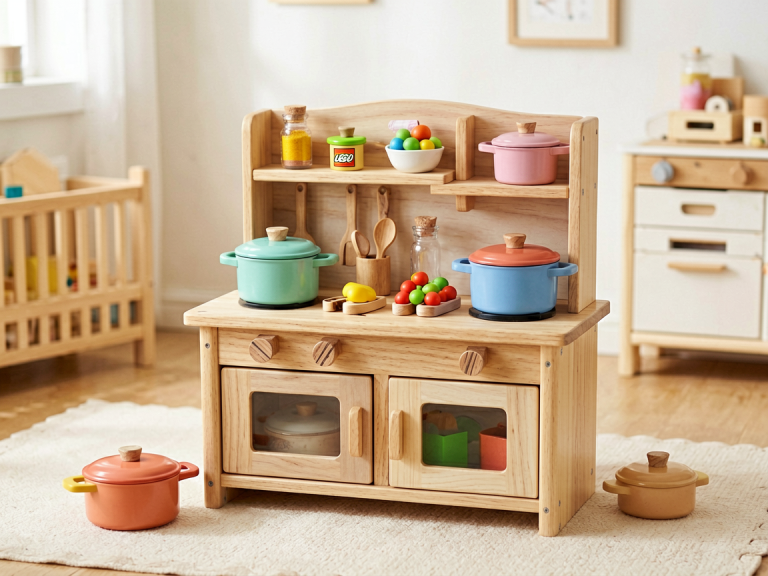
Recommended examples: High-quality wooden play kitchens (like those from KidKraft or IKEA) with utensils and fake food encourage open-ended cooking and serving scenarios. Costume sets—whether a firefighter’s hat, a princess dress, or a doctor’s coat—let children step into different roles. Puppets and puppet theaters are especially powerful for language development, as children often speak more freely through a puppet character. Play figures and miniature animals (such as Schleich or Playmobil) allow children to create entire worlds and narratives.
Why they work: Imaginative play is child-directed, meaning the child controls the story. This autonomy builds confidence and creativity. Additionally, social pretend play with peers requires negotiation, compromise, and shared imagination—all critical skills for school and life. Research also shows that children who engage in rich pretend play score higher on measures of theory of mind (the ability to understand others’ mental states).
Art and Craft Supplies: Creativity and Fine Motor Skills
Art supplies are often overlooked as “learning” toys because they seem purely creative, but in reality, they are powerhouses of developmental benefit. From crayons and finger paints to modeling clay and collage materials, art builds both brain and body.
What they teach: Fine motor skills and hand-eye coordination (crucial for future writing), color and shape recognition, cause-and-effect (mixing colors), planning and follow-through, and emotional expression. Art also teaches children that there is no single right answer—a liberating lesson in a world full of standardized tests.
Recommended examples: For toddlers, large, washable crayons and non-toxic finger paints are essential. As children grow, introduce safety scissors, glue sticks, construction paper, and a variety of textures like felt, feathers, and beads. Modeling compounds like Play-Doh or air-dry clay strengthen small hand muscles. For older children, consider watercolor sets, origami paper, or simple sewing kits. Age-appropriate easels or art stations provide a dedicated space for messy creativity.
Why they work: Art is process-oriented, not product-oriented. When a child squeezes paint onto a page, they are learning about viscosity and pressure. When they snip paper, they practice bilateral coordination. Moreover, art allows children to communicate feelings they cannot yet put into words, supporting emotional health.
Musical Toys: Auditory Development and Coordination
Music is deeply connected to brain development, especially in the areas of language, math, and memory. Simple musical toys give children the opportunity to explore rhythm, pitch, and tempo in a playful, hands-on way.
What they teach: Auditory discrimination, pattern recognition, gross and fine motor coordination, and an early appreciation of culture. Playing a drum requires bilateral movement; shaking a rattle builds cause-and-effect understanding; singing along to a simple instrument supports vocal development and listening skills.
Recommended examples: For babies, rattles, bells, and soft squeaky toys introduce sound-making. For toddlers, xylophones, maracas, and small drums are ideal. As children enter preschool and beyond, consider a high-quality ukulele (small and easy to hold), a recorder, or a simple keyboard with color-coded notes. Hand percussion sets with multiple instruments encourage group play and turn-taking.
Why they work: Musical play is inherently joyful. Children are motivated to repeat actions that produce pleasing sounds, which reinforces neural pathways. Additionally, making music together—in a family jam session or a playgroup—builds social bonds and teaches listening and cooperation.
Board Games and Strategy Games: Critical Thinking and Cooperation
Board games are perhaps the ultimate learning-through-play tool for school-age children. They combine cognitive challenge with social interaction, requiring players to think strategically, manage emotions, and follow rules.
What they teach: Mathematical skills (counting, probability, resource management), reading comprehension (game cards and instructions), strategic planning, delayed gratification, and sportsmanship. Cooperative games—where players work together against the game itself—teach teamwork over competition.
Recommended examples: For ages 3–5, simple matching games like “Memory” or “Go Fish” build memory and turn-taking. For ages 5–7, try “Hoot Owl Hoot!” (a cooperative color-matching game) or “The Sneaky, Snacky Squirrel Game” (fine motor and counting). For ages 7 and up, classics like “Catan Junior,” “Ticket to Ride: First Journey,” and “Carcassonne” introduce resource management and spatial reasoning. For older kids, “Settlers of Catan” or “Azul” offer deep strategic challenge.
Why they work: Board games demand that children sustain focus over a longer period than most other activities. They also provide a safe space to experience losing—an essential life lesson. When parents or teachers play alongside children, they can model grace, resilience, and problem-solving, making the experience even richer.
Outdoor and Active Play Toys: Physical Health and Exploration
Learning is not confined to the indoors. Active play toys that encourage movement, balance, and exploration are vital for overall development, especially in an era when children spend increasing time in front of screens.
What they teach: Gross motor skills, body awareness, risk assessment, sensory integration, and scientific curiosity about the natural world. Climbing, jumping, and running build strength and coordination, while activities like digging in a sandbox or observing insects foster investigative thinking.
Recommended examples: For young children, ride-on toys (like balance bikes or push cars) develop leg strength and balance. Tricycles and later bicycles with training wheels teach coordination and spatial awareness. Sand and water tables offer endless opportunities for sensory exploration and scientific experimentation (sinking vs. floating, wet vs. dry). A simple ball—whether for throwing, kicking, or rolling—is perhaps the most versatile active toy. For nature-based learning, consider magnifying glasses, bug catchers, and gardening tools sized for small hands.
Why they work: Physical activity increases blood flow to the brain, improving cognitive function. Outdoor play, in particular, reduces stress and improves attention. When children build a fort from sticks or dig a channel in the sand, they engage in real-world problem-solving that no app can replicate.
Choosing the Right Toys: Age-Appropriateness and Safety
While the toys discussed above are excellent choices, their effectiveness depends on being age-appropriate. A complex logic puzzle meant for a 10-year-old will frustrate a 4-year-old; a simple rattle will bore an 8-year-old. When selecting toys for learning through play, consider these guidelines:
- Birth to 12 months: Focus on sensory exploration—soft blocks, rattles, textured balls, and mobiles.
- 1 to 3 years: Push-pull toys, simple shape sorters, stacking toys, and pretend play items like phones and dolls.
- 3 to 5 years: Construction sets with larger pieces, puzzles with 12–24 pieces, art supplies, dress-up clothes, and sand/water tables.
- 5 to 7 years: More complex building sets (e.g., magnetic tiles or LEGO), board games that require counting and reading, and beginner musical instruments.
- 7 years and up: Advanced board games, strategy puzzles, science kits, and sports equipment.
Safety is equally crucial. Always check for small parts that could pose choking hazards, ensure materials are non-toxic, and inspect toys for sharp edges or durable construction. The best toy is one that a child can use safely and independently.
Conclusion: The Power of Playful Learning
The best toys for learning through play are not necessarily the ones with the most batteries or the loudest commercials. They are the ones that invite a child to wonder, to try, to fail, and to try again. Whether it is a set of wooden blocks, a deck of cards, or a patch of dirt in the backyard, the true magic lies in the interaction—between child and toy, child and caregiver, and child and the world. By choosing open-ended, engaging, and developmentally appropriate toys, we give children the gift of joyful discovery. And that is the most powerful lesson of all.