From Play to Payoff: How Toys Cultivate Problem-Solving Skills in Childhood
Introduction
Problem solving is often hailed as the cornerstone of critical thinking, creativity, and adaptive intelligence. It is the cognitive process that enables individuals to identify obstacles, generate strategies, evaluate alternatives, and implement solutions. While traditional education systems emphasize direct instruction and structured exercises, a growing body of developmental psychology and neuroscience research highlights the profound role of play—specifically, play with toys—in nurturing these very abilities. Toys are not mere sources of entertainment; they are meticulously designed (or spontaneously repurposed) tools that present children with miniature, manageable problems. From a toddler struggling to fit a square block into a square hole to an older child debugging a complex LEGO mechanism, each play session is an implicit training ground for problem solving. This article explores the multifaceted ways in which toys support problem-solving development, examining the cognitive mechanisms involved, the types of toys that are most effective, and the practical implications for parents and educators.
The Cognitive Foundations of Problem Solving Through Play
Problem solving, in its essence, involves three core components: recognizing a discrepancy between the current state and a desired goal, generating potential actions to bridge that gap, and executing those actions while monitoring feedback. Toys provide an ideal environment for practicing each of these steps. First, a toy often presents a clear, tangible goal—stacking rings in order, completing a puzzle, or building a tower that does not topple. The child must first perceive the mismatch between the chaotic pile of pieces and the finished image on the box, thereby engaging executive attention and goal-setting. Second, toys encourage hypothesis generation: “If I put this piece here, will it fit? If I rotate it, will it be better?” This trial-and-error process is the engine of inductive reasoning. Third, toys offer instantaneous, non-judgmental feedback. A block that does not balance provides immediate sensory information that the child can use to revise their strategy. This cycle—plan, act, observe, adjust—is identical to the scientific method and to real-world problem solving in engineering, medicine, and everyday life.
Moreover, toys scaffold problem-solving complexity. A simple shape sorter for an 18-month-old requires only a single matching operation. But a construction set for a six-year-old demands sequencing, spatial visualization, and error correction across multiple steps. As children progress through different toy types, their cognitive flexibility, working memory, and inhibitory control are progressively challenged. This aligns with Vygotsky’s concept of the “zone of proximal development”: a well-chosen toy sits just beyond the child’s current independent capability, offering enough challenge to promote growth without causing overwhelming frustration.
Types of Toys and Their Specific Problem-Solving Mechanisms
Not all toys support problem solving equally. The most effective ones are open-ended, require active manipulation, and incorporate inherent constraints that mimic real-world complexities.
Construction Toys: Engineering Thinking in Miniature
Construction toys—LEGO bricks, Magna-Tiles, wooden blocks, K’Nex—are perhaps the most direct problem-solving tools. When a child attempts to build a stable bridge, they must confront structural principles: weight distribution, symmetry, balance, and friction. If the bridge collapses, the child must diagnose why: Was one side heavier? Were the pieces not interlocked properly? This is a rudimentary form of root-cause analysis. Construction play also demands planning. A child building a spaceship must sequence steps: first build the base, then the cockpit, then the wings. This mirrors project management and requires the child to inhibit impulsive actions in favor of a longer-term goal. Research by Oostermeijer, Boonen, and Jolles (2014) found that children who frequently engaged with construction toys performed better on mathematical problem solving tasks, likely because the spatial reasoning and logical sequencing transferred directly to algebraic and geometric challenges.
Puzzles: Pattern Recognition and Constraint Satisfaction
Jigsaw puzzles are classic problem-solving devices. Each piece has a unique shape and image fragment, and the child must deduce its correct location based on color, edge patterns, and interlocking geometry. This requires the solver to manage multiple constraints simultaneously: the piece’s orientation, its neighbors’ shapes, and the overall picture. Puzzles also teach the valuable strategy of breaking a large problem into smaller subproblems—first assembling the edge pieces, then grouping by color. Studies have shown that regular puzzle play in early childhood correlates with stronger visuospatial working memory and mental rotation abilities, both of which are predictive of later success in science, technology, engineering, and mathematics (STEM) fields. Moreover, puzzles foster persistence. A child who abandons a puzzle after two minutes learns nothing; one who wrestles with a difficult section for ten minutes is practicing frustration tolerance and self-regulation—critical components of complex problem solving.
Board Games: Strategic Thinking and Social Problem Solving
While often overlooked, board games such as chess, checkers, Settlers of Catan, or even simple cooperative games like “Hoot Owl Hoot!” are rich problem-solving environments. They require players to anticipate opponents’ moves, weigh short-term gains against long-term risks, and adapt strategies based on new information. In cooperative games, children must communicate, negotiate, and pool their mental resources to solve a shared challenge—for instance, moving all the owl tokens to the nest before the sun rises. This teaches social problem solving: how to listen to others’ ideas, compromise, and build consensus. Competitive games, on the other hand, teach the value of error analysis. A child who loses a game of checkers can replay the moves in their mind, identifying the moment when a better choice was possible. This metacognitive reflection—thinking about one’s own thinking—is a hallmark of expert problem solvers.
Building and Coding Toys: Computational Problem Solving
In the digital age, toys like programmable robots (e.g., Sphero, Ozobot, LEGO Mindstorms) and coding board games (e.g., Robot Turtles) introduce computational thinking: decomposition, pattern recognition, abstraction, and algorithm design. To make a robot move through a maze, a child must break the task into discrete steps (“forward, turn left, forward”), test the sequence, debug errors, and iterate. This process mirrors the engineering design cycle and directly builds the kind of logical, step-by-step reasoning demanded in modern problem solving. Crucially, these toys make abstract concepts tangible. A wrong command results in a robot crashing into a wall—an immediate, concrete consequence that teaches cause and effect far more vividly than a textbook worksheet.
Role-Playing and Pretend Play: Open-Ended Problem Solving
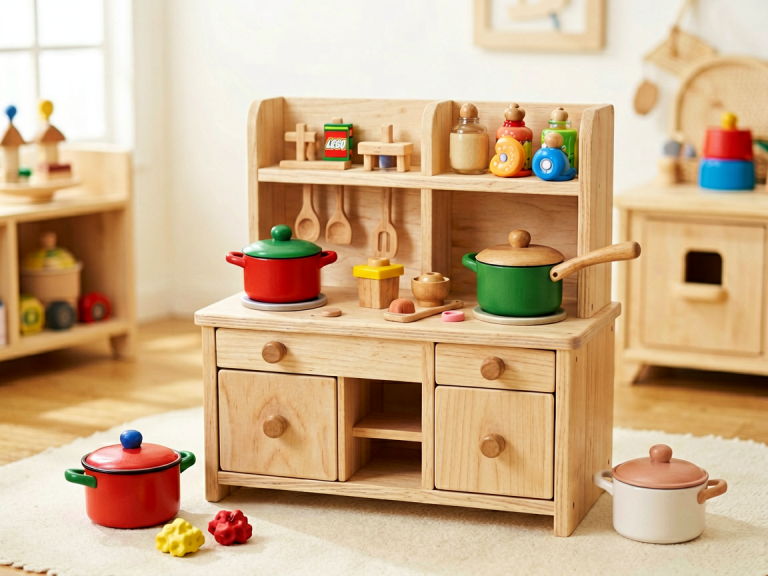
Not all problem-solving toys require structured pieces. A cardboard box, a set of toy kitchen utensils, or a pile of dress-up clothes can become a hospital, a spaceship, or a restaurant. In pretend play, children spontaneously generate problems: “Our spaceship has run out of fuel! What do we do?” They must then negotiate solutions, often using imaginative substitutions (“These leaves can be fuel”). This type of problem solving is uniquely open-ended—there is no single correct answer—which fosters divergent thinking and creativity. Research by Russ (2004) showed that children who engaged in more fantasy play scored higher on measures of divergent problem solving, such as generating multiple uses for an object. Pretend play also requires social problem solving, as children must coordinate roles, resolve conflicts over plot direction, and incorporate each other’s ideas.
Case Studies and Research Evidence
Empirical studies provide robust support for the link between toy play and problem solving. A notable longitudinal study by Wolfgang, Stannard, and Jones (2001) followed preschoolers who played with LEGO blocks and later assessed their mathematics achievement in high school. After controlling for IQ and socioeconomic status, they found that the quality and complexity of the children’s block constructions at age 4 significantly predicted their math grades at age 12. The authors argued that block play cultivates spatial visualization, number sense, and the ability to mentally manipulate symbols—all foundational for algebraic problem solving.
Another line of research focuses on the “insight” problem solving that puzzles facilitate. In a classic experiment, Glucksberg and Weisberg (1966) gave children a set of Duncker’s candle problem materials: a candle, a box of tacks, and matches. Some children were exposed to the materials as a “toy” (free exploration), while others received direct instruction. Those who explored freely were more likely to solve the problem (attaching the candle to the wall using the box as a platform) because they had spontaneously noticed the box’s potential as a support—a classic case of functional fixedness being overcome through playful interaction.
More recent neuroscience research using fMRI has shown that when children engage in constructive play, brain regions associated with executive function—particularly the dorsolateral prefrontal cortex and the anterior cingulate cortex—become highly active. These regions are responsible for planning, error monitoring, and cognitive flexibility. Over time, repeated activation through play strengthens the neural circuits that underpin complex problem solving.
Practical Implications for Parents and Educators
Understanding how toys support problem solving enables adults to make intentional selections and facilitate play in ways that maximize developmental benefits. First, choose toys that are slightly challenging but not frustrating—the “Goldilocks” principle. A puzzle with too few pieces teaches nothing; one with too many pieces discourages effort. Observing a child’s frustration level and providing a small hint (e.g., “Try turning that piece different ways”) can maintain the optimal difficulty.
Second, prioritize open-ended toys over rigid, single-purpose toys. A battery-operated toy that performs one fixed action offers little problem-solving opportunity. In contrast, a set of wooden blocks, a marble run, or a pile of magnetic tiles affords endless problems to solve. The same principle applies to digital toys: apps that require creative construction (e.g., Toca Boca Builder, Osmo Coding) are far more valuable than those that simply reward rote responses.
Third, encourage the process, not the product. When a child builds a wobbly tower that collapses, rather than saying “Oh, it fell again,” ask “What do you think caused it to fall? What could you change?” This type of questioning promotes metacognition and self-explanation, which are powerful learning mechanisms. Avoid solving the problem for the child. The discomfort of struggle is precisely what builds problem-solving resilience.
Fourth, incorporate collaborative play. When two children work together on a large LEGO structure or a cooperative board game, they must articulate their reasoning, negotiate strategies, and jointly evaluate outcomes. This social dimension adds communicative and perspective-taking elements to problem solving, skills that are essential in team-based professional environments.
Conclusion
Toys are far more than diversions. They are the first laboratories in which children learn to define problems, generate hypotheses, test solutions, and learn from failure. Whether through the spatial logic of a jigsaw puzzle, the structural reasoning of a block tower, the strategic foresight of a board game, or the creative improvisation of pretend play, each interaction with a toy layers new cognitive competencies onto the developing brain. Research consistently demonstrates that high-quality, open-ended play with appropriate toys promotes the executive functions and domain-specific reasoning that underpin sophisticated problem solving later in life. For parents, educators, and toy designers, the message is clear: by curating environments rich in problem-solving possibilities, we can harness the natural joy of play to cultivate the most essential of human skills—the capacity to solve problems, adapt, and thrive in an ever-changing world.