Tiny Hands, Big Skills: How Toys Cultivate Fine Motor Development in Early Childhood
Introduction: The Quiet Symphony of Small Muscles
When a toddler picks up a single Cheerio between thumb and forefinger, or a preschooler carefully threads a lace through a wooden bead, something remarkable is happening. These seemingly trivial actions are, in fact, intricate neurological and muscular events that lay the foundation for writing, buttoning, cutting, and countless other life skills. Fine motor development—the coordination of small muscles in the hands, fingers, and wrists—is a critical domain of early childhood growth. While genetics and general physical maturation play a role, the environment that a child grows up in, particularly the toys they interact with, is a powerful catalyst. Toys are not merely diversions; they are the unsung trainers of the hand’s dexterity, precision, and strength. This article explores the multifaceted ways in which carefully designed toys support fine motor development, from the first grab of a rattle to the complex bilateral coordination required for construction sets.
1. The Grasping Phase: Foundational Strength and Palmar Control
During the first year of life, infants move from reflexive palmar grasps to purposeful, controlled holding. Toys that respond to a baby’s grip—such as soft rattles, textured rings, and squeezable teethers—are the earliest tools for this journey. When a baby wraps all four fingers around a rattle and shakes it, they are not just making noise; they are strengthening the intrinsic muscles of the hand, building the neural pathways that connect the brain’s motor cortex to the tiny muscle fibers in the palm. The weight, size, and texture of these toys matter. A lightweight wooden ring, for instance, encourages an infant to maintain a sustained grip, which improves muscle endurance. A textured teether with raised edges provides tactile feedback that helps the brain map the hand’s position in space—a concept known as proprioception.
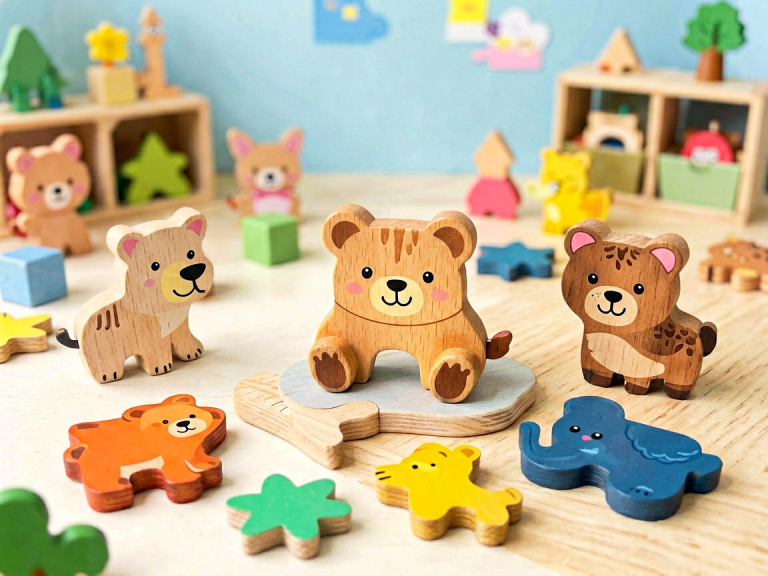
As the child approaches the end of the first year, the pincer grasp emerges—the ability to hold a small object between the thumb and index finger. This is a landmark achievement in fine motor development. Toys that facilitate this skill include small stackable blocks, large peg puzzles with knobs, and “ball drop” toys that require the child to pick up a small ball and insert it into a tube. The inherent motivation in these toys—the satisfying “clack” of a block falling, the visual reward of a puzzle piece snapping in—encourages repeated practice. Each repetition strengthens the thenar muscles (the thumb pad) and improves the coordination between the two sides of the hand.
2. Hand-Eye Coordination: Marrying Vision with Action
Fine motor skills are almost never purely manual; they are always paired with visual guidance. Hand-eye coordination refers to the ability to process visual information and translate it into precise hand movements. Toys that demand this synchronization are vital for later tasks such as catching a ball, writing within lines, or using scissors.
A classic example is the bead-maze toy—those colorful arches with wooden beads that can be pushed along twisted, sliding wires. A child must track the bead with their eyes while simultaneously adjusting the pressure and direction of their fingers. This cross-modal integration trains the brain to predict movement, which is essential for activities like dressing (threading a button through a hole) or even typing. Similarly, interlocking puzzles (often called “chunky puzzles” for toddlers) require the child to look at a shape, locate the matching cutout, and rotate the piece to fit. The feedback loop is instantaneous: the piece either fits or it doesn’t. This trial-and-error process fine-tunes both visual discrimination and manual control.
Stacking rings on a cone is another deceptively powerful toy. while it appears simple, the child must align the ring’s opening with the central pole, adjust the angle, and release the ring at precisely the right moment. The gradual narrowing of the cone’s diameter as it rises adds an extra layer of challenge, teaching the child to modulate force. Over time, the child’s movements become less jerky and more fluid, a sign that the cerebellum is becoming more efficient at calibrating motor commands based on visual feedback.
3. Precision and Bilateral Coordination: The Work of Two Hands
As children enter the preschool years (ages three to five), fine motor tasks become more complex. They now require not only precision in one hand but also the collaborative work of both hands—a skill known as bilateral coordination. This is where toys like building bricks (LEGO Duplo, for instance), snap-together beads, and construction sets shine.
When a child builds a tower with interlocking blocks, one hand often holds the base steady while the other pushes a new block into place. This division of labor—the non-dominant hand stabilizing, the dominant hand performing the fine action—is a direct precursor to holding paper steady while writing with the other hand. Toys that require twisting, such as Duplo wheels or plastic nuts and bolts, also develop rotational wrist movements. The pronation and supination of the forearm (turning the palm up and down) are gross motor actions that, when paired with fine motor manipulation, become essential for using a screwdriver, turning a doorknob, or opening a jar.
Lacing and threading toys are among the most effective for bilateral coordination. With a set of large, brightly colored beads and a shoelace, a child must hold the lace steady with one hand (or the table) while guiding a bead onto the lace with the other. This requires precise angle adjustment and a gentle, controlled push. The repetitive nature of threading—dozens of beads per session—builds what occupational therapists call “motor memory.” The brain learns the sequence of movements so thoroughly that it becomes automatic, freeing up mental resources for higher-order tasks like pattern-making or counting.
4. Manipulation and Dexterity: Tools That Train the Fingers
Isolated finger movements—the ability to move one finger independently from the others—are a hallmark of mature fine motor skills. This is crucial for writing (holding a pencil with a dynamic tripod grip), playing a musical instrument, or typing. Toys that challenge the child to press, squeeze, or turn small objects are excellent for this.
Play dough is a prime example. While often dismissed as mere sensory play, it is a powerful fine motor tool. Rolling a ball of dough between the palms works the muscles of the whole hand; pinching off small pieces strengthens the thumb and forefinger; using plastic cookie cutters requires careful pressure and orientation. Adding small tools—a child-safe rolling pin, a plastic knife for cutting, or a garlic press that extrudes long “noodles”—turns the activity into a dexterity workshop.
Pegboards, often sold as “button art” or “nail boards” with large plastic pegs, require the child to pick up a peg, orient it correctly, and push it into a hole. The resistance of the peg being inserted provides proprioceptive input, which helps the child understand how much force is needed. More advanced sets include tiny tweezers or tongs to transfer pegs, directly mimicking the fine motor control used in writing. In fact, many occupational therapists use “tweezer tasks” to prepare children for handwriting, as they strengthen the same muscles used in a pencil grasp.
Scissor-skill toys also deserve mention. Start with toys that have “squeeze” mechanisms—like small plastic animal clothespins or tongs that pick up pom-poms. These require the child to open and close the tool with coordinated finger movement. Once the child masters this, they can progress to actual safety scissors that cut play dough or paper strips. The bilateral coordination of holding the paper with one hand while cutting with the other is a significant developmental milestone.
5. The Role of Fidgets, Puzzles, and Fine-Motor Games
Not all fine motor development comes from traditional “educational” toys. Everyday objects like fidget spinners, pop-it toys, and even simple board games can be surprisingly effective. Pop-it toys, made of reusable silicone bubbles that make a satisfying “pop” when pushed through, strengthen the same muscles used in the pincer grasp. The variety of bubble sizes and patterns encourages the child to use different fingers and apply varying pressure.
Puzzles, especially those with small pieces and intricate shapes, are a complete fine motor workout. A 24-piece jigsaw requires the child to lift, rotate, align, and press each piece. The “edge finding” and “tab insertion” steps demand visual-spatial reasoning paired with delicate finger movement. Older preschoolers who engage with magnetic puzzles (where pieces are held by a magnetic wand) also practice controlled wrist movement that translates directly to writing.
Even board games like “Operation” (the classic where players remove plastic bones with tweezers without touching the sides) are, in essence, fine motor challenges disguised as fun. The concentration required, the steady hand, and the precise lateral movement all build fine motor endurance.
6. Choosing the Right Toy for Each Stage
Understanding how toys support fine motor development is only half the battle; the other half is selecting toys that match the child’s current abilities. A toy that is too simple will bore the child; one that is too difficult will frustrate them. Occupational therapists often recommend a “just-right challenge”—an activity that is slightly beyond the child’s current skill level but achievable with effort.
For infants (0–12 months): focus on grasping toys with varied textures, rattles that require a shake, and soft blocks that can be picked up with two hands. For toddlers (12–24 months): introduce stacking rings, jumbo crayons for scribbling, and simple shape sorters that demand a wrist twist. For preschoolers (2–5 years): add interlocking bricks, beads for lacing, safety scissors, and play dough with tools. For kindergarteners (5+): include small construction sets (like LEGO Classic), tweezers with crafting materials, and more complex puzzles (48–100 pieces).
It is also worth noting that open-ended toys—those that can be used in multiple ways—tend to provide more fine motor practice than single-purpose electronic toys. A set of wooden blocks can be stacked, sorted, knocked down, and picked up repeatedly; a plastic toy with a single button that lights up and talks may require only a coarse push. The child who spends twenty minutes building with blocks is engaging in hundreds of fine motor repetitions; the child who presses a button for a sound effect engages perhaps two.
Conclusion: Play is the Work of the Hand
The development of fine motor skills is not a passive process that unfolds automatically with age. It is nurtured through countless small, voluntary actions that strengthen neural connections and physical muscles. Toys are the silent partners in this journey. From the rattle that first teaches a baby’s hand to close around an object, to the pegboard that trains a preschooler’s fingers to isolate and press, each toy serves as a practice ground for real-world tasks.
When we watch a child deeply engrossed in threading beads, squeezing play dough, or aligning puzzle pieces, we are witnessing more than play. We are watching the construction of a brain that will one day write letters, play piano keys, and perform delicate surgeries. The humble toy, in its colorful simplicity, is doing something profound: it is turning tiny hands into capable, skilled instruments of human creativity and independence. So the next time you see a child struggle to push a block onto a stack, resist the urge to help immediately. Give them a moment. Their hands are learning. And the toy is the teacher.