The Art of Toy Progression: Navigating Play for the 4-Year-Old Mind
As children grow, their play is not merely a pastime—it is the language through which they process the world, experiment with social roles, and build the cognitive scaffolding for lifelong learning. For parents and caregivers, understanding the natural progression of toys is akin to choosing the right books for a budding reader: too simple and the child becomes bored; too complex and frustration replaces joy. At age four, children stand at a unique developmental crossroads. They have outgrown the sensorimotor exploration of infancy and the parallel play of toddlerhood, yet they are not quite ready for the structured rules of early elementary school. This stage demands toys that reflect their burgeoning independence, imagination, and growing understanding of cause and effect. Here, we explore the science and art of toy progression for four-year-olds—a guide to selecting playthings that challenge, delight, and nurture the whole child.
## Understanding the 4-Year-Old Developmental Landscape
Before diving into specific toys, it is essential to understand what the average four-year-old is capable of—and what they are still learning. At this age, children typically exhibit dramatic leaps in language, empathy, and executive function. They can speak in full sentences, recount simple stories, and even negotiate with peers. Their fine motor skills have refined enough to hold a pencil with a tripod grasp, cut along a line with safety scissors, and manipulate small objects like beads or buttons. Gross motor development is equally impressive: they can hop on one foot, catch a large ball, pedal a tricycle, and climb playground structures with confidence. Cognitively, they are beginning to understand concepts like sequencing, matching, and the difference between reality and fantasy. This is also the age when magical thinking flourishes—a child might believe that a stuffed animal feels sad or that the moon follows their car.
Toys designed for this age must therefore address multiple domains simultaneously. A single toy that encourages storytelling, fine motor practice, and social interaction is far more valuable than one that focuses on only one skill. Moreover, the toy should allow for open-ended play—opportunities for the child to create their own narratives rather than simply following a predetermined set of instructions. This is the key principle of toy progression: moving from toys that *do something* (a button that lights up) to toys that *enable the child to do something* (blocks that become a castle).
## Cognitive Development: Puzzles, Games, and Early Logic
At four, children are natural problem-solvers. They love figuring out how things fit together, both physically and conceptually. The best cognitive toys for this age are those that introduce simple rules, cause-and-effect relationships, and memory challenges without overwhelming the child.
Jigsaw puzzles are a classic example of progressive play. A four-year-old can typically handle puzzles with 12 to 24 large pieces, especially those with recognizable scenes (animals, vehicles, or family scenes). The act of scanning for color and shape patterns, rotating pieces, and persevering through frustration builds spatial reasoning and patience. As the child masters these puzzles, you can increase the piece count or introduce puzzles that are cut into irregular shapes (such as floor puzzles shaped like a dinosaur). Some puzzles now include a “self-correcting” feature—each piece only fits its unique spot—which subtly reinforces the concept of matching.
Board games also make a powerful appearance at this age. Simple cooperative games like “Hoot Owl Hoot!” or “My First Orchard” teach turn-taking, following visual cues, and the idea that everyone can win together. Competitive games such as “Candy Land” or “Chutes and Ladders” (with modified rules for younger players) introduce counting, color recognition, and the emotional regulation required to handle winning and losing. The progression here is from games with no reading required to those with a few sight words or symbols. Children learn that games have rules that all players follow, a critical social and cognitive milestone.
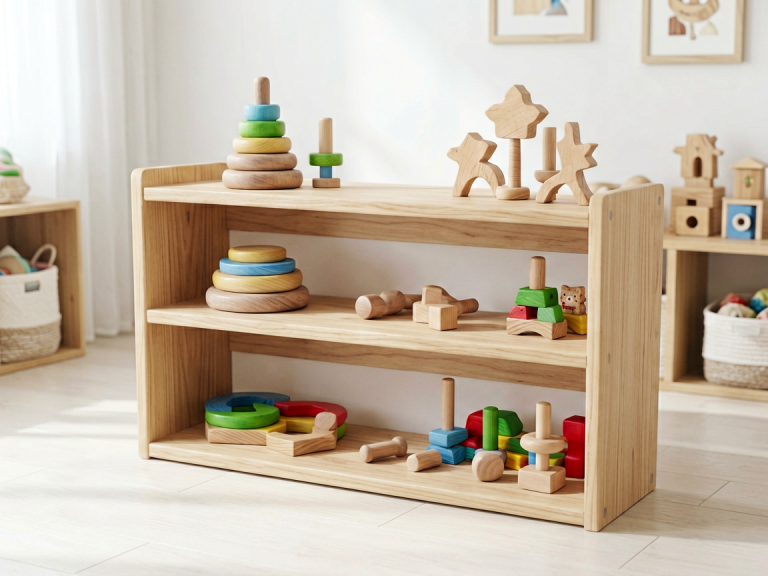
Construction sets in the form of magnetic tiles, large wooden blocks, or building bricks whose pieces click together (like Duplo) encourage engineering thinking. Four-year-old builders will stack towers and knock them down—a deeply satisfying cause-and-effect experience—but they also begin to create enclosures, bridges, and simple symmetrical structures. As they grow, you can introduce sets with more specialized pieces, such as wheels, arches, or even small animal figures that “live” in the block castle. This progression moves the child from pure stacking to functional, representational building.
## Social and Emotional Development: Pretend Play and Cooperative Toys
The social world of a four-year-old is rapidly expanding. They are more interested in playing with other children than alongside them, though conflicts over toys and turns are still common. Toys that foster empathy, negotiation, and role-taking are invaluable at this stage.
Dress-up costumes and props are a cornerstone of four-year-old play. A simple cape, a firefighter hat, or a doctor’s kit allows the child to step into another person’s perspective. This is sometimes called “sociodramatic play,” and it is directly linked to the development of theory of mind—the ability to understand that others have different thoughts and feelings. As children progress, they will move from wearing one costume (being “just a princess”) to creating elaborate scenarios that involve multiple characters: a patient who needs an x-ray, a chef cooking a feast for a teddy bear. Parents can support this progression by adding open-ended props like fabric scraps, cardboard boxes, and kitchen utensils, which encourage children to invent rather than consume.
Figurines and playsets—animal families, human figures, or vehicles—also foster social narratives. A child might arrange a group of plastic farm animals into a “family” that goes on a picnic. The progression here is from simple labeling (“cow”) to complex stories (“the cow says it’s too sunny, so she needs an umbrella”). Playsets that include multiple characters (like a dollhouse with a family, a garage with a mechanic, or a castle with knights) allow for increasingly intricate social negotiations. When playing with peers, these toys become the medium through which children practice sharing, compromising on plot lines, and resolving disagreements (“No, the dragon is friendly today!”).
Cooperative activity kits that require two or more children to work together offer additional social growth. For example, a large floor puzzle that two children must assemble together, or a “fishing” game where each child uses a magnetic rod to catch fish while following a color pattern, teaches teamwork. The key is that the toy itself encourages joint attention and shared goal-setting. Avoid toys that are inherently individualistic, like electronic games with only one controller, until the child is ready for parallel play within a shared screen.
## Physical Development: Fine Motor and Gross Motor Milestones
Four-year-olds are full of kinetic energy. Their bodies demand movement, and their hands crave dexterous challenges. Toy progression in this domain means providing both large-scale physical activity and precise hand-eye coordination tasks.
Gross motor toys should focus on balance, coordination, and strength. A tricycle or balance bike (without pedals) is excellent for building leg muscles and spatial awareness. As the child masters pedaling, you can introduce a small two-wheeled bike with training wheels. Jumping ropes, hula hoops, and simple obstacle courses made from pillows or cones help develop agility and body control. The progression here is from simple motor tasks (pushing a cart, climbing a low slide) to those requiring rhythmic timing and sequencing (jumping rope, hopping in and out of a hoop). Even a large-sized bouncy ball for bouncing and catching builds hand-eye coordination and core strength.
Fine motor toys are equally critical for school readiness. Lacing beads, stringing pasta, or threading yarn through pre-punched cards refine the pincer grasp needed for writing. Playdough, modeling clay, and sand offer sensory feedback and allow the child to squeeze, roll, pinch, and cut—all strengthening the small muscles of the hand. The progression should move from large, easy-to-manipulate materials (chunky beads with a thick string) to smaller components (tiny beads, or even a child-safe sewing kit with a plastic needle). Puzzle boards with knobs, pegboards, and simple lock-and-key sets also build precision. By the end of the fourth year, many children can manipulate a pair of child-sized scissors to cut along a straight line—a major milestone that can be encouraged with “cutting practice” strips that have progressively more complex shapes.
Art supplies deserve a special mention. Four-year-olds love to draw, paint, and glue. The progression here is from large crayons and finger paints to smaller crayons, markers with washable ink, and even child-safe scissors and glue sticks. Offer a variety of surfaces (paper, cardboard, fabric) and tools (sponges, paintbrushes of different sizes, stampers). As children’s representational abilities grow, they will produce recognizable shapes—a circle with lines for legs becomes “me at the park.” Support this progression by displaying their artwork and asking open-ended questions (“Tell me about the colors you chose”) rather than prescribing what to draw.
## Creativity and Imagination: Open-Ended and Loose Parts
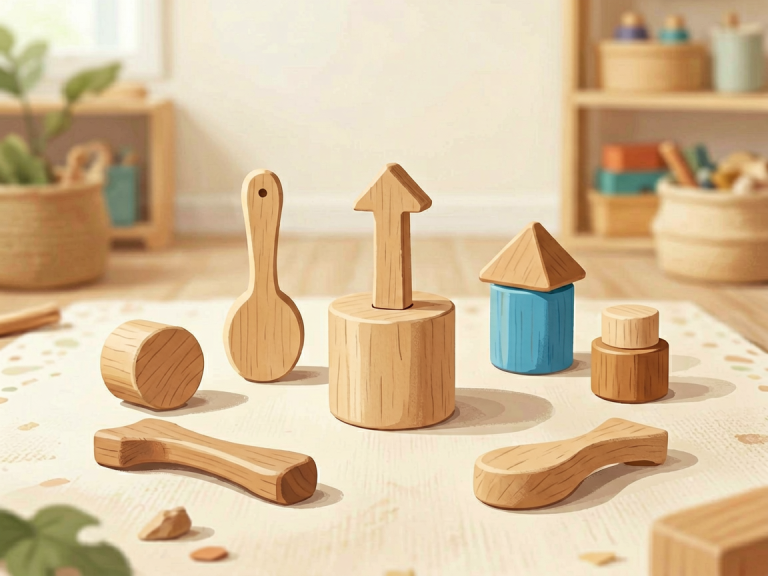
Perhaps the most important category for a four-year-old is open-ended materials that have no single intended purpose. These “loose parts” are the engine of creative thought. They include natural objects (pinecones, stones, leaves), recycled materials (cardboard tubes, bottle caps, fabric scraps), and manufactured items (wooden blocks, LEGO bricks, magnet tiles, or a simple set of nesting cups).
The genius of open-ended toys is that they adapt to the child’s developmental level. A four-year-old might use a basket of smooth stones to “feed” a toy dinosaur; a few months later, the same stones become the foundation for a counting game, and later still, they might be sorted by color to create a pattern. The progression is not in the toy itself, but in how the child uses it. Parents can encourage this by rotating the loose parts, introducing new materials gradually, and resisting the urge to demonstrate “correct” ways to play. When a child builds a tower of blocks and declares it a “rocket ship,” the play is infinitely more valuable than following a step-by-step instruction manual for a pre-packaged rocket.
Imaginative story kits—like a simple wooden castle with a few characters, or a set of felt animals and a felt board—allow children to act out narratives without the constraints of a script. As children’s language and memory improve, they can retell stories they have heard or invent entirely new ones. The progression from simple labeling (“the cat sits on the mat”) to complex plots (“the cat gets lost in the forest and meets a friendly owl who helps her find her way home”) reflects cognitive growth. Encourage this by joining in the play occasionally, but always following the child’s lead.
## Safety and Sustainability: Choosing Wisely
As toys become more complex, so too do safety considerations. Four-year-olds are still prone to putting small objects in their mouths, though the risk decreases. When selecting toys, ensure they do not contain small parts that could be a choking hazard (items smaller than a toilet paper tube are generally not recommended under age three, but even at four, supervision is wise). Avoid toys with long cords or strings that could pose a strangulation risk. Check that paints and finishes are non-toxic, and that electronic toys have secure battery compartments. Additionally, look for toys that are durable enough to withstand rough handling—wooden toys, high-quality plastics, and well-stitched fabrics are better than flimsy plastic that breaks instantly.
Equally important is sustainability and longevity. A toy that holds a child’s interest for only a week is not a good investment. The best toys for four-year-olds are those that grow with them: a set of magnetic tiles that can be used for simple stacking now and later for building complex geometric structures; a dollhouse that can be decorated and redecorated; a set of art supplies that lasts through multiple creative phases. Buying fewer, higher-quality toys—and rotating them to maintain novelty—is far more effective than overwhelming a child with dozens of cheap, disposable items.
## Conclusion: The Joy of Watching Play Evolve
Toy progression for a four-year-old is not a checklist but a dance. It requires observation—watching how a child engages with a toy, what frustrates them, what excites them—and then responding with the next appropriate challenge. The goal is never to push a child faster, but to provide the right environment for their natural curiosity to flourish. When a child spends an hour arranging small plastic animals into a story, they are not merely “playing”; they are constructing narratives, negotiating social roles, and exercising the very muscles of thought that will serve them throughout life. The wooden blocks that become a castle, the costume that transforms them into a doctor, the puzzle that finally clicks into place—these are the building blocks of a confident, empathetic, and creative human being. As caregivers, our role is to offer the tools, step back, and marvel at the unfolding.