Learning Through Play Activities at Home: Unlocking the Joy of Discovery
Introduction: The Power of Play
For many parents, the word “play” evokes images of carefree fun, laughter, and unstructured time. Meanwhile, the word “learning” often brings to mind formal lessons, textbooks, and homework. Yet the two are not opposites—they are, in fact, deeply intertwined. Research in developmental psychology, neuroscience, and education consistently demonstrates that play is one of the most effective ways for children to acquire essential cognitive, social, emotional, and motor skills. When play happens at home, in a safe and nurturing environment, it becomes even more powerful. Home-based play activities offer children the freedom to explore, experiment, and make mistakes without the pressure of formal assessment. This article explores the myriad ways that families can harness the magic of play to foster a love of learning, build key competencies, and create lasting memories—all within the familiar walls of their own living rooms.
Why Home Is the Ideal Classroom for Play-Based Learning
The home environment is uniquely suited for learning through play. Unlike a school setting, where schedules are rigid and curricula are predetermined, the home allows for flexibility, spontaneity, and child-led exploration. When children feel safe and comfortable, they are more likely to take intellectual risks, ask questions, and engage deeply with materials. Moreover, parents and caregivers can tailor activities to a child’s specific interests, strengths, and developmental stage. A child obsessed with dinosaurs can learn counting, sorting, and storytelling through dinosaur-themed games. A child fascinated by cooking can practice fractions, reading, and sequencing while baking cookies. This personalized approach not only boosts engagement but also reinforces the idea that learning is relevant, meaningful, and fun.
Another advantage of home-based play is the opportunity for repeated practice. In a typical school day, a child might spend only a few minutes on a particular skill. At home, through play, the same skill can be revisited countless times in different contexts—building a tower with blocks, pouring water in the bathtub, or playing a board game. Each repetition strengthens neural connections, leading to mastery. Furthermore, home play often involves multi-sensory experiences that are crucial for young learners. Touching, seeing, hearing, and even tasting (when safe) create rich neural networks that enhance memory and understanding.
Types of Play Activities That Promote Learning at Home
Sensory Play: Engaging the Senses to Build Brain Power
Sensory play encompasses any activity that stimulates a child’s senses: touch, smell, taste, sight, and hearing. It is foundational for cognitive development because it helps children process and organize sensory information. Simple home-based sensory activities include playing with rice or sand in a plastic bin, making homemade playdough, or creating a water table in the kitchen sink. While squishing, pouring, and scooping, children are developing fine motor skills, hand-eye coordination, and cause-and-effect understanding. They are also learning scientific concepts like volume, density, and texture. For example, when a child adds water to dry sand, they discover that the mixture becomes moldable—a basic lesson in material properties. Parents can enhance the learning by asking open-ended questions: “What happens if you add more water?” or “How does the cold playdough feel compared to the warm one?”
Construction and Building: Mathematical and Spatial Thinking
Building blocks, LEGOs, magnetic tiles, and even household items like cardboard boxes and empty containers are powerful tools for learning. Construction play naturally introduces concepts of geometry, symmetry, balance, and measurement. A child trying to build a tall tower must consider the stability of the base and the distribution of weight, engaging in early engineering thinking. Counting blocks, comparing sizes, and creating patterns all lay the groundwork for mathematical reasoning. Moreover, when children build collaboratively with siblings or parents, they develop negotiation skills, turn-taking, and language development as they describe their creations. To maximize learning, parents can challenge children with specific tasks: “Can you build a bridge that is long enough for three toy cars to pass under?” or “How many blocks do you need to make a square that is the same size as this book?”
Pretend Play and Role-Playing: Social, Emotional, and Language Development
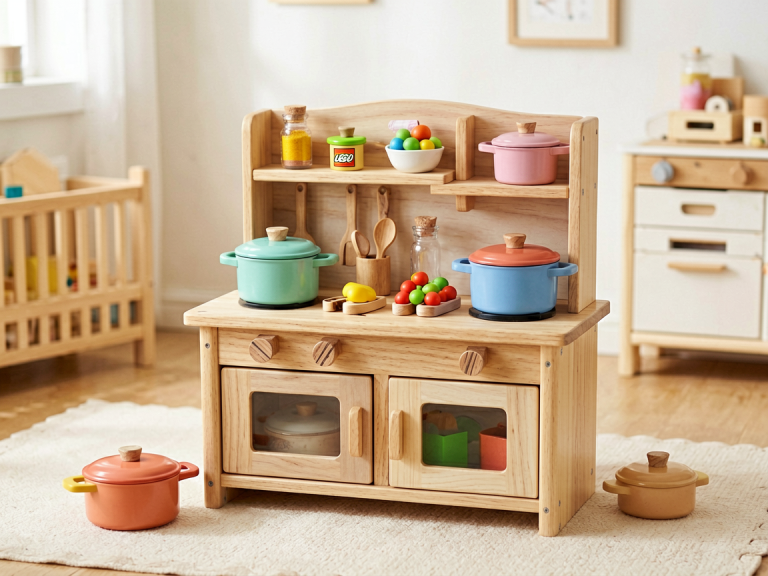
Pretend play—whether it involves dressing up as a doctor, running a pretend grocery store, or playing house—is arguably one of the most important types of play for holistic development. Through role-playing, children explore different perspectives, practice empathy, and experiment with social roles. A child pretending to be a teacher learns to explain concepts and manage a classroom; a child pretending to be a chef practices sequencing (first wash the vegetables, then chop, then cook). Language skills blossom as children invent dialogue, negotiate plotlines, and describe imaginary scenarios. Additionally, pretend play provides a safe space for children to process emotions. A child who is anxious about a doctor’s visit can replay the experience with stuffed animals, gaining a sense of control. Parents can support this by providing props (old clothes, kitchen utensils, empty food boxes) and by joining in the play as a co-actor, asking questions that extend the narrative: “What should we do after we finish cooking dinner?”
Board Games and Card Games: Literacy, Numeracy, and Strategic Thinking
Classic board games are treasure troves of learning opportunities. Games like *Candy Land* teach color recognition and turn-taking. *Chutes and Ladders* introduces counting and the concept of consequences (good or bad). *Monopoly Junior* involves money management, addition, and subtraction. Card games like *Go Fish* improve memory and matching skills, while *Uno* reinforces number and color recognition alongside strategic decision-making. Even simple games like *I Spy* or *20 Questions* boost deductive reasoning and vocabulary. The key is to choose games that are age-appropriate and to play regularly. During game time, parents can model good sportsmanship, discuss strategies aloud, and encourage children to think ahead. The social aspect of game playing—waiting for one’s turn, handling winning and losing—is an invaluable life lesson that cannot be learned from a worksheet.
Creative Arts: Imaginations and Fine Motor Skills
Drawing, painting, sculpting with clay, cutting and pasting, and making collages are all forms of creative play that support learning. Art activities encourage self-expression, decision-making, and problem-solving (e.g., “How do I make the color purple?”). They also build fine motor control, which is essential for writing. A child who practices cutting with scissors is strengthening the same muscles needed to hold a pencil. Furthermore, art can be integrated with other subjects. For example, a child can draw a map of their bedroom to learn about spatial relationships, or create a timeline of their day to understand sequencing. Parents can turn art into storytelling by asking children to describe their pictures, thereby developing narrative skills. The process is more important than the product; the goal is not a perfect drawing but the exploration and learning that happens along the way.
Designing a Home Environment That Invites Playful Learning
Creating a space that encourages learning through play does not require a dedicated playroom or expensive toys. What matters most is intentionality. Designate a few areas in your home where play can happen with minimal restrictions. A corner of the living room with a small rug and a basket of blocks invites building. A low shelf in the kitchen with plastic measuring cups, funnels, and spoons invites water play. Keep materials accessible so children can initiate play independently. Rotate toys and materials periodically to maintain novelty; hiding half the toys for a month and then swapping them out can reignite interest.
Equally important is the adult’s mindset. Parents should view themselves not as teachers delivering lessons but as facilitators who observe, support, and sometimes join in the play. Instead of correcting a child’s “mistake” during a counting game, ask “What do you think works?” or “Can you show me your thinking?” This encourages metacognition—the ability to think about one’s own thinking. Also, embrace messiness. Play is rarely tidy; flour may spill, paint may get on clothes, and blocks will scatter. But the learning that occurs is worth the cleanup. Set simple rules (e.g., toys are put away before meals) and involve children in tidying up, which itself becomes a learning activity (sorting, categorizing, responsibility).
The Role of Parental Involvement: Balancing Guidance and Freedom
One of the greatest challenges for parents is knowing when to step in and when to step back. Over-direction can stifle creativity and make play feel like work. Under-involvement can leave a child frustrated or disengaged. The sweet spot is a balance: offer a gentle prompt, ask a thought-provoking question, or demonstrate a new way to use a material, but then allow the child to take the lead. For example, if a child is building with blocks and the tower keeps falling, resist the urge to fix it. Instead, ask, “I wonder why it falls when you put the big block on top? What happens if you try the small block first?” This teaches problem-solving and resilience. Similarly, in pretend play, follow the child’s script. If they want to be a firefighter and you are assigned the role of a cat stuck in a tree, embrace it. Your willingness to play along validates their imagination and strengthens your bond.
Parents can also model a love of learning by engaging in their own playful activities. Show your child that you enjoy reading, solving puzzles, or trying new recipes. Talk aloud about your own thought processes: “I’m trying to figure out which piece of this jigsaw puzzle fits—I think this blue piece might be part of the sky.” Children learn by imitation, and seeing a parent approach challenges with curiosity and persistence is one of the most powerful lessons of all.
Conclusion: Play Is Learning, Learning Is Play
In a world that often emphasizes academic achievement, test scores, and structured lessons, it is easy to overlook the profound value of simple play. Yet the research is clear: when children engage in self-directed, joyful play at home, they are not just having fun—they are building the neural architecture for future learning. They are developing critical thinking, creativity, collaboration, and communication skills that no drill or worksheet can replicate. They are learning to love the process of discovery, to embrace failure as a step toward mastery, and to see the world as a place full of puzzles and possibilities.
Families who prioritize learning through play at home are giving their children a gift that lasts a lifetime: the understanding that learning can be joyful, that mistakes are stepping stones, and that curiosity is the engine of growth. So the next time you see your child covered in finger paint, building a wobbly castle, or pretending to be a superhero, remember that you are witnessing one of the most powerful learning moments possible. Step in, play with them, and celebrate the magic that happens when learning and play become one.