Building Blocks of Numeracy: The Best Beginner Toys for Early Math Learning
Introduction: The Importance of Play in Early Math
Mathematics is often perceived as a daunting subject, reserved for older students with pencils, worksheets, and abstract formulas. Yet, for young children—toddlers and preschoolers—the foundations of mathematical thinking are built long before they ever enter a formal classroom. Early math is not about memorizing times tables or solving equations; it is about recognizing patterns, understanding quantities, comparing sizes, and developing spatial awareness. And the most natural, effective, and joyful way for a child to acquire these skills is through play.
Beginner toys for early math serve as bridges between concrete experiences and abstract concepts. When a child stacks blocks, they are not just building a tower; they are exploring gravity, balance, and geometry. When they sort colorful bears into cups, they are practicing classification and one-to-one correspondence. When they fit a shape into a puzzle, they are internalizing the properties of circles, squares, and triangles. These seemingly simple activities lay the neural pathways that will later support arithmetic, logic, and problem-solving.
In this article, we will explore a range of beginner math toys categorized by the core skills they develop. From counting and number recognition to shape sorting, measuring, and early addition, each category offers parents and educators practical, research-backed insights into how to turn everyday playtime into a rich mathematical experience.
—
1. Counting and Number Recognition Toys
The very first step in early math is helping a child understand that numbers represent quantities. Counting toys are designed to make this connection visual, tactile, and repetitive in an enjoyable way.
Wooden Number Puzzles are classic staples. Each puzzle piece has a number, and the corresponding slot often contains that number of dots or objects (like apples or fish). As the child fits the “3” piece into a slot with three dots, they simultaneously see the numeral, hear the word (if an adult says it), and feel the shape. This multisensory approach reinforces the link between symbol and quantity.
Counting Bears and Sorting Cups are another favorite. A child might be asked to “give me five red bears” or “put two bears in the blue cup.” As they physically move the bears, they practice counting aloud and matching numbers to sets. Some sets come with numbered dice or spinner games that add an element of chance, making repetition feel like a game rather than a drill.
Abacuses deserve special mention. Unlike electronic devices, a traditional wooden abacus allows a child to slide beads one by one, physically grouping them into tens. Pushing four beads across, then adding two more, provides a concrete demonstration of addition and place value that no screen can replicate. For beginners, abacuses with large, brightly colored beads are ideal; they can simply count the beads, later progressing to simple addition and subtraction.
Finally, pop-up counters—such as the popular “Pegboard” toys where children push numbered pegs into holes—help develop fine motor skills while reinforcing number order. The satisfying “pop” sound when a peg clicks into place provides positive feedback, encouraging the child to continue until all numbers are placed correctly.
—
2. Shape and Pattern Toys for Geometric Thinking
Geometry begins not with theorems but with recognizing that a wheel is round and a book is rectangular. Shape toys teach children to identify, compare, and manipulate forms, which is essential for later understanding of symmetry, area, and even fractions.
Shape Sorters are arguably the most iconic early math toy. A cube or box has openings in different shapes: a star, a triangle, a rectangle, a hexagon. The child must rotate the corresponding block to fit it through the correct hole. This requires spatial reasoning—visualizing how an object will look from different angles. It also introduces the concept of “same” and “different.”
Magnetic Pattern Blocks take shape play a step further. These are flat geometric pieces (triangles, squares, rhombuses, trapezoids) with magnetic backing that can be arranged on a metal board. Children follow pattern cards to build pictures: a house made of a square and a triangle, a flower made of hexagons and diamonds. In doing so, they learn how shapes combine to form new shapes—a precursor to area perception and fractions.
Tangrams are another powerful tool. The classic seven-piece set can form hundreds of silhouettes. When a child tries to create a specific animal or letter, they experiment with rotation, translation, and flipping. This strengthens their mental rotation ability, which research has linked to higher math achievement later in school.
For younger beginners, giant foam blocks (shapes that can be stacked and knocked down) are excellent. They allow free exploration without the frustration of small pieces. A toddler might notice that a cylinder rolls but a cube does not—an early lesson in attributes and stability.
—
3. Sorting, Classifying, and Sequencing Toys
Before children can add or subtract, they need to understand how objects are alike and different. Sorting and classifying toys teach logical categorization, a skill that underlies all mathematical reasoning.
Color and Size Grading Toys often come as rings or cups that stack in a specific order. For example, a set of eight rings that increase in diameter must be placed on a cone from largest to smallest. The child must compare sizes and decide which ring comes next. This is a direct exercise in seriation—arranging items along a continuous dimension.
Button or Bead Sorting Sets provide small objects in multiple colors, shapes, and sometimes textures. A child might be asked to “put all the yellow buttons in this bowl” or “find all the star-shaped beads.” These tasks strengthen attention to detail and the ability to sort by a single attribute. More advanced versions require sorting by two attributes simultaneously, such as “large red buttons.”
Pattern Cards and Linking Chains are wonderful for sequencing. A card might show a repeating pattern: red, blue, red, blue. The child replicates it using plastic links or colored blocks. As they progress, patterns become more complex: red, red, blue, red, red, blue. Recognizing and extending patterns is a foundational skill for algebra—predicting what comes next is exactly what mathematicians do.
Even a simple puzzle with a sequence of pictures (like a life cycle of a butterfly) reinforces temporal order, which helps children understand the concept of “first,” “next,” and “last.” These positional words are crucial for following instructions and understanding procedures.
—
4. Measuring and Comparing Toys
Measurement is one of the most practical applications of math. Young children are naturally curious about “who is taller” or “which cup holds more.” Measurement toys channel that curiosity into structured learning.
Stackable Measuring Cups (often used in kitchen play) allow children to fill and pour. They discover that a cup marked “1” is bigger than a cup marked “1/2,” even though both are labelled with numbers. Through trial and error, they learn about volume and the idea of “more than” and “less than.” Adding a scale can turn simple play into a lesson about weight: comparing a heavy block to a light feather.
Balance Scales are particularly engaging. A child places a bear on one side and then adds bears on the other until the scale is level. They are intuitively learning about equality—when both sides balance, they have the same number of items. Some scales come with numbered weights, so the child can gradually connect the physical mass to the numeral on the weight.
Height Chart Rulers can be turned into a game. Have the child stand against a wall-mounted growth chart and mark their height monthly. Then compare with a sibling’s mark or a favorite toy’s height. Asking questions like “How many more inches did you grow than last month?” introduces subtraction vocabulary in a meaningful context.
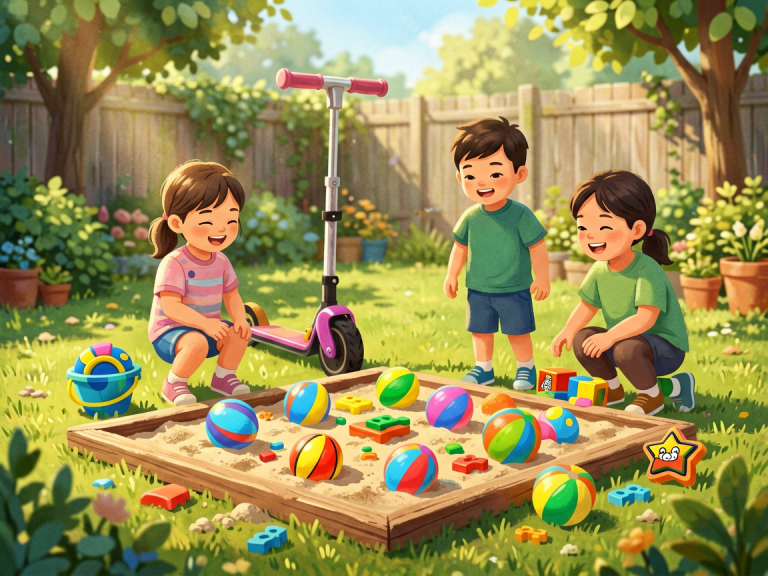
Sand and Water Play might seem purely sensory, but with the addition of spoons, funnels, and differently sized containers, it becomes a lab for measurement. A child pouring water from a tall narrow jar into a short wide jar is shocked to see the water level change—yet the amount hasn’t changed. This challenges their understanding of conservation, a key Piagetian concept that develops through repeated hands-on experiences.
—
5. Simple Addition and Subtraction through Play
Once a child is comfortable with counting and comparing, they are ready for the most exciting step: combining and separating sets. The best toys for this stage turn arithmetic into a story.
Linking Cubes (like Snap Cubes or MathLink Cubes) are tiny plastic blocks that snap together. Build a train of four cubes, then add two more. “How many now?” The child can count each cube, but soon they realize they can just say “four… five, six!” This bridges counting to addition. To introduce subtraction, “If three cubes roll away, how many are left?” The child physically removes them, counting the remainder.
Play-Dh or Modeling Clay can be rolled into balls for “mommy bear” and “baby bear” sets. “Mommy bear has five cookies, baby bear has two. How many altogether?” The child rolls small clay balls to represent the cookies, then combines them. The tactile nature of clay makes the abstract concept tangible.
Dominoes are a classic tool for subitizing (instant recognition of small quantities) and addition. Each domino has two sides with dots. Young children can count the dots on one side, then the other, and finally say the total. Some domino sets come with numbers printed underneath, so the child can later match the numeral with the dot count.
Number Line Floor Mats turn the living room into a giant number line. The child stands on 3, then hops forward 2 spaces: “Where am I? On 5!” This gross-motor activity embeds the concept of addition as movement forward on a number line. Similarly, hopping backward teaches subtraction.
—
6. Tips for Parents: How to Choose and Use Beginner Math Toys
Selecting the right toys is only half the equation; how you use them matters just as much. Here are practical tips for maximizing the math-learning potential of play:
- Follow the child’s lead. If a child is fascinated by sorting colors today, don’t force them to count. The most powerful learning happens when curiosity drives the activity.
- Use mathematical language naturally. Instead of saying “Put the blue one here,” say “Put the blue one next to the red one, so they are in a pattern: blue, red, blue.” Or say “You have more bears than I do. Let’s count and see how many more.”
- Encourage estimation before counting. Ask “Do you think we have more red blocks or more blue blocks?” Then count to check. This builds number sense.
- Embrace mess and repetition. A child may want to dump out the same counting bears every day for a month. That’s okay—repetition is how the brain solidifies neural connections.
- Combine toys. Use building blocks with counting bears: “Put four bears on top of this tower.” Or use a shape sorter with a timer: “Can you fit all the shapes in before the timer rings?” This adds challenge and fun.
- Avoid over-structuring play. The toy should be a tool, not a worksheet. Let the child explore freely first; structured guidance can come later.
Most importantly, show enthusiasm. If a parent says “Let’s see how many blocks we can stack!” with genuine excitement, the child will associate math with joy, not drudgery.
—
Conclusion: Fostering a Love for Math from the Start
Early math is not about acceleration—it is about foundation. The toys we choose for our youngest learners shape their attitudes toward numbers, patterns, and problem-solving for years to come. A child who has spent hours nesting measuring cups, sorting beads, and building with shape blocks does not view math as a foreign language; they view it as a natural part of the world, full of beauty and logic.
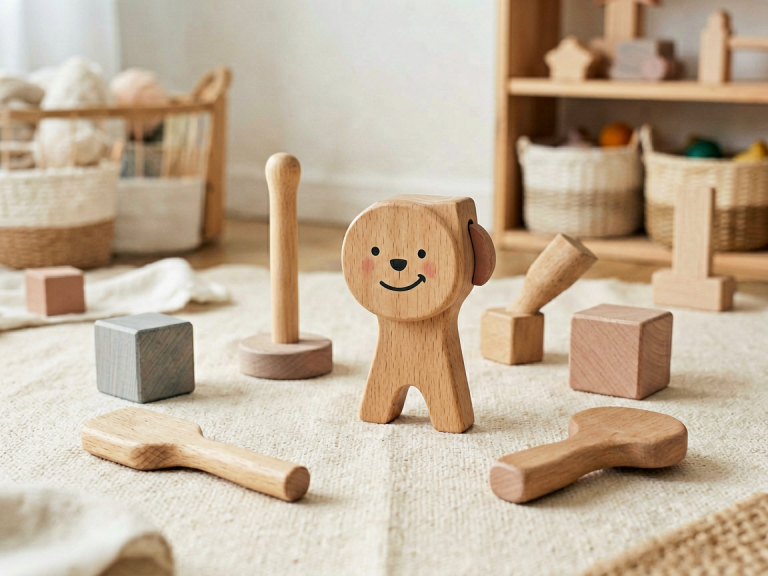
The best beginner toys for early math are those that invite exploration, reward curiosity, and adapt to a child’s growing abilities. They do not need to be expensive or high-tech. A simple set of wooden blocks, a bag of counting bears, or a homemade pattern card can be more powerful than any app. What matters is the interaction—the conversation between child and caregiver, the questions asked (“What happens if we add one more?”), and the joy of discovery.
As you choose toys for the little mathematician in your life, remember: every tower that falls, every shape that fits, every bear sorted into a cup is a small victory. These victories accumulate, brick by brick, into a lifelong confidence in numbers. And it all begins with play.
*(Word count: approximately 1,620)*