Play with Purpose: The Best Toys for Social Skills Development
In an increasingly digital world, the ability to connect with others face-to-face, read social cues, and collaborate effectively has never been more critical. While academic skills often dominate parenting conversations, social competence—the capacity to understand, manage, and navigate interpersonal relationships—is a fundamental predictor of long-term happiness and success. Fortunately, children do not need formal lessons to learn these skills; they develop them naturally through play. The right toys act as catalysts, creating structured opportunities for turn-taking, empathy, negotiation, and joint problem-solving. This article explores the best categories of toys that intentionally foster social skills, from early childhood through the primary school years, offering parents and educators a practical guide to building a playroom that prioritizes human connection.
Cooperative Board Games: Learning to Win Together
Traditional board games often crown a single winner, which can trigger disappointment, jealousy, or frustration in less competitive children. Cooperative board games, by contrast, require all players to work toward a common goal—defeating a monster, solving a mystery, or completing a mission before time runs out. This shift from “me versus you” to “us versus the game” dramatically changes the social dynamics. Games like *Hoot Owl Hoot!* (for ages 4+) ask players to work together to fly all the owls back to their nest before the sun rises. Children must discuss strategies, decide whose turn should be sacrificed for the team, and celebrate shared victories. Similarly, *The Sneaky, Snacky Squirrel Game* (a cooperative variant) teaches patience and verbal encouragement when a player’s acorn is knocked off a tree. These games build essential social competencies: active listening (“What did you say we should try?”), perspective-taking (“If I use my turn to move the red owl, you can move the blue one next”), and emotional regulation when the group fails. Research shows that cooperative play reduces aggression and increases prosocial behavior, making these toys a cornerstone of any social-skills development toolkit.
Role-Playing and Pretend Play Sets: The Theater of Empathy
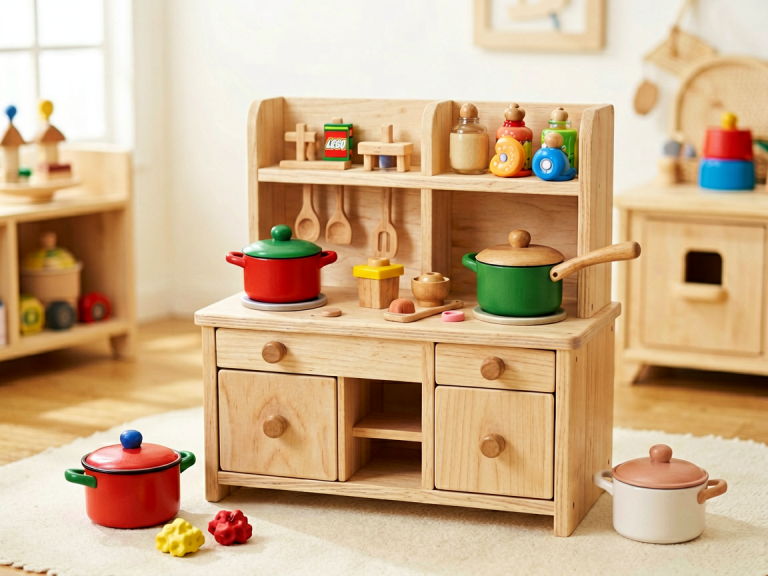
When children engage in pretend play, they step into someone else’s shoes—a doctor, a cashier, a parent, or even a dragon. This practice of adopting another perspective is the very foundation of empathy. High-quality role-playing sets, such as a wooden kitchen with play food, a doctor’s kit with stethoscope and bandages, or a market stall with a cash register and play money, encourage rich, multi-layered social interactions. Two children playing “restaurant” must negotiate who is the chef, who is the customer, and what is on the menu. They learn to request politely (“May I have a pizza, please?”), respond to complaints (“The soup is too salty!”), and cooperate to keep the imaginary business running. A more elaborate set, like a dollhouse or a castle with multiple characters, invites even deeper storytelling. Children assign roles, create conflicts (a toddler doll who refuses to sleep), and collaboratively resolve those conflicts through dialogue. The open-ended nature of pretend play means that no script exists; every interaction requires real-time negotiation, compromise, and verbal clarity. Studies in developmental psychology confirm that children who engage in frequent sociodramatic play demonstrate greater theory of mind—the ability to understand that others have thoughts and feelings different from their own—and perform better on tasks requiring emotional intelligence.
Building and Construction Toys: Engineering Collaboration
Construction toys like LEGO, magnetic tiles (e.g., Magna-Tiles), and wooden blocks are often praised for fostering spatial reasoning and creativity, but their potential for social skill development is equally impressive. When children build together, they must communicate their ideas, divide labor, and handle inevitable disagreements about design. A pair of children constructing a castle with wooden blocks will quickly encounter the need to negotiate: “You build the towers, I’ll build the walls.” If one child grabs a block that the other was reaching for, a mini-conflict arises—and with adult guidance or natural trial-and-error, children learn to say, “Can I use that when you’re done?” or “How about we each build our own tower and then connect them?” Larger sets, such as LEGO Friends or LEGO City, come with multiple minifigures and accessories that inspire role-play within the building process: children might create a fire station and then collaboratively act out a rescue scenario. The physical act of building side by side also teaches spatial awareness of others—not bumping elbows, respecting the other person’s structure, and offering help (“Do you need a flat piece for the roof?”). These subtle but repeated experiences build the neural pathways for cooperation, patience, and constructive feedback.
Communication-Focused Toys: Storytelling and Conversation Starters
Some toys are explicitly designed to stimulate verbal exchange and narrative thinking. Storytelling card games like *Rory’s Story Cubes* (dice with pictures on each face) or *Tell Tale* (cards with whimsical images) require players to take turns crafting a story that connects the images. This is a highly social activity: a child rolls the dice, creates a sentence, then passes the turn to the next player, who must build on the previous sentence. This reinforces turn-taking, active listening (“What did she say happened to the wizard?”), and creative collaboration. Another excellent example is *The Talking, Feeling & Doing Game* (or similar therapeutic board games) which uses cards with prompts like, “Tell about a time you felt left out” or “What would you do if your friend was sad?” These structured conversations normalize emotional disclosure and teach children how to respond empathetically to peers’ experiences. Even simpler tools, like a set of conversation starter cards (e.g., “What is your favorite thing to do with your family?”), used during dinner or in the classroom, transform everyday chatter into deliberate social practice. For younger children, hand puppets or finger puppets can serve as communication props, allowing shy children to speak through a character, reducing the anxiety of direct eye contact while still engaging in dialogue.
Outdoor and Group Activity Toys: Active Social Play
Physical play often happens in groups, and the right outdoor toys can turn a simple afternoon into a lesson in sportsmanship, teamwork, and inclusive behavior. Classic toys like a large parachute (the kind used in physical education classes) require synchronized effort: children must lift the parachute together, run underneath while others hold it up, and communicate rhythmically (“Up! Down! Up! Down!”) to create waves or bounce balls. This experience teaches the importance of coordination and shared timing. Similarly, a set of colorful cones and a soft ball can be used for cooperative games like “Capture the Flag” or “Team Tag” where children must strategize, assign roles, and encourage one another. A simple jump rope turned into a group game of “Double Dutch” or “Snake” demands that children take turns, count aloud together, and celebrate each other’s successes. Outdoor toys that involve multiple participants—such as a large sand-and-water table (where children must share tools and negotiate who digs the river and who builds the dam), a set of foam building blocks for outdoor forts, or a classic game of “Simon Says” led by a child—all foster the social skills of following directions, leading politely, and accepting input from peers. Moreover, physical activity releases endorphins and reduces stress, creating an emotional state more conducive to friendly, cooperative interaction.
Important Considerations When Choosing Toys for Social Development
Not all toys labeled “educational” actually promote social interaction. Parents should look for a few key features. First, the toy should require more than one person to be fully engaging. A single-player puzzle, even if excellent for cognitive skills, does not inherently teach turn-taking or negotiation. Second, open-ended toys—those that can be used in multiple ways without a fixed outcome—tend to generate more creative, collaborative play than toys with a single correct answer. A set of colorful scarves, for instance, can become a river, a superhero cape, or a wedding veil depending on the children’s imagination. Third, avoid toys that encourage passive observation (like a robotic pet that moves on its own) or that are highly competitive in a way that leads to frequent meltdowns. Instead, prioritize toys that allow children to modify rules, invent new games, and accommodate different skill levels. Finally, the best social-skills toy is often the least expensive: a simple cardboard box that two children can turn into a spaceship, a fort, or a car. The magic lies not in the toy itself but in the interactions it sparks.
Conclusion: Play as a Social Curriculum
Social skills are not innate; they are learned through repeated, meaningful practice. The toys we choose for our children shape the nature of that practice. Cooperative board games teach collective problem-solving under gentle time pressure. Role-playing sets offer a safe stage for exploring emotions and perspectives. Construction toys build collaboration and conflict resolution. Communication-focused cards and dice strengthen verbal fluency and empathy. Outdoor group toys foster physical teamwork and inclusive sportsmanship. By intentionally selecting toys that encourage interaction over isolation, parents and educators can transform playtime into a vibrant social curriculum. The next time you walk down the toy aisle, ask yourself: *Will this toy bring my child closer to another child, or will it push them apart?* The answer will guide you toward the best tools for raising a generation of compassionate, collaborative, and socially fluent human beings.
Sources and further reading
For additional evidence-based guidance, consult these authoritative resources: