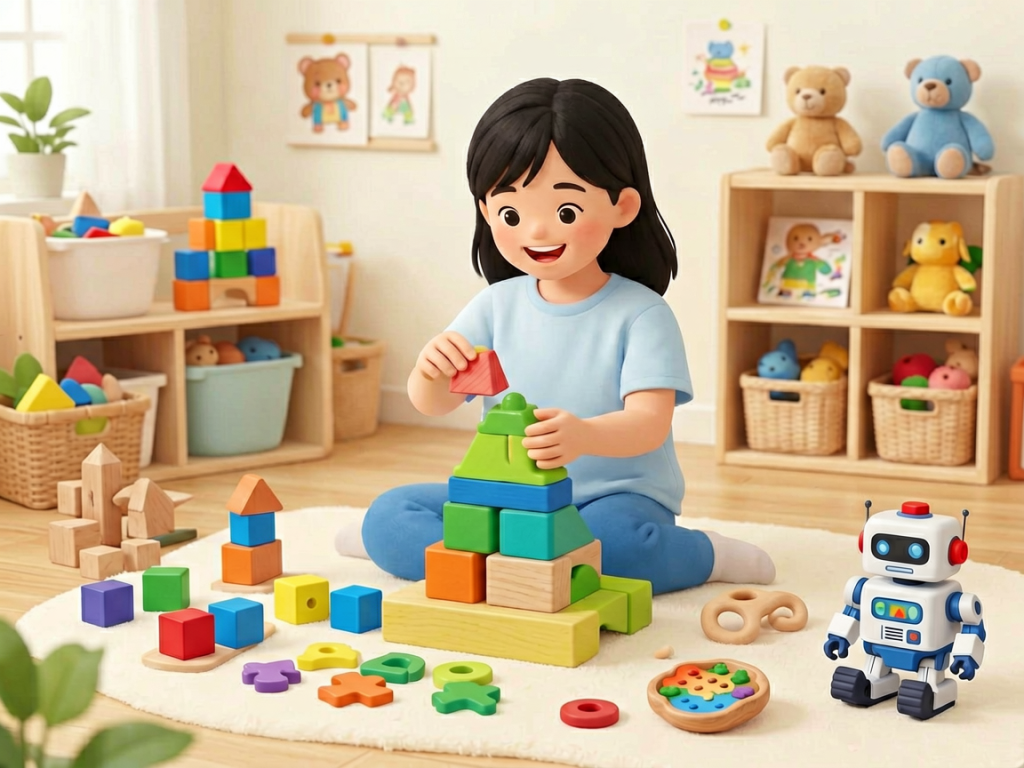
Six is the last rung of this path, and it is the one where the shelf changes character most. Up to five, toys were things the child used. From six, toys become the equipment for subjects: reading, number, strategy, making. The child is no longer learning how to use a material. They are using materials to learn a system.
This is step six of the upgrade order: five to six, what leaves, what stays, and the order to add the last set of things before the toy path hands over to school and to the skill lines that run alongside it.
What changes between five and six
A five-year-old can follow a rule. A six-year-old can hold a rule and a strategy at the same time, which is why games suddenly become interesting rather than merely tolerable. The same jump shows up everywhere: puzzles are sorted before they are started, brick builds are planned before the first piece, drawings have a background.
The second change is endurance. Six-year-olds can work on one thing for forty minutes and come back to it. That makes bigger kits, longer books, and multi-day projects viable in a way they were not a year earlier.
What to retire at six
Letter-of-the-week toys and alphabet puzzles. The letters are known. What is needed now is using them, which means words, not letter shapes.
Preschool matching and sorting sets. Colour, shape, and size sorting are solved. They can go to a younger sibling or a box.
Games with two rules and no decisions. Any game where the dice makes the choice has done its job. Keep the ones where the child must choose.
First science toys with one outcome. The sink-and-float set, the magnet wand, the gears board. Replaced by kits where the child sets up the test.
Toys that are younger siblings’ toys. At six, sharing a shelf with a three-year-old starts to matter: the older child needs a place where pieces are not scattered, and the younger needs toys that are safe to mouth.
What to keep, and what it becomes
Small bricks. The single best long-term toy on the shelf. At six the child builds from the instructions once and then builds inventions, which is the whole point of the material.
Games. Now the fastest-growing part of the shelf, because the child can hold rules, plan, and lose.
Pretend props and figures. Still in use, though the scripts get longer and more rule-bound: shops with prices, schools with registers, games with invented rules.
Art and making materials. The job is now construction: cardboard, tape, string, fabric, and a place to leave a project out overnight.
The bike and outdoor equipment. Movement stays on the shelf at every age; its absence is one of the quiet reasons indoor play gets stale.
What to add, in this order
Seven additions. The order matters here more than at any previous step, because the last three are the ones parents buy too early: a strategy game before the child can plan, a coding robot before the child can sequence, a science kit before the child can read the instructions.
| Order | Add at this step | What it unlocks | Move to the next when |
|---|---|---|---|
| 1 | Puzzles of one hundred to two hundred pieces, plus a 3D puzzle | Sorting by feature, working in sections, and holding an unfinished project across days | Finishes a hundred-and-fifty-piece puzzle without help or hints |
| 2 | Brick sets of two hundred pieces or more, with multi-step instructions | Reading a long sequence accurately, then deviating from it deliberately | Builds a set unaided and then rebuilds it into something original |
| 3 | Strategy games: checkers, simple card games, first chess | Modelling what the other player will do, and planning two moves ahead | Explains a losing move afterwards, rather than only being upset by it |
| 4 | Real reading practice: decodable readers, word-building tiles | Applying sounds to print, which is the bridge from being read to, to reading | Reads a short decodable book aloud with few hesitations |
| 5 | Number manipulatives: base-ten blocks, an abacus, play money and a clock | Place value, and numbers as quantities that can be regrouped | Exchanges ten ones for a ten without being told |
| 6 | First real science kits: circuits, a microscope, magnet sets rated six and up | Setting up a test and recording what happened | Runs the same test twice to check the result |
| 7 | Beginner coding toy with sequences, or a build kit with real fasteners | Instruction sequencing in a machine, or force and precision in making | Debugs a sequence after it fails, rather than starting over |
What to leave off the shelf at six
Kits rated nine and up. The rating is about reading level, fine motor precision, and patience, not about how interesting the subject is. A six-year-old can be gripped by electricity and still need an adult to strip the wire, at which point the toy is a demonstration.
Anything with a competitive score that the child plays alone. Scores without an opponent turn practice into performance, which is the fastest way to make a child avoid the thing they were good at.
Another themed set of the same material. At six, the shelf does not need a fifth brick set. It needs one bigger set, and the space to leave it up.
Two mistakes that stall the sixth year
Buying the school year in advance. Six is when the gap between “toys” and “school” starts to feel like a problem, and the shelf fills with workbooks and graded readers. The children who read well at seven are usually the ones who were read to a lot at five and six, not the ones who finished the most workbooks.
Forgetting that the path continues. Six is not the end of the toy path, it is the point where it splits into skill lines: reading, number, spatial reasoning, logic, science. The next step is not a bigger toy, it is a line to follow.
Details worth keeping from the parallel guides
The age on the box is not the rung. Packaging prints “5+” or “8+” as a shelf label, not a placement test. A six-year-old who already plans two moves ahead will be bored by a box marked 6+, and a six-year-old still working on pencil grip will be frustrated by one marked 8+ for reasons that have nothing to do with thinking. Place the toy by what the child has finished, not by the number printed on it.
The practical version: before adding anything at this step, name the last thing the child stopped doing — nesting, sorting by a single attribute, playing a game without needing to win. If that behaviour is gone, the next rung is open whatever the label says; if it is still there, the label is irrelevant. The shelf this step leaves is the toy path for five-year-olds, and the age page ahead is the toy path for six-year-olds.
Frequently Asked Questions
What toys should a six-year-old have?
Big puzzles, large brick sets, strategy games, real reading and number materials, a first science kit, and one making kit with real fasteners. Plus the open-ended materials from earlier years, which are still in use.
Is six too late to start a toy path?
No. The path can be joined at any rung: start with what the child can already do, then move to the next step in the sequence. What does not work is starting at the top because of the child’s age.
What comes after six?
The shelf stops being a single path and splits into skill lines: reading, number, spatial reasoning, logic, and science. Each line has its own sequence, and this site’s skill paths follow them from beginner to advanced.
Where this step sits in the toy path
Step six of six. The full map is in the toy path by age, and the rung you are leaving is the toy path for five-year-olds.
If you are arriving here first, start at the beginning: From One to Two is where the sequence starts.
The age page for this rung is the toy path for six-year-olds, and the logic line continues in beginner toys for the logical thinking path.
The board game branch of this rung, where hidden information opens up, is first board games from ages three to six.