The Best Toy Path for Critical Thinking: From Blocks to Board Games, a Developmental Journey
Introduction: Why Toys Matter for the Mind
In an age of digital saturation, where screens dominate children’s attention from infancy, the humble toy has never been more important—or more misunderstood. While parents often gravitate toward toys that promise quick entertainment or academic skill-building, the most powerful playthings are those that quietly cultivate critical thinking: the ability to analyze, evaluate, question, and create solutions in novel situations. Critical thinking is not a single skill but a constellation of habits—curiosity, skepticism, logical reasoning, perspective-taking, and metacognition. And the best path to develop it is not a single toy but a sequenced, age-appropriate “toy pathway” that challenges the mind at each stage of development.
This article maps out that pathway—the best toy path for critical thinking—from early childhood through adolescence. It is a route that prioritizes open-endedness over instructions, complexity over flashiness, and reflection over rote play. Along the way, we will see how toys like wooden blocks, construction sets, strategy board games, and logic puzzles build the cognitive muscles that schools often overlook but life absolutely demands.
I. The Foundation: Open-Ended Construction Toys (Ages 2–6)
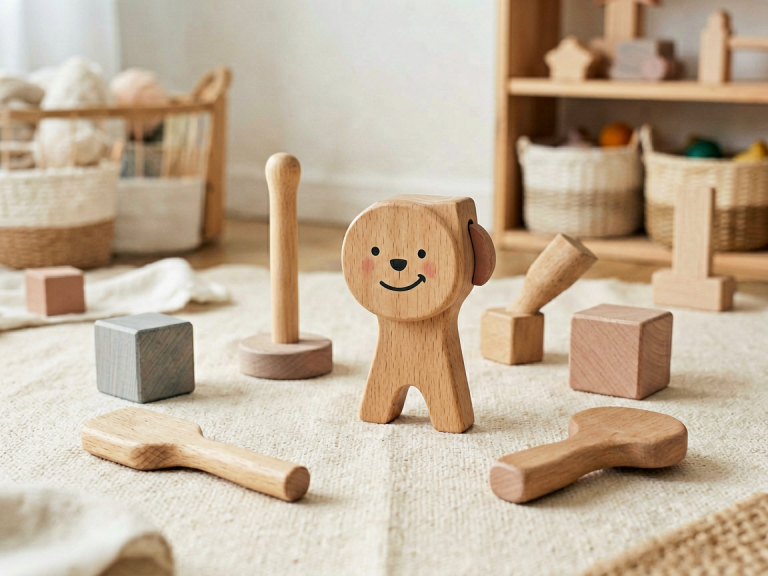
Critical thinking begins with the most basic cognitive act: understanding cause and effect. For toddlers and preschoolers, the best toys are those that allow them to manipulate physical objects and observe outcomes without predetermined rules. Wooden blocks, stacking rings, magnetic tiles, and simple LEGO Duplo are the gold standard here. Why? Because they force the child to ask questions: “What happens if I put this big block on top of that small one?” “How can I make this tower taller without it falling?” “What shapes fit together to make a bridge?”
These toys do not come with step-by-step instructions. The child must experiment, fail, and try again. This process—trial and error combined with observation—is the raw material of scientific thinking. A child who repeatedly builds a tower that topples is not just playing; she is forming hypotheses (if I use a wider base, it might stay), testing them, and revising her mental model. This is the essence of critical thinking: the willingness to be wrong and the ability to learn from mistakes.
Moreover, open-ended construction toys naturally foster spatial reasoning and planning. A child trying to build a castle must visualize the final structure before placing the first block. Over time, this develops the prefrontal cortex’s ability to hold multiple steps in mind—a precursor to complex problem-solving later in life. Parents and educators should resist the urge to show children “the right way” to play; instead, they should ask questions like, “What do you think will happen if you put that piece there?” or “How could you make your tower stronger?” This metacognitive prompting turns simple stacking into a mini-laboratory for logic.
II. The Bridge: Pattern Recognition and Logic Puzzles (Ages 5–9)
As children enter elementary school, their brains become hungry for patterns and rules. This is the perfect moment to introduce toys that demand systematic thinking and deductive reasoning. Tangrams, pattern blocks, logic grid puzzles (like those in puzzle books), and simple coding games (like Robot Turtles or Code-a-Pillar) are excellent choices. These toys teach children to identify relationships, classify information, and follow logical sequences—all core components of critical thinking.
Consider tangrams: a set of seven geometric shapes that must be rearranged to form a specific silhouette. To succeed, a child must analyze the silhouette’s contours, mentally rotate shapes, and test combinations. This is not mere visual play; it is an exercise in hypothesis testing and constraint satisfaction. Similarly, pattern block activities require children to extrapolate from a repeating sequence—a skill directly linked to mathematical reasoning and scientific inference.
Logic puzzles, whether in book form or as board games like Mastermind (simplified versions), introduce the concept of deductive elimination. In Mastermind, one player sets a secret code of colored pegs, and the other tries to deduce it through a series of guesses, each of which receives feedback. The child must use the feedback to eliminate possibilities and narrow down the solution. This is a hands-on, enjoyable way to learn the principle of if-then reasoning and the importance of keeping track of what you know and what you do not.
At this stage, the role of the adult should shift from asking open-ended questions to guiding reflection. After a puzzle session, a parent might ask: “How did you figure out that the triangle goes there?” or “What clues did you use to make your guess?” This helps the child articulate her thinking process, making tacit knowledge explicit—a key step toward metacognitive awareness.
III. The Core: Strategy Board Games (Ages 8–12)
By middle childhood, children are ready for the most powerful critical-thinking tool in the toy box: strategy board games. Games like Chess, Checkers, Settlers of Catan, Ticket to Ride, Blokus, and Carcassonne require players to think several moves ahead, anticipate opponents’ actions, and adapt to changing circumstances. Unlike puzzles, which have a single correct answer, strategy games are dynamic, social, and full of uncertainty—exactly like real-world problems.
Take Chess. It is often called the ultimate critical-thinking game for good reason. Every move requires consideration of multiple possibilities, evaluation of trade-offs (e.g., sacrifice a pawn to gain positional advantage), and long-term planning. The player must hold a mental model of the board, reason about the opponent’s intentions, and update that model as the game unfolds. Moreover, chess teaches consequential thinking: the recognition that every decision has a ripple effect. A child who loses a game learns to analyze: “Where did I go wrong? What was the critical mistake?” This post-game reflection is a form of critical self-evaluation that is rarely taught in classrooms.
Other strategy games add additional layers. Settlers of Catan forces players to negotiate and trade, introducing social reasoning and perspective-taking. A child must ask: “What does my opponent need? How can I use that information to my advantage while still appearing fair?” This is a sophisticated exercise in empathy combined with self-interest—a hallmark of advanced critical thinking. Ticket to Ride emphasizes efficiency and resource management: the player must optimize routes given limited train cars, a classic constrained optimization problem.
Importantly, these games are best played in a low-pressure, collaborative environment. While competition is motivating, the goal is not to win but to think. Parents and teachers should encourage post-game discussions: “What was the most important decision you made?” “If you could replay that move, what would you do differently?” This transforms gameplay into a thinking laboratory.
IV. The Pinnacle: Argument and Systems Thinking (Ages 12+)
Adolescents are capable of abstract reasoning, but they still need concrete tools to practice it. This is where debate-oriented toys, complex role-playing games, and simulation games come into play. Think of Dungeons & Dragons, Risk (with complex rules variants), cooperative games like Pandemic, or even logic-based escape room kits. These games require players to synthesize information from multiple sources, weigh competing values, and make decisions under uncertainty.
Take Pandemic, a cooperative board game where players work together to stop global disease outbreaks. Each player has a unique role with special abilities. To win, the group must coordinate, share information, and prioritize actions. This involves systems thinking: understanding how different parts of the system (cities, diseases, player abilities) interact. A critical thinker must ask: “If we cure this disease first, will that free up resources for the other tasks? Or does it make more sense to contain the current outbreaks?” This is exactly the kind of decision-making needed in real-world crisis management.
Similarly, Dungeons & Dragons (D&D) is a masterclass in critical thinking. Players must solve problems through storytelling, character abilities, and creative reasoning. There is no single solution; the Dungeon Master (game leader) adjudicates based on logic and narrative consistency. Players must argue their case (“My character would try to negotiate with the goblin chief because we share a common enemy”), evaluate risks (“Should I use my last spell slot now or save it for the boss fight?”), and adapt when plans fail. D&D also fosters ethical reasoning—players often confront moral dilemmas that have no clear right answer.
Even simpler role-playing games, like the Mind’s Eye mysteries or social deduction games such as Werewolf or Secret Hitler, train critical listening and logical fallacies detection. Players must evaluate statements for consistency, identify hidden biases, and decide whom to trust—all while managing their own emotions and presentation. This is a direct rehearsal for navigating real-world social and political complexity.
V. The Digital Frontier: Strategic Video Games (with Caution)
No discussion of the best toy path for critical thinking would be complete without acknowledging the role of digital games. When chosen wisely, certain video games can be even more effective than physical toys for some aspects of critical thinking. Minecraft in “creative” or “survival” mode is essentially a digital version of open-ended construction, but with infinite possibilities and automatic feedback. Portal and Portal 2 are pure logic puzzles that require players to think spatially and chronologically, often using portals to solve problems that seem impossible. Kerbal Space Program forces players to design rockets and manage orbital mechanics—an incredible exercise in physics-based reasoning.
However, digital games come with risks: passive consumption, algorithm-driven loops, and attention fragmentation. The key is to choose games that are non-linear, sandbox-oriented, and require active problem-solving rather than rote clicking. Parents should play alongside their children, ask questions, and limit screen time to ensure that digital play does not crowd out the richer, social, tactile experiences of physical toys. The best path for critical thinking rarely relies on a single medium.
Conclusion: A Path, Not a Destination
The best toy path for critical thinking is not a shopping list. It is a developmental philosophy. It begins with the freedom to fail with blocks, moves through the logic of puzzles, deepens with the strategy of board games, and culminates in the collaborative complexity of role-playing and simulation. Throughout, the adult’s role is to be a thinking partner—asking questions, celebrating mistakes, and modeling curiosity.
In a world that increasingly demands creative problem-solvers, the simplest toys—a set of blocks, a chess board, a deck of cards—are the most revolutionary tools we have. They reverse the modern trend of passive consumption and invite children to become active architects of their own understanding. By following this path, we do not just raise kids who can answer tests; we raise thinkers who can question, adapt, and build a better world.
Start with the complete guide: Building Minds: The Best Beginner Toys for Problem Solving.