From Rattles to Puzzles: The Optimal Toy Progression for Developing Fine Motor Skills
1. Introduction
Fine motor skills—the coordinated movements of small muscles in the hands, fingers, and wrists—are foundational to a child’s independence, academic readiness, and self‑confidence. From grasping a spoon to writing a letter, these skills emerge gradually and are profoundly shaped by the environment. Among the most powerful environmental tools are toys. However, not all toys are created equal; the key lies in a *progression* that aligns with developmental milestones. This article explores the evidence‑based sequence of toy types and play activities that support fine motor skill development from infancy through early childhood. Understanding this trajectory helps parents, educators, and therapists select toys that challenge without overwhelming, and that transform play into purposeful practice.
2. The First Six Months: Sensory Exploration and Reflexive Grasp
2.1 From Reflex to Voluntary Reach
Newborns are born with a palmar grasp reflex—if you place a finger in their palm, they will clutch it tightly. This reflex, however, is not a voluntary fine motor skill. During the first three months, infants begin to swipe at objects, and by four to six months they can deliberately reach and bat at dangling toys. The ideal toys for this stage are lightweight, easy to hold, and rich in sensory feedback.
2.2 Recommended Toys and Their Roles
- Soft rattles and plush rings: These encourage the infant to close their fingers around an object. The sound reinforces the action, creating a cause‑effect loop that motivates repetition.
- Activity gyms with hanging toys: Reaching upward and swiping strengthens shoulder and arm muscles, which are proximal prerequisites for later hand control.
- Textured teethers: Different surfaces (ribbed, smooth, bumpy) stimulate tactile perception and prompt the child to transfer objects from one hand to the other—a milestone known as hand‑to‑hand transfer, usually emerging around five to six months.
During this period, fine motor skill progression is less about dexterity and more about building the neural pathways that connect vision, touch, and movement. Toys should be presented in an accessible but supervised manner, allowing the infant to explore with their mouth as well as their hands. Mouthing is a critical sensory exploration that informs the brain about object properties, which later aids in tool use.
3. Six to Twelve Months: The Pincer Grasp and Intentional Release
3.1 The Emergence of Precision
Around seven to eight months, a major transition occurs: the pincer grasp. The infant begins using the thumb and index finger—instead of the whole palm—to pick up small objects. This requires refined motor control and opposition of the thumb, a uniquely human ability. Simultaneously, the skill of *voluntary release* (letting go of an object deliberately) appears.
3.2 Toy Progression for Precision and Release
- Stacking rings (with wide central post): Initially, infants may only knock over a stack; later, they attempt to place rings onto the post. That action demands eye‑hand coordination and the ability to release at the right moment.
- Oversized pegs and pegboards: Pegs with knobs allow the child to grasp with a three‑finger grip (thumb, index, middle) and then push the peg into a hole, combining grasp, aim, and release.
- Shape sorters (simple shapes, large pieces): Sorting requires the child to rotate the shape mentally and physically while maintaining a grip—a complex motor planning activity.
- Pull‑apart toys (like plastic eggs or blocks that snap together): Pulling apart exercises grip strength and bilateral coordination (using both hands together).
It is crucial at this stage to offer toys that are too large to be swallowed but small enough to challenge the fingers. Choking hazards must be strictly avoided, but a reasonable size—such as 2‑inch blocks or rings—provides the necessary challenge without risk.
4. Twelve to Eighteen Months: Refining Dexterity and Tool Use
4.1 Building on Existing Skills
As toddlers begin to walk, their hands become freer to manipulate objects while standing or sitting. The pincer grasp becomes more precise, and they start using simple tools: a crayon to scribble, a spoon to scoop, or a brush to paint. Fine motor progression now involves coordination across the midline of the body and the ability to perform actions in sequence.
4.2 Toy Types That Support Advanced Manipulation
- Fat crayons or egg‑shaped crayons: These are easier to grip than standard crayons and encourage a fist grip that will later transition to a tripod grasp. Scribbling strengthens the intrinsic hand muscles.
- Nesting cups or stacking cups: Nesting requires careful alignment and graded release (letting go gently), while stacking requires stability and wrist control.
- Simple puzzles (one‑to‑three pieces with large knobs): Lifting a puzzle piece using a knob reinforces the pincer grasp and visual‑spatial reasoning.
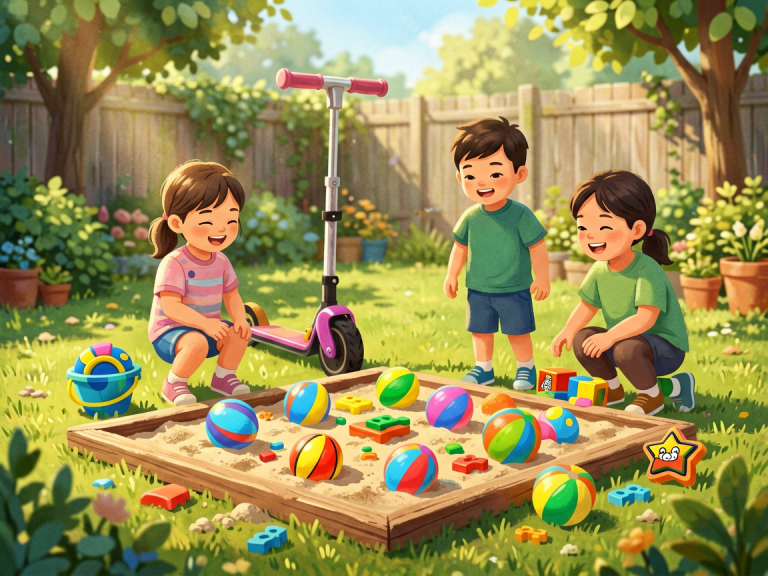
- Scooping and pouring toys (e.g., sand toys with scoops and containers): These bilateral activities (one hand holds the container, the other scoops) are excellent for developing wrist rotation and hand‑eye coordination.
- Lacing beads (with large holes and blunt tips): Threading a string through beads requires sustained attention, bilateral coordination, and the ability to stabilize with one hand while the other manipulates.
During these months, children also begin to rotate their wrists to turn objects—for instance, turning a door knob or unscrewing a lid. Toys like plastic jars with screw‑on lids (with large threads) can be introduced to practice pronation and supination.
5. Eighteen to Twenty‑Four Months: Hand‑Eye Coordination and Two‑Handed Tasks
5.1 The Age of Manipulative Play
Toddlers in this age range are capable of more complex manipulative tasks. They can stack blocks six to eight high, turn single pages of a book, and begin to use scissors (with assistance). The progression of fine motor skills now includes the ability to sustain grip strength for longer periods and to adjust force based on object properties (e.g., holding a fragile egg‑shaped toy gently vs. squeezing a rubber ball).
5.2 Purposeful Toy Progressions
- Interlocking blocks (Duplo‑style): Pushing two blocks together requires controlled force and alignment; pulling them apart requires bilateral coordination. This activity strengthens the arches of the hand.
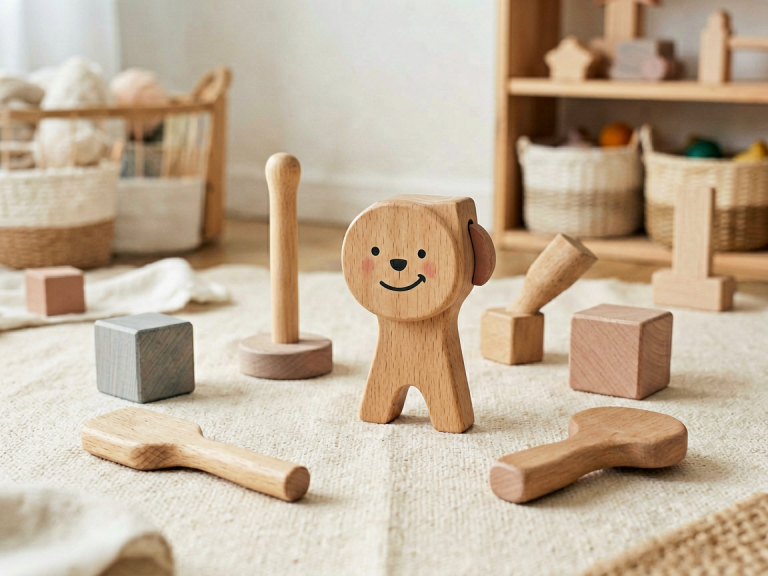
- Pounding benches with pegs: Using a wooden hammer to hit pegs develops grip strength, motor planning, and the ability to hit a target repeatedly—a precursor to writing strokes.
- Chunky puzzles with interlocking pieces (four to six pieces): Unlike knob puzzles, interlocking puzzles require the child to manipulate the piece while it is flush with the board, demanding more precise finger movements.
- Play dough with simple tools (plastic knives, rollers, cookie cutters): Rolling, squeezing, and cutting dough provide rich proprioceptive feedback and exercise the small muscles of the hands. Pinching off small pieces of dough is an excellent pincer grasp exercise.
- Self‑care toys: Wooden food items with Velcro pieces that can be “cut”: These simulate actual kitchen tasks, promoting the use of a sawing motion, bilateral coordination, and hand division (holding the food with one hand while cutting with the other).
At this stage, parents should also encourage dressing practice—snaps, large buttons, and zippers on activity boards—which combine fine motor skills with daily living independence.
6. Two to Three Years: Precision, Scribing, and the Transition to Writing
6.1 Refining the Tripod Grasp
Between ages two and three, children typically shift from a fist grip on a writing tool to a more mature grasp involving the thumb, index, and middle fingers. This is known as a static tripod grasp—the hand moves as a unit, but the wrist is relatively stable. Fine motor progress now emphasizes the separation of the two sides of the hand: the precision side (thumb, index, middle) and the power side (ring, pinky).
6.2 Toys That Build the Foundation for Handwriting
- Chunky crayons, markers, and sidewalk chalk: Drawing circles, lines, and dots on large surfaces builds shoulder stability and wrist extension—both critical for future writing.
- Stringing small beads (holes 1‑2 cm): This requires a more refined pincer grasp and sustained concentration. It also develops the in‑hand manipulation skills (e.g., transferring a bead from palm to fingertips).
- Scissors (blunt‑tipped, spring‑assisted): Initially, children cut random snips; later they cut along a line. Cutting is one of the best activities for strengthening the thenar eminence and the intrinsic hand muscles.
- Lacing boards or cards: Threading a shoelace through holes in a stiff card requires precise eye‑hand coordination and the ability to push and pull with controlled force.
- Pop beads (connecting beads that snap together): These require a pincer grip to align and then a push with the thumb—an excellent exercise for opposition.
- Sticker books and sticker tasks: Peeling a sticker off a sheet and placing it accurately on a page challenges the pincer grasp and the ability to release with precision.
Children at this age also benefit from construction toys such as large Lego Duplo sets (now with smaller details) and simple magnetic building tiles. The magnetic attraction provides satisfying feedback and reduces the frustration of pieces falling apart.
7. Three to Five Years: Complex Manipulation and Fine Artistry
7.1 Mastery of the Dynamic Tripod Grasp
By age four or five, many children have achieved a dynamic tripod grasp—the fingers move independently while the wrist is stable and the forearm rests on the table. This is the mature grip used in handwriting. Fine motor progress now includes the ability to manipulate small objects with speed and accuracy, and to perform sequences of actions such as knotting, weaving, or using a hole punch.
7.2 Advanced Toy Progressions
- Small interlocking bricks (eg, classic Lego): Building structures with small bricks requires precise alignment, controlled force, and the ability to retrieve a specific piece from a pile using a pincer grip. Advanced sets introduce step‑by‑step instruction following.
- Beading kits with letters or patterns: Threading beads onto a string to spell names or create patterns combines fine motor practice with cognitive and literacy skills.
- Wooden lacing animals or sewing cards: Using a real needle (blunt‑tipped) and thread to sew around an outline is an excellent pre‑sewing activity that develops bilateral coordination and finger dexterity.
- Tweezer or tongs transfer games: Picking up small pom‑poms or beads with tweezers and moving them to an ice‑cube tray is a powerful activity for isolating the thumb and index finger, simulating the movements required for zipping and buttoning.
- Paper crafts (cutting, folding, gluing): Using a glue stick to apply adhesive only to specific areas, folding paper along lines, and cutting curves and shapes all demand high levels of fine motor control.
- Screwdriver boards (with large plastic screws): Turning a screwdriver or twisting a screw with fingers strengthens the thenar muscles and promotes wrist rotation.
Play dough also evolves at this age—children can roll it into thin snakes, pinch small balls, and use cookie cutters to create shapes, requiring graded force and precise finger movement.
8. Beyond Five Years: Fine Motor Fluency and Tool Mastery
8.1 Integration into Daily Life
Once foundational fine motor skills are established, toys shift from being solely skill‑builders to tools for creative expression and complex problem‑solving. Children at age five and older should engage in activities that require sustained fine motor effort and that mimic real‑world tasks.
8.2 Recommended Activities (Some of Which Are Toys, Others Play‑Based)
- Construction sets with nuts, bolts, and wrenches (e.g., Erector sets or K’Nex): These demand bilateral coordination, grip strength, and the ability to turn small fasteners.
- Model‑making kits (airplanes, cars) with snap‑together or screw‑together parts: Following multi‑step instructions while handling tiny components is an excellent fine motor workout.
- Beading jewelry with tiny beads (4‑6 mm): Threading needles with small beads and creating patterns or bracelets develops the dynamic tripod grasp and hand‑eye coordination at a high level.
- Origami and paper folding: Precise folding along creases, pinching corners, and flattening paper require sustained control and finger strength.
- Drawing and writing tools: Using pencils with grips, calligraphy markers, or fine‑tipped pens encourages a mature grasp. Mazes, dot‑to‑dots, and detailed coloring books offer structured practice.
At this stage, the toy progression should also include board games that involve picking up small tokens (e.g., Monopoly money, game pieces), as well as musical instruments like the recorder, xylophone, or piano keyboard, which require independent finger movements.
9. Conclusion: Matching Toys to Milestones
The journey of fine motor development is not a race; it is a carefully sequenced dance between maturation and environmental opportunity. By choosing toys that align with the child’s current abilities and that provide just the right level of challenge—neither too easy nor too frustrating—adults can support the gradual refinement of hand skills. From the reflexive grasp of a newborn to the precise finger movements of a school‑aged child, every toy plays a role in sculpting the neural pathways that will serve the child for a lifetime. Whether a simple rattle or a complex construction kit, the right toy at the right time transforms play into progress, and progress into confidence.
Start with the complete guide: Unlocking Dexterity: The Best Toys for Fine Motor Development in Early Childhood.