Unlocking Imagination: The Best Creativity Development Toys by Age
Introduction
Creativity is not a mysterious gift reserved for a select few; it is a cognitive muscle that can be strengthened from the earliest days of life. For children, the most effective way to exercise this muscle is through play. Toys are the tools of that play, and when chosen wisely, they do more than entertain—they spark curiosity, encourage problem-solving, and build the neural pathways that underpin original thinking. However, not all toys are created equal. A rattle that delights a three-month-old will bore a three-year-old, while a complex robotics kit that inspires a ten-year-old may frustrate a toddler. Understanding which creativity development toys work best at each age is essential for parents, educators, and caregivers who want to nurture a child’s innate imaginative potential. This article explores playthings tailored to different developmental stages, explaining how each type of toy supports the growth of creativity through sensory exploration, open-ended play, construction, storytelling, and complex problem-solving.
—
Infants (0–12 Months): Sensory Seeds of Creativity
In the first year, a baby’s world is built entirely through the senses. Creativity at this stage is not about making something new but about discovering the properties of the world. The best toys for infants are those that stimulate sight, sound, touch, and eventually cause-and-effect relationships. High-contrast black-and-white cards, soft fabric books with crinkly pages, and rattles with different textures invite babies to explore. Simple activity gyms with hanging objects encourage batting and grasping, which builds hand-eye coordination and the understanding that actions produce reactions.
Why does this foster creativity? Because every new sensory experience forms a mental schema. When a baby shakes a rattle and hears a sound, she is learning a fundamental principle: “I can change my environment.” This cause-and-effect awareness is the bedrock of creative problem-solving. Additionally, toys that offer multiple ways to interact—such as a set of soft blocks that can be mouthed, stacked, or knocked down—introduce the idea of open-endedness. Even at this age, the toy does not dictate the play; the baby does. Parents can enhance this by rotating toys to prevent habituation, keeping the environment fresh. The goal is not to teach but to allow the infant to be an active discoverer, laying the sensory foundation for all future creative endeavors.
—
Toddlers (1–3 Years): Building Blocks of Imagination
As children begin to walk and talk, their world expands, and so does their capacity for pretend play. Toddlers are natural imitators, and toys that support symbolic thinking—where one object stands for another—are powerful creativity boosters. Simple building blocks, such as classic wooden unit blocks or large interlocking plastic bricks (like Mega Bloks), allow toddlers to construct towers, houses, and bridges. The act of stacking, balancing, and knocking down teaches physics, spatial reasoning, and resilience (learning from failure is a creative skill).
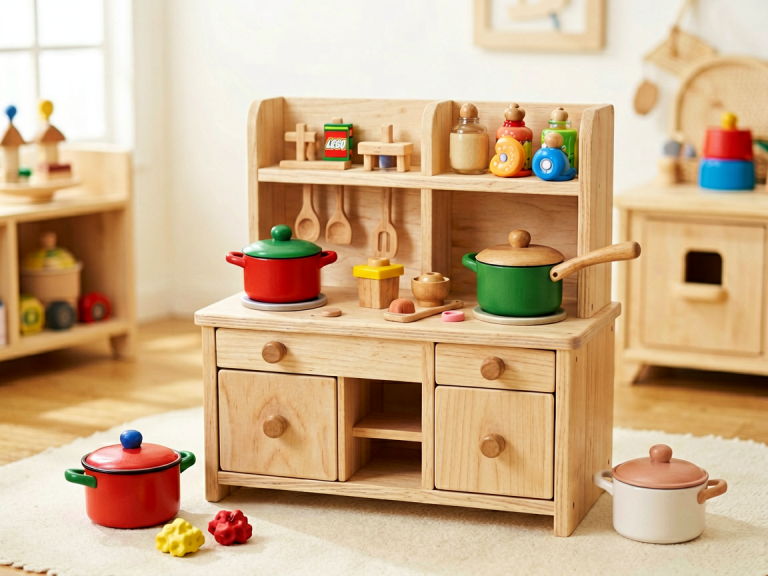
Equally important are toys that invite role-play. A play kitchen with plastic fruits and pots, a toy tool bench, or a simple doll with a blanket lets toddlers act out everyday scenes they observe. When a child pretends to “cook” a meal using a block as a carrot, she is practicing divergent thinking—using an object in a non-literal way. Art supplies for this age should be safe and washable: chunky crayons, non-toxic finger paints, and large sheets of paper. These allow toddlers to make marks simply for the joy of seeing color and shape appear. The process, not the product, matters. At this stage, avoid toys with flashing lights and pre-programmed songs that dictate the play; instead, choose simple, open-ended items that require the child to invent the story. A cardboard box can become a car, a spaceship, or a castle—the ultimate creativity development toy.
—
Preschoolers (3–5 Years): Storytelling and Structured Invention
Preschoolers possess a burgeoning imagination and a growing ability to hold complex narratives in their minds. They can plan, sequence, and collaborate. Creativity development toys for this age should challenge them to expand their stories and refine their fine motor skills. LEGO Duplo sets with themed pieces (such as a farm or a fire station) provide scaffolding for narrative play. The child builds a setting and then populates it with figures, acting out scenes that often mix real-life experiences with fantasy. Dress-up costumes—from doctor coats to superhero capes—are another excellent investment. When a preschooler wears a costume, she steps into a character’s shoes, exploring different perspectives and emotions.
Art and craft materials become more sophisticated: safety scissors, glue sticks, play dough, modeling clay, and recyclable materials for collage. These allow children to plan and execute a vision, such as making a “spaceship” from a toilet paper roll and foil. Simple board games like “Candy Land” or “Chutes and Ladders” introduce turn-taking and rule following, but also allow for creative variations (children often invent their own rules). Storytelling toys—such as felt boards with cut-out characters or blank books to draw and dictate stories—encourage language development and narrative structure. Perhaps most importantly, preschoolers thrive on open-ended questions from adults: “What does your robot do?” or “What happens next in your story?” Such interactions transform a toy into a creativity catalyst.
—
School-Age Children (6–12 Years): Complex Systems and Self-Expression
Once children enter school, their cognitive abilities leap forward. They can understand abstract concepts, follow multi-step instructions, and work on projects that span days or weeks. Creativity development toys for this age should challenge them to design, build, and debug. Advanced construction sets—like LEGO Technic or magnetic building tiles (e.g., Magna-Tiles)—let children create structures with gears, pulleys, and moving parts. These toys teach engineering thinking: planning, testing, and iterating.
Coding toys have become powerful tools for creativity. Kits like the Sphero robot, Osmo coding games, or the Makey Makey invention kit allow children to program behaviors, linking logical thinking with imaginative outcomes. A child can code a robot to perform a dance, design a video game character, or create a musical instrument from fruit. Science kits—crystal-growing sets, volcano experiments, or simple circuitry projects—blend creativity with inquiry. Art kits that include advanced materials like watercolor pencils, embroidery thread, or polymer clay invite refined craftsmanship. Storytelling takes digital form: children can use apps like Scratch or stop-motion animation kits to produce their own short films.
Board games for this age, such as Settlers of Catan or collaborative puzzle games, require strategic thinking, negotiation, and creative problem-solving under constraints. Musical instruments—a recorder, a ukulele, or a digital keyboard—give children a medium for emotional expression and pattern creation. The key is to present toys that are both challenging and forgiving, allowing for failure as part of the creative cycle. A child who builds a bridge that collapses must reimagine its supports; that process mirrors real-world innovation.
—
Tweens and Teens (13+ Years): Mastery and Personal Projects
Adolescents crave autonomy, identity, and relevance. Creativity development for this age group shifts from guided play to self-directed, often tech-integrated projects. Advanced coding and electronics kits—such as Arduino starter sets, Raspberry Pi computers, or 3D printing pens and printers—allow teens to design and fabricate their own inventions. They might create a custom phone case, a programmable LED sign, or a simple robot. These toys teach project management and persistence.
Artistic teens benefit from specialized tools: a high-quality sketchbook with charcoal and pastels, a digital drawing tablet, a sewing machine, or a pottery wheel. Photography or videography equipment—even a good smartphone camera with editing software—can become a medium for storytelling and visual experimentation. Musical instrument upgrades (a decent guitar, a MIDI keyboard for music production) support composition and performance. Board games and role-playing games like Dungeons & Dragons encourage world-building, collaborative storytelling, and improvisation.
At this age, the most valuable “toy” is often a subscription box or online platform that provides challenges and a community. Examples include monthly craft boxes that teach silk-screen printing or leatherworking, or coding platforms like Codecademy that allow teens to build websites or games. The creativity development comes from the process of setting a goal, acquiring skills, executing a plan, and sharing the result. Parents can support this by providing space, materials, and encouragement—not direction. The teen needs to own their creative journey.
—
Conclusion
Selecting creativity development toys by age is not about following a rigid formula; it is about recognizing the child’s current cognitive, emotional, and physical capabilities and then offering tools that stretch those abilities just beyond their comfort zone. For infants, sensory toys build foundational neural connections. For toddlers, open-ended blocks and pretend-play sets ignite symbolic thinking. Preschoolers thrive on storytelling and construction that combine imagination with fine motor skills. School-age children benefit from systems that merge logic with invention, while teens need tools for mastery and self-expression.
The best toy is never the one that does everything; it is the one that invites the child to do something. A cardboard box, a set of blocks, a handful of clay, or a coding kit—all are empty stages upon which a child can write their own play. By matching toys to developmental stages, we give children the richest possible environment for imagination to flourish. In doing so, we prepare them not only to be creative thinkers but also to be resilient, curious, and confident individuals ready to solve the problems of tomorrow.