Unleashing Imagination: The Best Toys for Creativity Development
In a world increasingly shaped by rapid technological change and standardized testing, the importance of creativity has never been more apparent. Creativity is not merely an artistic talent; it is a fundamental human skill that enables problem-solving, innovation, emotional expression, and adaptive thinking. While many factors contribute to a child's creative growth—such as environment, encouragement, and exposure to diverse experiences—the role of play cannot be overstated. The toys children interact with daily can either stifle or stimulate their imaginative capacities. The best toys for creativity development are those that are open-ended, encourage exploration, and allow for multiple outcomes. They do not dictate a single correct way to play; instead, they invite children to invent, experiment, and discover. This article explores the most effective types of toys that nurture creativity, examining why they work and how they contribute to a child’s cognitive and emotional development.
The Power of Open-Ended Building Blocks
Building blocks are perhaps the quintessential creative toy, and for good reason. Unlike many modern electronic gadgets that offer pre-programmed responses, a simple set of wooden or plastic blocks presents an infinite number of possibilities. A child can construct a tower, a bridge, a spaceship, or an imaginary city—the only limit is their imagination. This open-ended nature is critical for creativity development because it encourages divergent thinking, the ability to generate many different ideas from a single starting point. When a child picks up a block, they must decide where to place it, what shape to create, and how to solve structural problems such as balance and symmetry. These decisions require planning, spatial reasoning, and iterative experimentation. If the tower falls, the child learns to adjust and try again, building resilience along with creativity.
Research in child development consistently shows that block play enhances executive functions, including working memory, cognitive flexibility, and inhibitory control—all of which are closely linked to creative thinking. Moreover, blocks can be combined with other toys, such as figurines or vehicles, to create elaborate narratives. A child might build a castle for a knight, then invent a story about a dragon attack. This synthesis of construction and storytelling amplifies creative expression. The best building block sets are those that are simple in design, perhaps made of natural materials like wood, with no pre-printed instructions or fixed shapes. Sets like unit blocks, magnetic tiles, or interlocking bricks (such as LEGO Classic series) that come with a wide variety of shapes rather than specialized pieces encourage the most creativity. Parents and educators should resist the temptation to buy sets that build only one specific model; the true value lies in the freedom to create anything.
Art Supplies: Unleashing Visual Expression
Art materials are another cornerstone of creative play. Crayons, markers, paints, clay, and collage materials allow children to translate their inner worlds into tangible forms. The act of creating art is inherently creative because there is no single "right" outcome. A child painting a purple sky or a three-legged dog is not making a mistake; they are exploring possibilities. These choices—of color, shape, texture, and composition—foster creative decision-making from a very young age. Unlike coloring books that confine children to pre-drawn lines, blank paper and unrestricted supplies invite original thinking. The best art toys for creativity are those that are open-ended and process-oriented rather than product-oriented. For example, a set of watercolor paints, a pad of good paper, and a brush offer endless variations in technique and result. Play-Doh or modeling clay allows children to sculpt three-dimensional forms, which engages different cognitive and motor skills than drawing.
Importantly, art supplies also support emotional creativity. Children often use art to express feelings they cannot yet verbalize—joy, anger, fear, or wonder. A child who creates a "monster" out of clay may be working through a fear in a safe, controlled way. The act of making something new from raw materials builds a sense of agency and confidence. To maximize creative benefits, adults should provide a variety of tools (brushes of different sizes, sponges, stamps, natural objects like leaves or sticks for texture) and resist the urge to direct the child's work. The best approach is to offer materials, demonstrate basic techniques if needed, then step back and let the child lead. Avoid asking "What is it?" too quickly; instead, ask "Tell me about your painting" to encourage narrative and interpretation. Rotating art supplies periodically can also spark new ideas—one week focus on collage, the next on watercolors, and so on.
Role-Play and Pretend Play Sets
Dramatic or pretend play is arguably one of the most powerful vehicles for creativity. When a child puts on a costume, picks up a toy kitchen set, or arranges a group of dolls for an imaginary tea party, they are engaging in complex cognitive processes: they create characters, invent scenarios, negotiate rules, and improvise dialogue. This form of play is directly linked to the development of what psychologists call "divergent thinking" and "theory of mind"—the ability to understand that others have different thoughts and perspectives. Pretend play allows children to experiment with social roles, emotions, and problem-solving in a low-stakes environment. The best toys for this type of play are not realistic plastic replicas of everyday objects, but rather simple, adaptable props that can be repurposed in countless ways.
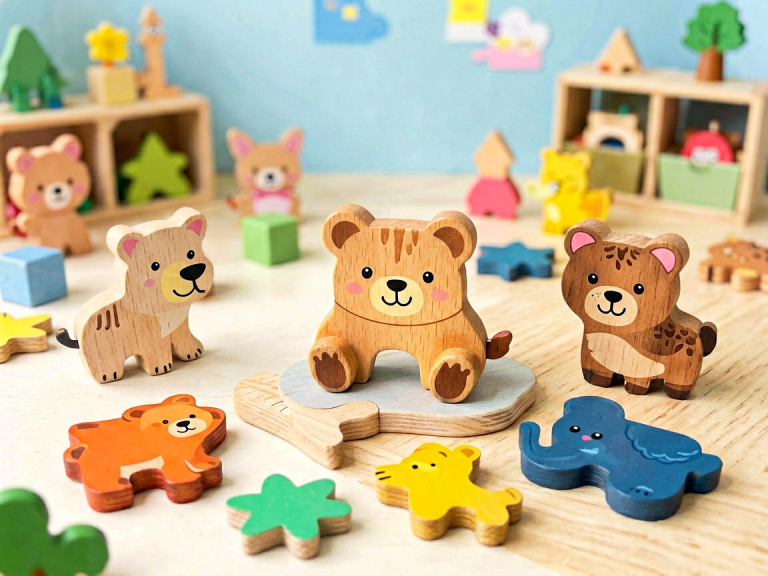
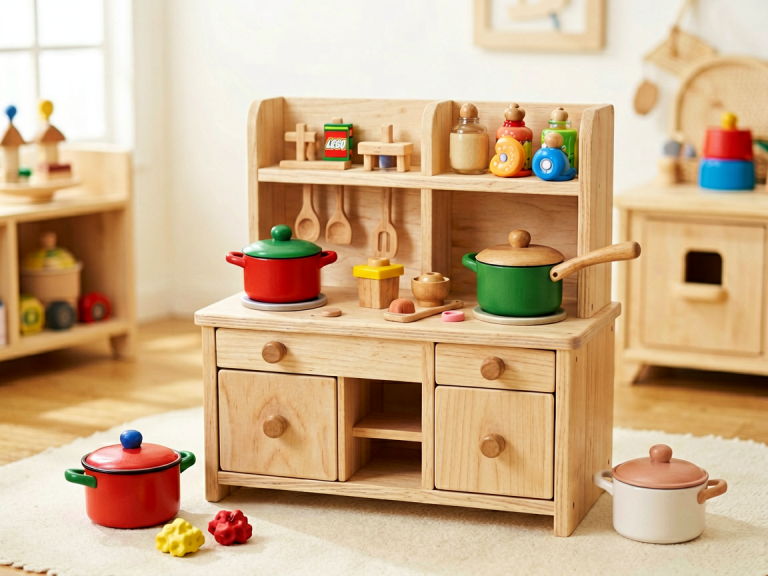
A wooden play kitchen, for example, can become a restaurant, a science lab, or a space station depending on the child’s imagination. Dress-up clothes, scarves, hats, and fabric pieces are far more valuable than a single specific costume, because they can be combined to create any character. Similarly, a simple set of animal figurines or dolls can serve as actors in an infinite number of stories. The key is that the toys are "loose parts"—objects that have no fixed purpose and can be moved, combined, and transformed. Loose parts theory, developed by architect Simon Nicholson, argues that the more possibilities a toy offers for manipulation and change, the more creative the play. For instance, a cardboard box is often more creative than a store-bought castle because it can become a car, a cave, a rocket, or a puppet stage. Parents should encourage this kind of open-ended pretend play by providing a variety of generic props, storage for them, and plenty of uninterrupted time for free play. Avoid over-scheduling; creativity thrives when children have the luxury to immerse themselves in their own worlds.
Construction and Engineering Toys That Foster Problem-Solving
While building blocks are excellent for free-form creativity, certain construction toys are specifically designed to introduce children to principles of engineering and physics while still encouraging inventive thinking. Magnetic construction sets, for example, allow children to create complex geometric structures that can be easily reconfigured. K’NEX, Erector sets, or marble run kits combine creative design with logical sequencing—a child must figure out how to make a track that successfully carries a marble from start to finish, but they have the freedom to design the track in any shape. These toys bridge the gap between creative play and analytical thinking, which is a hallmark of true creativity: the ability to synthesize imagination with practical constraints.
The best such toys are those that come with a base set of components and encourage children to build their own creations rather than following pre-set blueprints exactly. Many modern construction sets include instructions for several models, which is fine as a starting point, but the most creative benefits arise when children deviate from the instructions and invent their own designs. Parents can facilitate by asking open-ended questions: "What happens if you add a longer ramp?" or "Can you make a structure that holds two marbles?" This kind of guided exploration helps children learn the fundamentals of cause and effect while keeping the creative flame alive. Additionally, combining construction toys with other creative materials—like adding paper sails to a K’NEX boat or decorating a magnetic structure with pipe cleaners—expands the possibilities. The goal is to view these kits not as puzzles with a single solution but as a language for building original thoughts.
Nature-Based and Sensory Toys: Engaging the Senses
In an age of digital screens, sensory and nature-based toys offer a grounding, creative experience that engages multiple senses simultaneously. Sand, water, mud, leaves, stones, and sticks are the ultimate open-ended toys. A child at a sand table can dig, mold, build, and sculpt—the texture and weight of the sand provide immediate sensory feedback that digital toys cannot replicate. Water play, whether in a bathtub or a sensory bin, encourages experimentation with volume, flow, and displacement. These materials have no prescribed use, so the child must invent a purpose for them. A stick can be a wand, a fishing rod, a sword, or a measuring tool. A collection of stones can become a counting game, a mosaic, or pieces in an imaginary kingdom. Nature toys also connect children to the physical world, fostering curiosity and a sense of wonder—both essential for creative thinking.
Sensory bins filled with rice, beans, or kinetic sand, combined with small scoops, containers, and figurines, provide endless opportunities for imaginative scenarios. The tactile input helps regulate the nervous system and supports focus, which in turn allows deeper creative engagement. The best approach is to keep these materials simple and natural, avoiding overly complex kits that dictate a specific outcome. For example, a simple set of wooden sorting bowls, a bag of smooth stones, and a collection of leaves from the backyard can inspire a child to create patterns, sort by size or color, or build tiny landscapes. Parents should also consider bringing the outdoors inside—a "nature table" where children can display and rearrange found objects like pinecones, feathers, and shells encourages ongoing creative exploration. These activities build observation skills, fine motor control, and the ability to find beauty and possibility in the everyday world.
Digital Toys: Balancing Screen Time with Creative Technology
Not all creative toys are physical. In the digital realm, thoughtfully designed apps and programmable robots can also nurture creativity, especially for older children. The key distinction is between passive consumption (watching videos or playing mindless games) and active creation. The best digital toys for creativity are those that allow children to make something—music, art, stories, code, or animations. For example, apps like "Toca Boca" series or "LEGO Digital Designer" provide virtual sandboxes where children can construct, dress up, or tell stories without rigid rules. Programming toys like "Sphero" or "Ozobot" teach basic coding through play; a child programs a robot to move in a pattern, draw a shape, or respond to light—essentially creating a set of instructions that result in a physical outcome. This merges logical thinking with creative expression.
However, it is crucial to set boundaries. Digital toys should complement, not replace, real-world creative play. The best practice is to use them as a tool for exploration, not as a babysitter. Parents can engage with their children while using these toys, asking them to explain their digital creations, or even combining digital and physical play—for example, drawing a map on paper and then programming a robot to follow it. The screen itself should be seen as one more material, like paint or blocks, that offers a unique set of possibilities. When chosen with care, digital toys can expand a child’s creative toolkit, teaching skills like sequencing, visual design, and storytelling in a medium that resonates with today’s generation.
Conclusion: Choosing Toys That Spark, Not Dictate
Selecting the best toys for creativity development ultimately comes down to a simple principle: prioritize toys that invite rather than instruct. The most creative toys are those that are simple, open-ended, and adaptable. They do not have a single correct use; they can be transformed, combined, and reimagined according to the child’s whim. Building blocks, art supplies, loose parts for role-play, construction kits, natural materials, and thoughtful digital tools all share this quality. By surrounding children with such toys, and by giving them the time and freedom to explore without fear of failure, parents and educators lay the foundation for a lifetime of creative thinking. Creativity is not a gift reserved for a few; it is a muscle that grows with use. The right toys are the gym equipment for that muscle—they provide the resistance, the challenge, and the joy of making something new. So next time you choose a gift for a child, think twice before reaching for the flashy, pre-programmed gadget. Instead, consider a box of wooden blocks, a set of watercolor paints, or a collection of natural treasures. In those simple objects lies the power to unlock a child’s imagination and set their creativity soaring.