The Ultimate Toy Guide for Language Development: Playful Pathways to Communication
Introduction
Language is the bedrock of human connection. From a baby’s first coo to a preschooler’s elaborate story, the journey of acquiring language is both miraculous and profoundly influenced by environment. Among the most powerful tools in a child’s linguistic environment are toys. Play is the natural language of childhood, and carefully chosen toys can transform everyday moments into rich opportunities for vocabulary growth, sentence building, narrative skills, and social communication. Yet with aisles of plastic gadgets and flashing screens, parents and educators often struggle to identify which toys truly foster language development rather than merely entertain.
This comprehensive guide dives into the science and art of selecting toys that stimulate language. We will explore how different types of play target specific language milestones, provide age-appropriate recommendations from infancy through early school years, and offer practical tips for maximizing the linguistic benefits of playtime. Whether you are a new parent, a speech-language pathologist, or a caregiver looking for intentional gift ideas, this resource will help you build a toy collection that speaks volumes.
Why Toys Matter for Language Development
Before examining specific toys, it is essential to understand the mechanisms through which play influences language. Language is not learned in isolation; it emerges through interaction, repetition, and contextualized experience. High-quality toys serve as catalysts for three critical processes:
- Joint Attention – When a child and an adult focus on the same object or activity, they create a shared reference point. Toys that demand or invite collaboration (like a simple ball or a puzzle) naturally encourage pointing, naming, and turn-taking.
- Symbolic Representation – Language is a system of symbols. Toys that represent real-life objects (e.g., a plastic banana or a toy phone) help children grasp that one thing can stand for another. This is a foundational step toward using words as symbols.
- Reciprocal Communication – The best toys are “conversation starters.” They prompt questions (“What does the cow say?”), expand utterances (“Yes, the red car is fast!”), and invite storytelling. The toy itself is less important than the social interaction it generates.
Research consistently shows that open-ended toys—those that can be used in multiple ways—outperform single-use, electronic toys in promoting language. For instance, a study published in *JAMA Pediatrics* found that electronic toys that talk or sing were associated with fewer adult words and fewer conversational turns compared with traditional block sets or picture books. The reason is simple: electronic toys often replace human interaction, while simple toys require a human partner to come alive.
Choosing Toys by Developmental Stage
Language milestones vary predictably across ages. Tailoring toy choices to a child’s current abilities—while gently challenging them—maximizes growth. Below are stage-specific recommendations.
Infants (0–12 Months): Sensory and Social Foundations
During the first year, babies are building the auditory discrimination, motor control, and social reciprocity that underpin language. Toys should focus on sensory input, cause-and-effect, and face-to-face interaction.
- High-Contrast Cloth Books – Black-and-white patterns or simple, bold images attract infant attention. As you hold the book and name the images (“Look, a ball!”), you model early word-object associations.
- Soft Rattles and Crinkle Toys – These produce interesting sounds when shaken, encouraging babies to experiment with vocalizations. When you imitate the rattle’s sound (“Shake shake shake!”), you are teaching turn-taking.
- Mirrors – Babies are fascinated by faces. A safe, unbreakable mirror placed near a play mat invites self-recognition and babbling. Narrate actions: “That’s you! Look at your smile.”
- Simple Puppets (e.g., a sock puppet) – Puppets can “talk” to the baby, encouraging eye contact and early dialogue. Even a dummy that says “peek-a-boo” reinforces the back-and-forth of conversation.
Toddlers (12–36 Months): Vocabulary Explosion and Early Sentences
Toddlers are word sponges, learning hundreds of new terms each month. They also begin combining two or three words. Toys should expand vocabulary, support categorization, and model simple syntax.
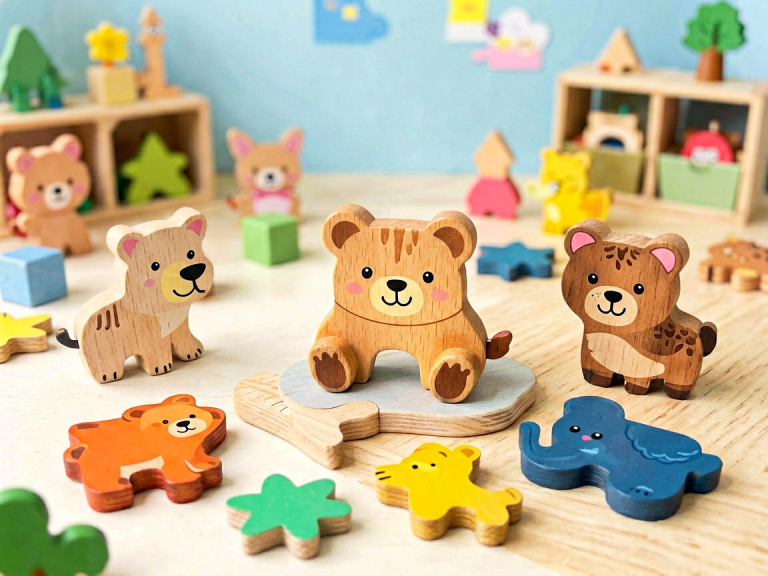
- Realistic Animal Sets and Farm Playsets – Animals are intrinsically motivating. A toddler can name each animal (“cow,” “duck”), learn animal sounds (“moo,” “quack”), and eventually describe actions (“the cow jumps”). The playset provides a context for modeling prepositions (“the duck is *on* the barn”) and verbs.
- Shape Sorters and Simple Puzzles – These require matching and naming shapes, colors, and objects. As the child fits a piece, say “The yellow star goes *in* the hole.” This embeds positional words and descriptive adjectives naturally.
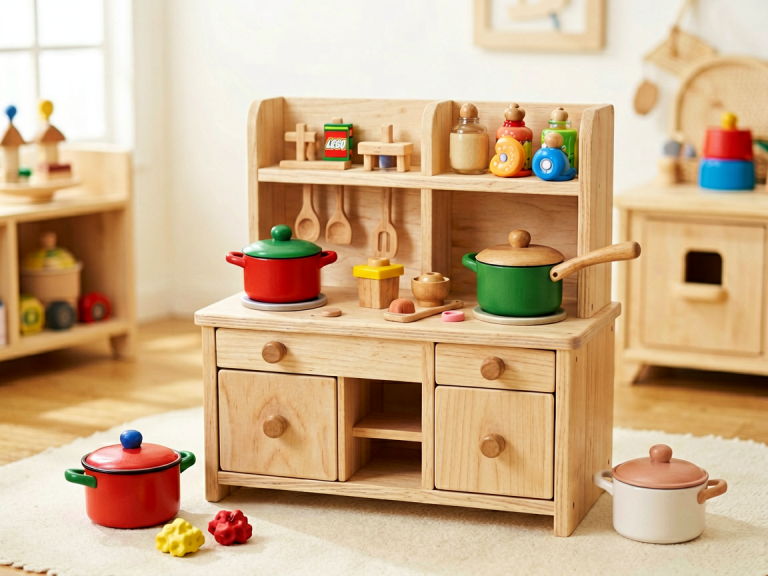
- Play Food and Kitchen Sets – Pretend cooking invites rich language: “I’m making soup. You want some? It’s hot!” Toddlers practice requests, offers, and sequencing (first cut, then stir). The toy becomes a springboard for conversation.
- Musical Instruments (Drums, Shakers, Xylophones) – Music and rhythm are linked to phonological awareness. Singing songs while playing instruments helps with syllable segmentation. Pause and let the child fill in the last word of a familiar song (“Twinkle, twinkle, little … star!”).
Preschoolers (3–5 Years): Narrative Skills and Social Language
At this stage, children are developing complex sentences, storytelling abilities, and the pragmatic skills of conversation (taking turns, staying on topic). Toys that inspire role-play, problem-solving, and sequencing are ideal.
- Dollhouses, Train Sets, and Construction Blocks – These open-ended systems allow children to create entire worlds. As they build, they narrate (“The family is going to the store because they need food”). Adults can ask “WH” questions: “Why did the train stop? What happens next?”
- Board Games (e.g., Candy Land, Memory) – Simple games teach turn-taking, following directions, and specific vocabulary (colors, numbers, “skip,” “draw”). The social context forces children to use language to negotiate rules and express emotions (“I’m sad I lost!”).
- Puppet Theaters and Costumes – Dramatic play is a powerhouse for language. A child wearing a doctor’s coat can practice greetings (“Hello, patient”), asking questions (“Where does it hurt?”), and giving commands (“Open your mouth”). Feelings vocabulary emerges naturally.
- Story Cubes and Picture Cards – Dice with pictures or simple story cards prompt children to link random images into a coherent narrative. This strengthens sequencing, imagination, and syntactic complexity.
Types of Language-Building Toys: A Detailed Breakdown
Beyond age, toys can be categorized by the specific language skill they promote. Understanding these categories helps you curate a balanced toy chest.
Role-Play and Pretend Play Toys
Role-play toys encourage decontextualized language—talking about things not present. A toy cash register, for instance, lets a child play “store,” using words like “buy,” “sell,” “price,” and “change.” Doll play elicits caregiving language (“The baby is hungry; let’s feed her”). This type of play is particularly effective for developing narrative structure and perspective-taking, both crucial for later reading comprehension.
Construction and Manipulative Toys
Blocks, LEGOs, magnetic tiles, and pegboards require spatial language (above, below, next to), comparative adjectives (tall, taller, tallest), and collaborative negotiation. When two children build together, they must articulate plans: “Let’s put the blue block here.” Adults can expand these utterances: “You want to put the blue block *on top of* the red one? That will make a tall tower.”
Art and Craft Supplies
Crayons, playdough, scissors, and glue seem non-linguistic, but they spark enormous language. While a child draws, you can discuss colors, shapes, and textures. Ask them to describe their creation: “Tell me about your picture. Is that a sun? Why is it smiling?” Descriptive vocabulary (smooth, bumpy, shiny) and storytelling emerge naturally.
Language-Specific Toys: Books, Cards, and Puzzles
Of course, books are the ultimate language toys. Board books with touch-and-feel elements engage babies; lift-the-flap books build anticipation and vocabulary; wordless picture books compel children to invent their own stories. Alphabet puzzles, magnetic letters, and rhyming card games support phonological awareness—the ability to hear and manipulate sounds, a strong predictor of reading success.
Tips for Maximizing Language During Play
Selecting the right toy is only half the battle. How you interact with the child during play determines the linguistic yield. Here are evidence-based strategies:
- Use the “Self-Talk” and “Parallel Talk” Technique – Describe your own actions (“I’m putting the red block on top”) and the child’s actions (“You are pushing the car very fast”). This models grammar and vocabulary without pressuring the child to respond.
- Ask Open-Ended Questions – Replace yes/no questions with “how,” “why,” “what if.” For example, instead of “Is the car red?” say “Why do you think the car is going so fast?” This encourages longer, more complex answers.
- Expand and Extend – When a child says “dog run,” you can respond “Yes, the big brown dog is running to the park!” This adds new words, corrects grammar implicitly, and models a more complete sentence.
- Follow the Child’s Lead – Observe what captures the child’s interest and comment on it. If they are focused on a single toy dinosaur, don’t redirect them to a puzzle. Instead, talk about dinosaurs: “That dinosaur has a long tail. What do you think it eats?” This sustained engagement deepens vocabulary and attention.
- Limit Screens and Noise – Toys with flashing lights and prerecorded phrases often discourage human interaction. A 2017 study found that for every minute of electronic toy use, parents uttered 67 fewer words. Opt for quiet, simple materials that require you to provide the sound effects.
Conclusion: Play with Purpose
Language development is not a race; it is a gentle, cumulative process that thrives on connection. The right toys are not expensive or technologically advanced—they are the ones that invite conversation, creativity, and collaboration. A cardboard box can become a spaceship, a stick can become a magic wand, and a set of wooden blocks can become a city. The magic lies not in the object itself but in the words shared around it.
As you build your toy guide for language development, remember that the most important “toy” is you: your voice, your attention, and your willingness to enter the child’s imaginative world. By choosing toys that promote interaction and by engaging in rich, responsive dialogue, you are laying the foundation for a lifetime of literacy, empathy, and expression. So go ahead—clatter the blocks, cuddle the doll, and narrate the adventure. Every word you share is a building block for the future.