The Best Toys for Play-Based Learning: Unlocking Creativity, Curiosity, and Cognitive Growth Through Purposeful Play
Title: The Best Toys for Play-Based Learning: Unlocking Creativity, Curiosity, and Cognitive Growth Through Purposeful Play
In recent years, educators and parents alike have embraced the profound value of play-based learning—an approach that treats play not as a break from serious education, but as the very engine of it. Play-based learning recognizes that children are natural explorers, and that the most enduring lessons are those discovered through hands-on, joyful interaction with their environment. The toys we choose for our children play a critical role in shaping these experiences. The best toys for play-based learning are not necessarily the most expensive, the most flashing, or the most technologically advanced. Instead, they are the ones that invite open-ended exploration, encourage problem-solving, foster social interaction, and spark imagination. This article will explore the philosophy behind play-based learning, outline the criteria for selecting effective toys, and provide a comprehensive guide to the best toy categories and specific examples that support holistic development from infancy through early elementary years.
The Philosophy of Play-Based Learning: Why Toys Matter
Play-based learning is grounded in the understanding that children learn best when they are actively engaged, intrinsically motivated, and emotionally invested. According to developmental psychologists like Jean Piaget and Lev Vygotsky, play is the primary vehicle through which children construct knowledge, practice social roles, and develop executive function skills. In a play-based environment, a simple block tower becomes a lesson in physics, balance, and spatial reasoning. A pretend tea party becomes a workshop in language, empathy, and sequencing. The toys that facilitate such learning must therefore be "loose parts"—objects that can be manipulated, combined, reimagined, and used in multiple ways. They must also be age-appropriate, safe, and durable enough to withstand the enthusiasm of young learners. Moreover, the best toys for play-based learning do not dictate a single outcome; they allow the child to be the author of their own play narrative. This autonomy is crucial for building confidence, resilience, and a lifelong love of learning.
Criteria for Selecting the Best Toys for Play-Based Learning
Before diving into specific recommendations, it is helpful to establish a set of criteria that any toy must meet to qualify as a powerful tool for play-based learning. First, the toy should be open-ended, meaning it can be used in countless ways without a predetermined result. A set of wooden blocks, for example, can become a castle, a rocket ship, a zoo, or a simple counting exercise. Second, the toy should encourage active engagement rather than passive consumption. Toys that require the child to push buttons and watch lights flash often limit creativity; instead, look for toys that demand manipulation, construction, and decision-making. Third, the toy should support multiple domains of development—cognitive, physical, social-emotional, and language. A simple set of magnetic tiles, for instance, can teach geometry, strengthen fine motor skills, foster collaboration when used with peers, and spark conversations about shapes and balance. Fourth, the toy should be adaptable across ages and skill levels, allowing it to grow with the child. Finally, the best toys are those that inspire collaboration and communication between children and adults, making play a shared journey of discovery rather than a solitary activity.
Top Toy Categories and Specific Examples
1. Building and Construction Toys
Building toys are perhaps the quintessential play-based learning tools. They teach fundamental principles of engineering, mathematics, and physics while honing fine motor skills and spatial awareness. Wooden unit blocks (like those from brands such as Melissa & Doug or Grimm’s) are a timeless choice. Their uniform size and weight allow children to experiment with balance, symmetry, and gravity. As children stack, bridge, and enclose, they learn about cause and effect, geometry, and even early fractions when comparing block sizes. Magnetic building tiles (such as Magna-Tiles or PicassoTiles) add the dimension of magnetism, enabling children to create intricate 3D structures that defy gravity. These tiles are especially valuable for teaching geometric concepts like vertices, edges, and faces. For older preschoolers and early elementary children, interlocking plastic bricks (like LEGO Duplo or classic LEGO) offer endless possibilities. LEGO sets that come with loose bricks rather than step-by-step instructions encourage open-ended design, fostering creativity and problem-solving. Building toys also naturally promote collaboration when children work together to construct a shared vision, practicing negotiation, turn-taking, and conflict resolution.
2. Imaginative and Pretend Play Toys
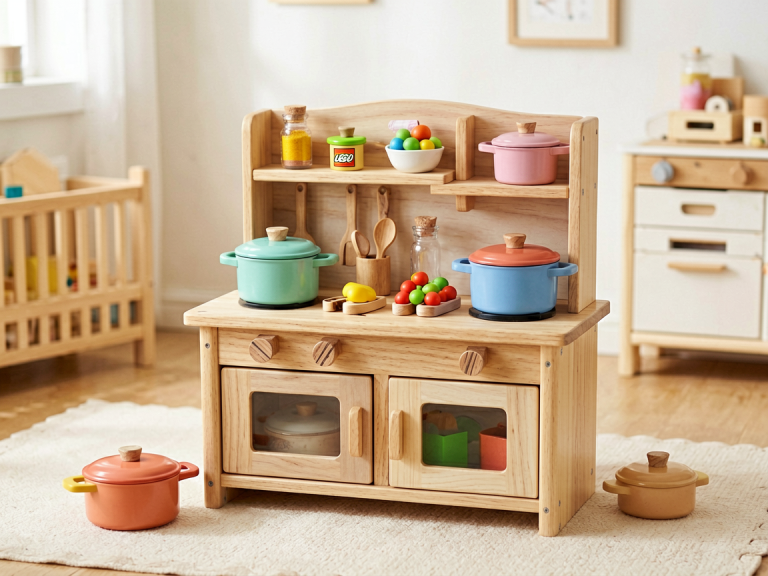
Imaginative play is the cornerstone of social-emotional and language development. The best toys in this category are those that serve as "props" for the child’s own stories. Dress-up clothes and accessories (such as hats, scarves, capes, and simple costumes) allow children to transform into doctors, firefighters, astronauts, or animals, each role offering a new set of vocabulary and social scripts. Play kitchens and food sets are classic staples; children sequence the steps of cooking, practice counting and measuring, and engage in dramatic scenarios that mirror real-life family interactions. Dollhouses and miniature figures (including people, animals, and furniture) provide a stage for children to process their own experiences, experiment with relationships, and develop narrative skills. A simple cardboard box is arguably one of the best pretend-play toys: it can become a spaceship, a cave, a car, or a castle. The lack of predetermined function forces children to use their imagination, turning the box into anything they desire. When selecting pretend-play toys, look for realistic yet simple designs that leave room for interpretation rather than overly detailed commercial characters that dictate a specific storyline.
3. Art and Creativity Supplies
Art is a form of play that directly supports self-expression, fine motor development, and cognitive flexibility. The best art toys are those that emphasize process over product. Washable paints, finger paints, and watercolors allow children to explore color mixing and texture without fear of mess. Modeling clay or Play-Doh builds hand strength and creativity as children roll, pinch, and shape their creations. A simple set of drawing tools (crayons, markers, chalk, and paper) is a must—but consider also offering unconventional surfaces like large cardboard sheets, rocks, or even an easel with a roll of paper to encourage large arm movements. Stamps, stencils, and collage materials (buttons, feathers, fabric scraps) add layers of texture and pattern exploration. The key is to provide a variety of materials and then step back, allowing the child to decide what to create. Avoid coloring books that prescribe a finished look; instead, offer blank paper and let the child’s imagination flow. Art play also helps children regulate emotions, as the act of creating can be soothing and empowering.
4. Puzzles and Manipulatives
Puzzles are excellent for developing logical reasoning, pattern recognition, and persistence. Wooden knob puzzles are ideal for toddlers learning to match shapes and animals. Floor puzzles with large pieces promote spatial awareness and cooperation when done with a partner. For preschoolers and older children, jigsaw puzzles with increasing piece counts challenge working memory and visual discrimination. Beyond traditional puzzles, consider pattern blocks (colorful geometric shapes used to create designs), sorting and sequencing toys (e.g., wooden pegs to stack by size or color), and threading beads that improve fine motor control and pincer grasp. Montessori-inspired manipulatives, such as the pink tower or brown stair, are specifically designed to isolate one concept (size, weight, texture) and allow repeated practice through trial and error. These toys are deceptively simple yet profoundly educational, as they teach children to compare, order, and classify—skills that underlie mathematical thinking.
5. Sensory and Loose Parts Play
Sensory play engages children’s senses—sight, sound, touch, smell, and even taste (with safe materials)—and is essential for brain development. The best sensory toys are often natural or household items that invite exploration. Sensory bins filled with rice, sand, water beads, or dried beans (with scoops, funnels, and small containers) provide hours of tactile exploration and teach concepts like volume, displacement, and cause and effect. Play sand and kinetic sand are especially appealing because they can be molded and cut, offering both tactile and constructional fun. Water play with cups, measuring spoons, boats, and sponges teaches scientific principles and fine motor control. Loose parts—a collection of random objects like wooden spools, bottle caps, pinecones, fabric scraps, and stones—are perhaps the ultimate open-ended toy. Children can sort, count, stack, and use them in imaginative ways. Loose parts encourage divergent thinking, as there is no single "right" way to play. They also promote creativity and problem-solving because children must adapt and combine materials to achieve their goals.
6. Movement and Gross Motor Toys
Play-based learning is not limited to tabletop activities; physical play is vital for brain development, balance, coordination, and social skills. Balance beams (or a simple line of tape on the floor) challenge vestibular systems and body awareness. Climbing structures (indoor wooden Arch climbers or outdoor playgrounds) build strength and risk assessment. Balls of various sizes and textures encourage throwing, catching, rolling, and kicking, which develop hand-eye coordination and spatial judgment. Tricycles, balance bikes, and scooters teach coordination and balance before transitioning to pedal bikes. Mats for physical play (such as a foam puzzle mat) allow children to practice yoga poses, gymnastics, and rough-and-tumble play safely. For younger children, push-pull toys (like a wooden snail on a string) encourage walking and coordination. The best gross motor toys are those that allow children to move freely and explore the limits of their bodies in a safe environment.
How to Maximize Learning Through Play: Tips for Parents and Educators
Even the best toys will not unlock their full potential without thoughtful adult involvement. The role of the adult in play-based learning is to be an observer, facilitator, and occasional co-player—not a director. Here are practical strategies to maximize the benefits:
- Follow the child’s lead. Let them choose what to play with and how to use the toy. Intervene only when safety is a concern or when the child invites you into their play.
- Ask open-ended questions. Instead of saying “What color is that block?” try “Tell me about your building—what happens if you put this block here?” This encourages deeper thinking and language use.
- Create a playful environment. Rotate toys every few weeks to maintain novelty, and store them in accessible bins so children can independently choose and return items.
- Embrace mess and imperfection. Play-based learning can be messy—art projects, sand on the floor, blocks scattered everywhere. This is a sign of deep engagement. Designate a play zone where mess is acceptable and clean-up is part of the routine.
- Model play yourself. When children see adults genuinely enjoying play—building a tower, making a funny voice for a doll, or painting alongside them—they learn that play is valued and worth their time.
- Avoid over-scheduling. Free, unstructured playtime is essential. Resist the urge to turn every play session into a lesson. Trust that learning is happening organically when children are deeply engaged.
Conclusion
The best toys for play-based learning are not the latest colorful gadgets advertised on commercial breaks. They are the simple, open-ended materials that invite children to question, experiment, collaborate, and imagine. A set of wooden blocks, a box of loose parts, a collection of art supplies, and a dress-up bin are worth more than any electronic tablet when it comes to building the foundational skills of creativity, critical thinking, emotional intelligence, and resilience. By choosing toys that prioritize process over product, flexibility over scripted play, and hands-on action over passive consumption, we give children the greatest gift: the joy of learning through play. As parents, educators, and caregivers, we can step back, observe, and marvel as children construct their own understanding of the world—one block, one dress-up costume, one painted masterpiece at a time. The journey of play-based learning is not about reaching a destination; it is about the richness of the path itself. And the right toys are the trusted companions on that beautiful, messy, and endlessly rewarding adventure.