The Power of Play: A Comprehensive Toy Guide for Problem-Solving Development
Introduction
In an era where rote memorization is gradually giving way to critical thinking and creativity, problem-solving has emerged as one of the most coveted skills for children to develop. Yet, the most effective classroom for nurturing this ability is not a desk or a workbook—it is the living room floor, the backyard, or the sandbox. Toys, when chosen and used thoughtfully, become powerful catalysts for cognitive growth. They transform abstract challenges into tangible, engaging experiences that encourage children to experiment, fail, adapt, and succeed. This comprehensive toy guide is designed for parents, educators, and caregivers who want to harness the power of play to foster robust problem-solving development. We will explore what problem-solving really means at different developmental stages, recommend specific toys that target these skills, and provide strategies to maximize the learning potential of every play session. By the end of this article, you will have a clear, actionable roadmap for turning simple playthings into engines of intellectual growth.
Understanding Problem-Solving and Its Developmental Stages
Problem-solving is not a single skill but a complex cognitive process that involves identifying a challenge, generating possible solutions, evaluating those options, implementing a plan, and reflecting on the outcome. According to Jean Piaget’s theory of cognitive development, children progress through distinct stages, each with unique capacities for logical reasoning. During the sensorimotor stage (birth to 2 years), problem-solving is physical and trial-based: a baby learns that shaking a rattle makes noise or that dropping a toy from a high chair causes an adult to pick it up. In the preoperational stage (2 to 7 years), symbolic thinking emerges, allowing children to imagine solutions and engage in pretend play, but their reasoning is still intuitive and often illogical. The concrete operational stage (7 to 11 years) brings logical thinking about tangible objects and events; children can mentally reverse actions and understand cause-and-effect relationships. Finally, formal operations (12 years and up) enable abstract and hypothetical reasoning. A well-designed toy guide must respect these developmental milestones. For example, a complex strategy board game might overwhelm a four-year-old, while a simple shape sorter would bore a ten-year-old. The best toys are those that offer a “just-right” challenge—difficult enough to provoke thought but not so hard that they lead to frustration. They should also allow for open-ended exploration, multiple solutions, and opportunities for iteration, all of which are hallmarks of authentic problem-solving.
Toy Recommendations by Age Group
Infants and Toddlers (0–2 Years): Building Foundational Cause-and-Effect
At this earliest stage, problem-solving is rooted in sensory exploration and motor actions. The best toys are those that demonstrate clear cause-and-effect relationships and invite repetitive experimentation. Stacking cups are a classic example: a toddler discovers that cups can be nested inside one another, or that stacking them in a particular order creates a tower that may topple. Each collapse teaches a lesson about balance, size, and gravity. Similarly, shape sorters require a child to match a three-dimensional shape to its corresponding hole, demanding spatial reasoning and fine motor control. Activity boards with latches, zippers, buttons, and knobs provide endless opportunities to figure out how doors open or how a bell rings. For this age, avoid electronic toys that do all the work; manual toys that respond directly to the child’s actions are far more effective. Parents should resist the urge to “fix” the problem for the baby. Instead, narrate the trial-and-error process: “Oh, the triangle doesn’t fit in the square hole. Let’s try turning it.” This simple language helps lay the neural groundwork for future strategic thinking.
Preschoolers (3–5 Years): Encouraging Planning and Imagination
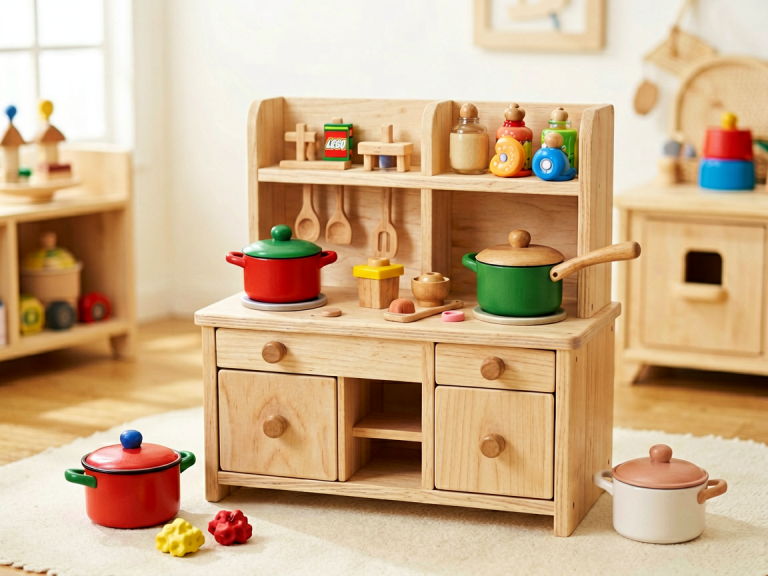
Preschoolers are ready for more structured problem-solving that involves planning, sequencing, and social negotiation. Building blocks—especially wooden unit blocks or large plastic interlocking bricks like Duplo—are unparalleled. A child who wants to build a tall tower must consider base width, weight distribution, and the order of stacking. When the tower falls, the building process itself becomes a problem-solving loop. Simple puzzles with 12 to 24 pieces teach pattern recognition and the strategy of sorting edge pieces from center pieces. Board games like “Hi Ho! Cherry-O” or “The Sneaky, Snacky Squirrel Game” introduce turn-taking, counting, and the concept of rules—a foundational problem-solving structure. Perhaps most importantly, pretend play props such as play kitchens, tool sets, or doctor kits invite open-ended problem scenarios: “I need to cook dinner but the stove is broken—what can I use instead?” or “The teddy bear is sick—how do we make him feel better?” These unstructured challenges force children to generate their own solutions, fostering creativity and flexibility. A parent’s role here is to ask questions rather than provide answers: “What do you think would happen if you put the biggest block at the bottom?” or “Is there another way to get the ball out from under the couch?”
Early Elementary (6–8 Years): Logic, Strategy, and Persistence
By ages six to eight, children have developed better attention spans and the ability to hold multiple variables in mind. This is the golden age for introducing more complex logic puzzles, construction kits, and cooperative games. Standard LEGO sets (with instruction books) teach sequential problem-solving and following complex directions, but even better are “free build” kits that include only a variety of pieces and an open-ended challenge, such as “build a bridge that can hold a toy car.” This requires children to test, modify, and retest their designs. Board games like “Gravity Maze” or “Rush Hour” are specifically designed to sharpen spatial reasoning and sequential logic; each puzzle presents a clear problem (e.g., “move the red car to the exit”) with a limited number of steps. Science experiment kits, such as snap-together circuits or simple chemistry sets, introduce the scientific method—hypothesis, experiment, observation, conclusion—in a hands-on way. For children who enjoy storytelling, magnetic storyboards or “create-a-scene” sets allow them to solve narrative problems: “The rabbit needs a way to cross the river—what objects could you use?” The key at this stage is to encourage persistence. When a child fails to solve a puzzle or build a stable structure, resist the urge to offer the solution. Instead, say, “That didn’t work. What do you think you could try differently?” This reinforces the growth mindset that mistakes are stepping stones to mastery.
Older Children (9–12 Years): Abstract Thinking and System Dynamics
Pre-teens are ready for advanced problem-solving that involves abstract variables, strategic planning, and collaboration. Construction toys such as LEGO Technic, K’Nex, or motorized building sets require reading complex diagrams, understanding mechanical principles (gears, levers, pulleys), and troubleshooting when the model doesn’t move as intended. Coding and robotics kits, like Sphero, micro:bit, or Lego Mindstorms (though expensive, they can be shared or borrowed), teach computational thinking: breaking down a problem into smaller steps, recognizing patterns, and debugging errors. Strategy board games like chess, checkers, Settlers of Catan, or Ticket to Ride demand forward planning, resource management, and adaptation to opponents’ moves. Escape room board games (e.g., “Unlock!” or “Exit”) simulate real-time puzzle-solving under time pressure, requiring teamwork and logical deduction. Additionally, DIY craft kits that involve sewing, woodworking, or electronics force children to follow multi-step instructions while also making creative decisions—a powerful combination of convergent and divergent thinking. For parents, the best support is to provide space and time without hovering. Let children struggle with frustration, only stepping in when they are truly stuck and asking guiding questions like, “What information are you missing?” or “Can you simplify the problem into smaller parts?”
How to Facilitate Problem-Solving During Play
Even the most carefully selected toy will fall flat without thoughtful adult facilitation. The goal is not to entertain children but to empower them as active problem-solvers. First, use “Socratic questioning” during play: instead of saying “Look, the block goes there,” ask “Why do you think that block doesn’t fit?” This encourages analysis. Second, normalize failure. Children often become upset when their tower collapses or their puzzle piece doesn’t fit. Parents can model a calm, curious response: “Oh, it fell! What happened? Let’s look at the base—was it wobbly?” This reframes failure as data, not defeat. Third, introduce the concept of “iteration.” After a child solves a puzzle, challenge them to find a second solution or a faster way. For example, after building a LEGO car, ask, “Can you modify it to make it go faster down a ramp?” This shifts the mindset from a single correct answer to a spectrum of possibilities. Fourth, create a “toy rotation” system to maintain novelty and prevent boredom. When a child has mastered a toy, put it away for a month; when it returns, they often discover new layers of challenge. Finally, engage in parallel play yourself. When children see adults grappling with their own puzzles (e.g., assembling furniture, solving a crossword, or cooking a new recipe), they learn that problem-solving is a lifelong, rewarding activity.
Beyond Toys: Integrating Problem-Solving into Daily Life
While this article focuses on toys, it is important to recognize that problem-solving development does not stop at the toy box. Everyday activities offer rich opportunities. Cooking with a child involves measurement, sequencing, and adaptation (“We’re out of eggs—what can we use instead?”). Building a fort with blankets and chairs requires structural thinking. Planning a family outing involves time management, budgeting, and contingency planning. Even simple chores like sorting laundry or loading a dishwasher require categorization and spatial optimization. Parents can intentionally frame these activities as puzzles: “Let’s see if we can fit all these groceries into the fridge by playing Tetris,” or “How can we organize the backpack so the heaviest things are at the bottom?” By consistently using the language of problem-solving—words like “hypothesis,” “test,” “compare,” “adjust,” and “reflect”—adults help children internalize the process across all domains. Moreover, encourage children to invent their own toys and games. A cardboard box, a handful of clothespins, and some string can become a marble run, a catapult, or a pulley system. These open-ended materials force the most authentic problem-solving because there is no instruction manual. When children are the architects of their own play, they develop resilience, creativity, and confidence that no store-bought toy can fully replicate.
Conclusion
Problem-solving is not an innate talent but a skill cultivated through thousands of small, playful challenges. The right toys—paired with patient, intentional adult guidance—can transform playtime into a rich laboratory for cognitive development. From the simple cause-and-effect of a rattle to the abstract strategy of a coding robot, each toy offers a unique doorway into the world of thinking, adapting, and overcoming obstacles. As you browse the toy aisle or rummage through your child’s toy box, remember that the most expensive or flashy toy is rarely the best. Instead, look for toys that invite exploration, tolerate multiple solutions, and reward persistence. Ask yourself: Does this toy encourage my child to ask “What if?” rather than “What now?” If the answer is yes, you have found a powerful tool for lifelong learning. By embracing the principles outlined in this guide, you can turn every play session into a step toward a more curious, resilient, and capable young problem-solver. Now go play—and may the challenges be just hard enough to be fun.