Unlocking Young Minds: The Best Toys for Problem-Solving Development
Introduction
In an era defined by rapid technological change and complex global challenges, the ability to solve problems effectively has never been more critical. Problem-solving is not merely an academic skill; it is a lifelong competency that underpins creativity, resilience, critical thinking, and adaptability. While formal education plays a significant role in nurturing this ability, the foundations are often laid in the earliest years through play. Toys are not just instruments of entertainment—they are the first tools children use to experiment, hypothesize, fail, and try again. Selecting the right toys can transform playtime into a powerful developmental engine. This article explores the best categories of toys designed specifically to foster problem-solving skills, explaining how each type engages different cognitive processes and why they are essential for a child’s growth.
1. Construction and Building Sets: The Architecture of Logic
Few toys are as universally recognized for problem-solving as construction sets. From classic wooden blocks to sophisticated interlocking systems like LEGO, these toys require children to translate a mental image into a physical structure. The process inherently involves planning, spatial reasoning, and iterative trial and error.
*Why they work:* When a child attempts to build a tower that does not topple, they must consider balance, weight distribution, and symmetry. They learn that if a base is too narrow, the structure will fall—a concrete lesson in physics and cause-and-effect. Advanced sets with gears, pulleys, and motors introduce mechanical reasoning. For example, a LEGO Technic car demands that the builder understand how gears interact to transfer motion. The open-ended nature of construction toys means there is no single “correct” answer; children must continuously refine their approach. This mirrors real-world problem-solving, where multiple solutions may exist and persistence is key.
*Best examples:* LEGO Classic and Technic sets, Magna-Tiles, wooden unit blocks, and K’NEX. For younger children, large foam blocks or Duplo offer a safe entry point. For older children, complex architectural models or robotics kits (like LEGO Mindstorms) challenge them to integrate coding with physical construction.
2. Puzzle Games: The Art of Pattern Recognition and Deduction
Jigsaw puzzles, logic puzzles, and brain teasers are direct training grounds for problem-solving. They demand that a child analyze pieces, identify patterns, and use deductive reasoning to fit elements together.
*Why they work:* A jigsaw puzzle requires the solver to sort pieces by color, shape, or edge type, then systematically test hypotheses about where each piece belongs. This exercises working memory and visual-spatial skills. More abstract puzzles—such as Sudoku, Rush Hour, or tangrams—require strategic thinking and planning multiple moves ahead. For instance, in the game “Rush Hour,” a child must slide cars and trucks out of a congested grid. Success depends on visualizing a sequence of moves and understanding that one wrong step can block progress. These puzzles teach children to break down a complex problem into smaller, manageable steps—a foundational problem-solving strategy.
*Best examples:* Ravensburger jigsaw puzzles (age-appropriate piece counts), ThinkFun’s “Rush Hour” and “Gravity Maze,” Melissa & Doug’s wooden pattern blocks, and Rubik’s Cubes. Digital apps like “Monument Valley” also offer spatial puzzles, though physical puzzles tend to promote better fine-motor engagement.
3. Strategy Board Games: Social Problem-Solving and Critical Thinking
Board games that involve strategy, resource management, and competition (or cooperation) are excellent for developing higher-order thinking. Unlike solitary puzzles, these games often require players to anticipate opponents’ moves, adapt to changing circumstances, and make decisions under constraints.
*Why they work:* Games like “Chess” or “Checkers” force players to think several turns ahead, weighing risks and rewards. A child must ask: “If I move this piece, what will my opponent do next?” This develops forward-planning and consequential reasoning. Cooperative games, such as “Forbidden Island” or “Pandemic,” shift the focus to collaborative problem-solving. Players must communicate, share information, and allocate resources effectively to achieve a common goal. This teaches children that problem-solving is often a social endeavor requiring negotiation and empathy. Moreover, board games provide a safe environment for failure—losing a game teaches resilience and the importance of learning from mistakes.
*Best examples:* “Catan Junior,” “Ticket to Ride: First Journey,” “Qwirkle,” “Blokus,” and “Hive.” For younger children, “The Sneaky, Snacky Squirrel Game” introduces basic turn-taking and strategic thinking. For older kids, “Settlers of Catan” and “Azul” offer deeper strategic layers.
4. Coding and Robotics Kits: Digital Problem-Solving for the Modern Age
As technology permeates every aspect of life, toys that teach coding and robotics have become invaluable for problem-solving development. These kits bridge the gap between abstract logic and tangible outcomes.
*Why they work:* When a child programs a robot to navigate a maze, they must break down the task into a sequence of instructions. They learn debugging—the process of identifying and fixing errors. For example, if a robot crashes into a wall, the child must analyze whether the turn angle was too small or the distance too long. This iterative cycle of hypothesis, test, and revision is the essence of computational thinking. Even screen-free coding toys, such as “Code-a-pillar” or “Botley,” teach sequencing and conditional logic without screen time. For older children, kits like “Arduino” or “micro:bit” introduce sensors, loops, and variables, demanding a higher level of abstraction and problem-solving.
*Best examples:* “LEGO Boost,” “Sphero BOLT,” “Osmo Coding,” “Learning Resources Botley,” and “Snap Circuits” (which teach electronics). For teens, “Raspberry Pi” starter kits offer advanced challenges.
5. Open-Ended Imaginative Play Sets: Creative Problem-Solving Without Boundaries
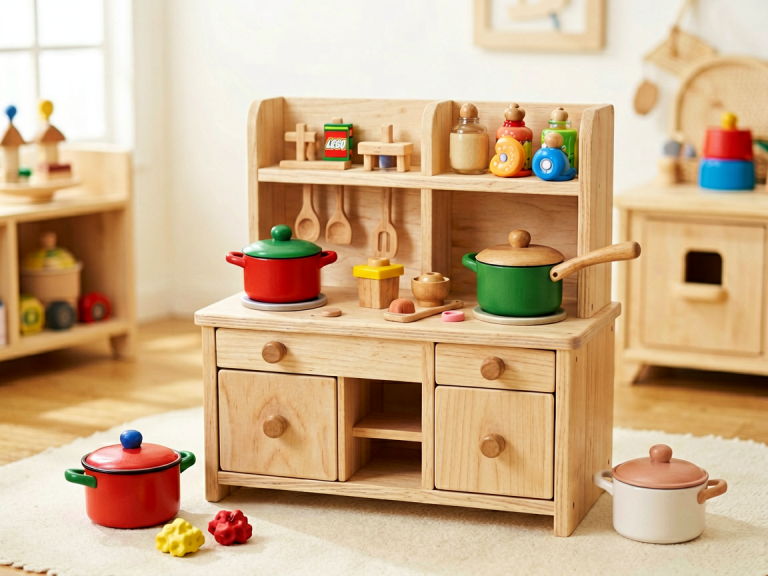
Toys that encourage imaginative play—such as dollhouses, train sets, play kitchens, or dress-up costumes—might not seem like obvious problem-solving tools. However, they are perhaps the most powerful because they require children to create their own problems to solve.
*Why they work:* When a child sets up a pretend grocery store, they must decide how to organize inventory, handle “customers,” and manage transactions. They invent rules, negotiate roles with peers, and solve emergent conflicts. If a toy train falls off the track, the child must engineer a fix or redesign the layout. This kind of play fosters divergent thinking—the ability to generate multiple solutions to an open-ended challenge. Unlike a puzzle with a single answer, imaginative play has infinite possibilities. It teaches flexibility, improvisation, and the confidence to tackle unstructured problems. Research shows that children who engage in rich pretend play demonstrate stronger executive function skills, including inhibition, working memory, and cognitive flexibility.
*Best examples:* “Melissa & Doug” wooden play sets, “Magna-Tiles” (used for building pretend environments), “Playmobil” sets, and simple props like blocks, scarves, and cardboard boxes. The simpler the toy, the more creative the child must be.
6. Science and Experiment Kits: Hypothesis-Driven Exploration
Science kits that allow children to conduct experiments are direct applications of the scientific method: ask a question, form a hypothesis, test it, analyze results, and draw conclusions. These toys make abstract concepts tangible.
*Why they work:* A volcano eruption kit teaches chemical reactions; a magnet set teaches physical forces. But more importantly, children learn that not every experiment works as planned. When a crystal-growing kit yields no crystals, the child must ask: Did I add too much water? Was the temperature wrong? This promotes systematic observation and logical reasoning. Robotics kits like “Thames & Kosmos” series integrate science with engineering, requiring children to troubleshoot mechanical or electrical failures. The best kits are those that allow for repeated trials and unexpected outcomes, turning failures into learning opportunities.
*Best examples:* “Thames & Kosmos” chemistry sets, “National Geographic” geology kits, “4M” crystal and volcano kits, and “Snap Circuits” (mentioned earlier for electronics). For nature-based problem-solving, bug-catching and observation kits encourage inquiry-based learning.
7. Multi-Player Collaborative Building Games: Teamwork and Communication
Some toys are specifically designed for group problem-solving. These emphasize that complex challenges often require collective intelligence.
*Why they work:* Games like “The Floor is Lava” (physical obstacle course) or “Team Building Blocks” (where players must work together to stack blocks using strings) force children to communicate clearly, listen, and coordinate. They learn that different perspectives can lead to better solutions. These toys also teach patience and compromise—essential components of social problem-solving. For classrooms or family play, such toys build a culture of collaborative effort rather than isolated competition.
*Best examples:* “Team Building Blocks” (with strings), “Straws and Connectors” for group construction, “Jenga” (when played in teams), and “Keep Talking and Nobody Explodes” (a collaborative digital game that requires verbal instructions). For outdoor play, large obstacle course kits encourage group problem-solving.
Conclusion
The best toys for problem-solving development are not necessarily the most expensive or technologically advanced. Instead, they are toys that require active engagement, encourage multiple attempts, and allow for open-ended exploration. Construction sets build logical thinking; puzzles sharpen spatial and deductive reasoning; board games teach strategic planning and social dynamics; coding kits develop computational logic; imaginative play fosters creative flexibility; science kits promote hypothesis testing; and collaborative games enhance teamwork. Parents and educators should look for toys that challenge children just enough to be stimulating without causing frustration—the sweet spot where growth occurs. By thoughtfully selecting toys that demand problem-solving, we equip children with the mental tools to navigate an unpredictable future. After all, every great innovator, scientist, and leader began as a child who was allowed to play, fail, and try again.
Start with the complete guide: Building Minds: The Best Beginner Toys for Problem Solving.