From Playthings to Pedagogical Tools: A Guide to Using Toys for Hands-On Learning
Introduction
For generations, toys have been dismissed as mere distractions—objects meant to entertain children while adults attend to more “serious” matters. Yet a growing body of research in education, psychology, and neuroscience reveals that toys, when intentionally selected and guided, can become powerful vehicles for hands-on learning. Hands-on learning—an approach that engages learners physically, cognitively, and emotionally—transforms abstract concepts into tangible experiences. By manipulating objects, constructing models, and experimenting with cause and effect, children develop problem-solving skills, spatial reasoning, creativity, and even social competence. This article explores the art and science of using toys for hands-on learning, offering practical strategies for parents, educators, and caregivers to turn everyday playthings into rich educational tools.
—
1. The Science Behind Play-Based Learning
Understanding why toys work requires a brief look at how the brain learns. Neuroscientific studies show that active, multisensory engagement strengthens neural connections more effectively than passive instruction. When a child picks up a toy, her hands send tactile information to the somatosensory cortex; her eyes track movement and color; her prefrontal cortex plans actions; and if she collaborates with others, her mirror neurons fire in empathy. This integrated neural activity promotes deeper encoding of information.
Moreover, play reduces stress and increases motivation. The release of dopamine during enjoyable activities enhances attention and memory consolidation. Toys that allow trial and error—such as building blocks or mechanical kits—create a safe environment for failure, which is essential for developing a growth mindset. Instead of fearing mistakes, children learn to iterate, adjust, and persevere. This cognitive resilience is far harder to teach through worksheets alone.
Finally, hands-on learning with toys aligns with constructivist theories (Piaget, Vygotsky) that emphasize learning as an active, meaning-making process. Children do not simply absorb facts; they build mental models by interacting with the physical world. A toy is therefore not a shortcut to knowledge but a scaffold for discovery.
—
2. Selecting the Right Toys for Educational Goals
Not all toys are created equal. The best toys for hands-on learning share certain characteristics: open-endedness, adaptability, and the ability to provoke inquiry. Below are categories of toys and the specific learning outcomes they support.
Construction and Building Toys
Examples: LEGO bricks, magnetic tiles, wooden blocks, K’NEX, Erector sets.
These toys develop spatial awareness, geometry, engineering principles, and fine motor skills. When children build a tower, they intuitively learn about balance, load distribution, and stability. By following instructions for a model, they practice sequencing and following directions. More advanced sets introduce gears, pulleys, and motors, bridging the gap to physics and robotics.
Puzzles and Logic Games
Examples: Jigsaw puzzles, tangrams, Rubik’s cubes, Sudoku boards, chess sets.
Puzzles strengthen pattern recognition, logical deduction, and perseverance. A child attempting a 100-piece jigsaw must classify pieces by color and edge shape, test hypotheses about where a piece fits, and adjust strategies when wrong. Logic games like chess teach forward planning and cause-effect reasoning.
Science and Exploration Kits
Examples: Microscope sets, chemistry labs, crystal-growing kits, weather stations, magnet sets.
These promote scientific method: observing, hypothesizing, experimenting, and recording. A simple magnet set can demonstrate magnetic fields, polarity, and attraction through play. Kits that involve growing crystals or hatching butterfly larvae introduce biological cycles and patience. Better yet, they encourage children to ask “what if” questions—the foundation of scientific inquiry.
Role-Playing and Pretend Toys
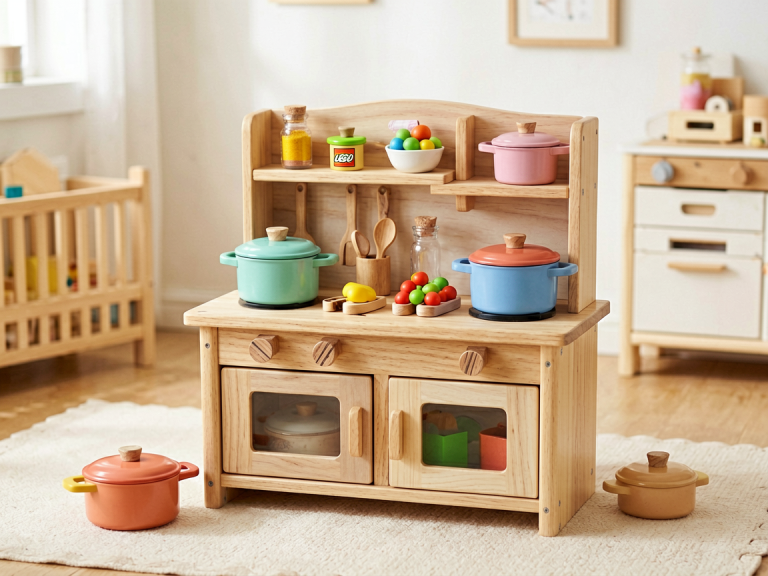
Examples: Dollhouses, play kitchens, doctor kits, cash registers, dress-up costumes.
Through pretend play, children develop language, social understanding, and emotional regulation. A child playing “shop” practices counting money, making change, and using polite phrases. A child caring for a doll learns empathy and responsibility. When combined with storytelling, these toys support literacy and narrative skills.
Art and Craft Materials
Examples: Modeling clay, paint sets, beads, looms, paper-cutting tools.
While not always considered “toys,” craft supplies offer hands-on learning in design, color theory, fine motor control, and creative expression. They also integrate mathematics (measuring, symmetry, tessellation) and engineering (structural integrity of a clay sculpture).
When selecting toys, prioritize those that can be used in multiple ways and that grow with the child. A simple set of wooden blocks can be used by a toddler to stack, a preschooler to build a castle, and a school-age child to explore fractions or balance.
—
3. Strategies for Integrating Toys into Lesson Plans
Having the right toys is only half the battle; knowing how to use them strategically is what turns play into learning. Below are concrete, subject-specific strategies.
Mathematics with Building Blocks
Instead of drilling flashcards, give a child a set of unit blocks and ask: “Can you build a tower that is exactly 12 blocks tall? How many blocks are in a 3×4 rectangle?” For older children, use LEGO bricks to teach fractions: a 2×4 brick can represent a whole, while 1×2 bricks represent halves, and 1×1 bricks represent quarters. Have children combine and compare fractions physically.
Physics with Marble Runs and Ramps
Marble runs, foam pipe insulation, or simple cardboard ramps teach gravity, momentum, and friction. Pose challenges: “Build a ramp that makes the marble go the farthest. Now change the angle. What happens if you cover the ramp with sandpaper or wax paper?” Children can graph their results, reinforcing data collection and analysis.
Literacy with Story Cubes and Puppets
Story cubes (dice with pictures) can be rolled to generate plot elements. A child rolls “castle,” “bird,” and “key” and must invent a story connecting them. Puppets and dolls enable children to act out dialogues, developing vocabulary, sequencing, and narrative structure. For older children, use a typewriter or a printing press toy to physically compose a story, connecting text production with motor action.
Biology with Magnifying Glasses and Bug Catchers
Take learning outdoors. A bug catcher with a magnifying lens allows children to observe insect anatomy, movement, and behavior. Guide them with questions: “How many legs does it have? Is it eating? Where does it hide?” Drawings and simple labeled diagrams turn observation into scientific documentation.
Engineering with Recycled Materials
You don’t need expensive kits. Challenge children to build a bridge from newspaper and tape that can hold a small weight. This task teaches structural design, load distribution, and iteration. Alternatively, give them a pile of cardboard boxes and ask them to design a marble maze, learning about angles and gravity.
The key is to frame toy-based activities as challenges or investigations rather than drills. Use open-ended questions: “What happens if…?” “How can you make it better?” “Why do you think that worked?”
—
4. Age-Appropriate Approaches: From Toddlers to Teens
Hands-on learning with toys must be tailored to developmental stages.
Toddlers (Ages 1–3)
At this stage, toys should focus on sensorimotor exploration and cause and effect. Stacking cups, simple shape sorters, and large peg puzzles build fine motor control and basic classification. Use toys to introduce vocabulary: “This is a red circle. Can you find the yellow square?” Avoid over-directing; let the child lead. The goal is not mastery but exposure and joy.
Preschoolers (Ages 3–5)
Children begin symbolic play and simple problem-solving. Provide dramatic play sets, magnetic tiles, and pattern blocks. Engage in co-play: “You’re the shopkeeper. How much does this apple cost? I have five coins. Do I have enough?” Use toys to count, compare sizes, and sort by color or shape. Simple board games (like Candy Land) teach turn-taking and counting.
Elementary School (Ages 6–10)
At this age, children can handle more complex instructions and projects. Introduce LEGO robotics kits, chemistry sets, and strategy games like checkers. Encourage independent challenges: “Build a vehicle that can move without being pushed.” Allow them to fail and redesign. Science kits that include notebooks for recording observations are especially valuable.
Middle and High School (Ages 11–18)
Teens benefit from sophisticated toys that connect to real-world applications. Mechanical construction sets, soldering kits for electronics, 3D modeling software with printable toys, and even simple coding robots (like micro:bit) offer deep hands-on learning. Encourage project-based challenges: “Design a catapult that can launch a marshmallow exactly 2 meters.” At this level, toys become prototypes for engineering and design thinking.
—
5. Assessing Learning Outcomes Through Play
A common concern is that play-based learning lacks accountability. In truth, assessment can be woven naturally into toy-based activities.
Observation and Documentation
Watch how a child interacts with a toy. Does she try multiple strategies when something fails? Does she ask questions? Note these behaviors in a simple journal. For example: “Today, Alex used LEGOs to build a bridge, then tested it by adding pennies. When it collapsed, he made the base wider. He showed understanding of stability.”
Product-Based Assessment
Have children present their creations. A child who builds a marble run can explain the path and why the marble moves faster on a steeper ramp. This verbal explanation reveals conceptual understanding. For older children, written reflections or simple diagrams serve as evidence.
Peer Collaboration
Group toy-based projects allow observation of social skills: cooperation, negotiation, compromise. Can a team agree on a design for a cardboard castle? Do they listen to each other’s ideas? These soft skills are as important as academic content.
Portfolios
Collect photographs, sketches, and written notes from toy-based activities. Over time, a portfolio shows growth in fine motor skills, problem-solving ability, and creativity. It also provides a meaningful alternative to standardized testing.
—
6. Overcoming Challenges and Maximizing Engagement
Despite its benefits, hands-on learning with toys faces obstacles: time constraints, mess, perceived lack of rigor, and the risk of distraction. Here are strategies to overcome them.
Turn Mess into Managed Chaos
Set clear boundaries: toys stay on a tray or mat; cleaning up is part of the activity. Use storage bins with labels so children can retrieve and return toys independently. Short sessions (20–30 minutes) with a clear goal prevent overwhelm.
Balance Free Play and Guided Play
Pure free play is valuable, but directed play often yields more learning. Alternate between “exploration time” (no rules) and “challenge time” (specific objective). For example: “First, play with the magnets however you like. Now, can you make a chain that lifts a paper clip?” This structure preserves autonomy while focusing attention.
Avoid Overstimulation
Too many toys at once scatter focus. Rotate toys every few weeks so that children remain curious. A minimalist approach—three or four high-quality toys available at a time—promotes deeper engagement.
Connect Toys to Real-World Contexts
Explain why a skill matters. If a child is building a circuit with a snap-together electronics kit, connect it to how lights in their home work. If they are using a balance scale, talk about how a grocer weighs fruit. Relevance fuels motivation.
Involve Parents and Caregivers
Parents often feel pressure to fill children’s time with “academic” work. Provide them with simple toy-based activity cards that explain the learning behind the play. For instance, a card for building blocks might read: “While stacking, your child learns balance, hand-eye coordination, and creativity. Try asking: ‘How can you make the tower taller without it falling?’”
—
Conclusion
Toys are not the opposite of learning; they are its natural allies. When we intentionally design play experiences around well-chosen toys, we tap into children’s innate curiosity, resilience, and joy of discovery. Hands-on learning with toys bridges the gap between abstract concepts and lived experience, making knowledge stick. Whether a toddler stacking rings or a teenager programming a robot, every child deserves the chance to learn through their hands, guided by thoughtful questions and a supportive environment. The next time you see a child deeply absorbed in a toy, resist the urge to interrupt. Instead, sit beside them, ask a question, and watch the miracle of hands-on learning unfold.