From Blocks to Blueprints: The Progression of Toys for Developing Spatial Reasoning
Introduction: The Invisible Skill Shaped by Play
Spatial reasoning—the capacity to visualize, manipulate, and navigate objects in two- and three-dimensional space—is far more than a niche ability reserved for architects or engineers. It underpins everything from reading a map to packing a suitcase, from solving geometry problems to learning advanced physics. Yet unlike literacy or numeracy, spatial reasoning is often left to develop incidentally, without deliberate scaffolding. Here, toys step in as silent teachers. The concept of *toy progression*—a carefully sequenced introduction of playthings that challenge spatial skills at increasingly sophisticated levels—offers a powerful, organic curriculum for the developing mind. This article explores how a thoughtful progression of toys, from the simplest stacking blocks to complex digital environments, can systematically cultivate spatial intelligence in children and even adults. By understanding this progression, parents, educators, and toy designers can harness play as a structured yet joyful pathway to cognitive growth.
—
The Foundation: Early Spatial Awareness with Simple Manipulatives
The journey begins in infancy with toys that are almost deceptively primitive. A set of colorful wooden blocks, a shape sorter, or a set of nesting cups might appear to be mere entertainment, but they lay the neural groundwork for spatial reasoning. When a six-month-old grasps a rattle, the brain is already encoding object permanence and the relationship between the hand and the object. By the time a toddler attempts to fit a square peg into a square hole, she is engaging in what psychologists call *mental rotation*—the ability to imagine how an object looks from a different angle.
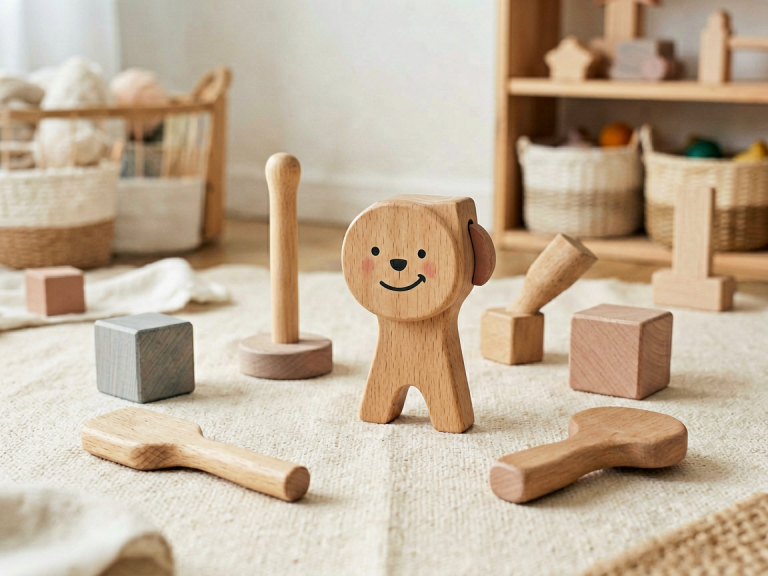
Simple stacking toys teach the concepts of *above*, *below*, *inside*, and *outside*. When a child tries to balance one block atop another, she experiments with gravity, center of mass, and alignment. Research from the University of Chicago has shown that the amount of time children spend playing with blocks correlates with later mathematical achievement, particularly in geometry. The key in this earliest stage is *open-endedness*: toys that allow multiple configurations rather than a single correct answer. For example, a set of wooden unit blocks (plain rectangular prisms, cylinders, and triangles) encourages trial and error, forcing the child to adjust her mental model each time a tower topples. The progression here is not about moving to more difficult toys but about deepening the complexity of the child’s interactions with the same toys—stacking higher, creating symmetrical patterns, or building enclosures that contain other objects.
—
Building Complexity: Construction Sets and Puzzles That Demand Coordination
As a child enters the preschool years (ages 3–5), the toy progression naturally introduces elements of *interlocking* and *constrained geometry*. This is where construction sets like Duplo (oversized LEGO bricks) or magnetic tiles (such as Magna-Tiles) come into play. Unlike free-form blocks, these toys have specific connection mechanisms—studs and tubes, magnets with polarity, or notches that click together. The child must now not only imagine the final shape but also plan the sequence of assembly. A tower built with magnetic tiles requires the child to consider which edges will attract and which will repel; a LEGO vehicle demands symmetry to avoid tipping.
Puzzles also become central at this stage. Simple jigsaw puzzles with 12 to 24 pieces train the brain in *visual discrimination*—recognizing that a curved edge on one piece fits a curved gap on another. More advanced puzzles, such as tangrams or pentominoes, require the solver to mentally flip and rotate shapes to fill a given outline. These activities strengthen the *spatial visualization* component of reasoning, which is the ability to mentally manipulate objects in multiple dimensions. A study published in *Child Development* found that children who regularly played with construction toys and puzzles outperformed peers on tests of spatial ability by as much as 30%. The progression here involves gradually reducing the size of pieces, increasing the number of pieces, and introducing puzzles with ambiguous or symmetrical elements that test the child’s ability to distinguish subtle differences.
Importantly, this stage also introduces *frustration tolerance*. A child who cannot force a magnetic tile to attach to the wrong pole learns to step back, reassess the orientation, and adjust her mental picture. This metacognitive loop—plan, attempt, fail, re-plan—is the very engine of spatial reasoning growth. The toy acts as a safe feedback system, rewarding correct spatial predictions with a satisfying click or a completed picture, and punishing errors with wobbles or mismatched shapes.
—
Advanced Visualization: 3D Modeling, Strategy Games, and Digital Environments
By the time a child reaches elementary school (ages 6–10), the foundation of spatial reasoning is solid enough to support much more abstract and complex challenges. This is the stage of *systematic spatial thinking*, where toys transition from physical manipulation to mental modeling and strategic planning.
One iconic example is the classic LEGO Technic or K’NEX sets, which introduce gears, axles, and mechanical linkages. Building a working crane or a gear-driven car requires the child to understand not only the static arrangement of parts but also their dynamic interactions—how a gear’s number of teeth affects rotational speed, or how a lever’s fulcrum position changes force. This blends spatial reasoning with basic physics, demanding what cognitive scientists call *mental animation*: the ability to predict how a system will change over time.
Strategy board games like *Blokus* or *Rush Hour* also shine at this level. *Blokus* requires players to place polyomino-shaped pieces on a grid while touching corners but not edges, forcing constant mental rotation and spatial planning in a competitive context. *Rush Hour* presents a puzzle where a grid of cars must be slid out of a traffic jam; solving it demands backward planning and spatial foresight. Digital tools, too, have a place. Minecraft, for instance, is a three-dimensional sandbox where players build structures using voxel blocks. The game teaches isometric thinking, scale, and perspective; players must estimate how many blocks are needed to create a bridge of a certain length, or how to dig a tunnel that meets another tunnel at a precise depth. Research from the University of Connecticut found that children who played Minecraft for 40 minutes a day over two weeks showed significant improvement in spatial ability tests, particularly in mental rotation and perspective-taking.
The progression at this stage is characterized by *multi-step planning* and *abstract constraints*. A child is no longer simply stacking or connecting; she is designing a solution that must meet structural, mechanical, or game-rule constraints. This mirrors real-world spatial challenges like reading architectural blueprints or solving geometric proofs.
—
The Role of Adult Guidance and Playful Exploration
No toy progression operates in a vacuum. The adult’s role—as a gentle guide, a question-asker, and a co-player—can significantly amplify the spatial reasoning benefits. For example, when a toddler builds a tower, a parent might ask, “What do you think will happen if you put this big block on top?” or “Can you make a bridge that a car can drive under?” These prompts encourage the child to verbalize spatial relationships, a practice that research shows strengthens *spatial language* and, in turn, spatial cognition.
Similarly, as children tackle more complex puzzles or construction sets, adults can model problem-solving strategies: “Let’s look at this piece. Does it have a straight edge or a curved one? Which part of the puzzle might need that shape?” The key is to avoid doing the spatial work for the child; instead, the adult scaffolds the child’s own mental effort. Even in digital environments, parents can guide children to use the game’s features (like Minecraft’s “spectator mode” or coordinate system) to understand spatial relationships from multiple viewpoints.
On the other hand, over-structuring play can be counterproductive. The best toy progression leaves room for *free exploration*. A child who spends an hour building an asymmetrical, unstable tower just to watch it fall is learning as much as one who builds a perfect pyramid. Allowing failure and iteration is crucial. In fact, studies on *productive failure* show that children who are allowed to struggle with spatial problems before being given solutions develop deeper and more flexible understanding.
—
Conclusion: A Lifelong Journey of Spatial Play
The progression of toys for spatial reasoning is not a rigid ladder to be climbed but a branching tree of opportunities. It begins with the first block placed on a rug, moves through the satisfying click of a magnetic tile, expands into the intricate mechanics of a gearbox, and eventually extends into digital worlds where the constraints are only those of physics and imagination. Each stage builds on the previous one, layering mental rotation with perspective-taking, static visualization with dynamic prediction, and isolated skill with integrated problem-solving.
What makes this progression so powerful is its universality. Spatial reasoning does not require expensive gadgets or formal lessons; it thrives on thoughtfully designed playthings and the freedom to experiment. For parents and educators, the insight is simple: choose toys that offer *graduated challenge*—toys that can be used in increasingly sophisticated ways as the child grows. A set of unit blocks can entertain a one-year-old and challenge a ten-year-old, provided the adult introduces new ways to use them: building arches, creating symmetrical patterns, or replicating a given structure from a photograph.
In an era when screen time often replaces hands-on play, preserving and nurturing the toy progression for spatial reasoning is more important than ever. The ability to see the world in three dimensions, to imagine how a sofa will fit through a doorway, or to visualize the structure of a molecule, begins with a child’s hand reaching for a block. It is a small act that holds the seeds of engineering, art, science, and navigation—a testament to the profound power of thoughtful play.